










CMR raises India scrap share while retaining global network
Key highlights
- CMR increased India’s scrap procurement share to 26% in FY26 from 20% in FY24.
- Outside India still supplied 74% of CMR’s disclosed scrap procurement mix in FY26.
- CMR retains access to more than 1,000 scrap yards across continents.
- Management estimates more than 7.0 lakh MTPA capacity across 15 plants in FY27E and guides for about Rs 200 crore of FY27 capital expenditure.
powered by IRIS
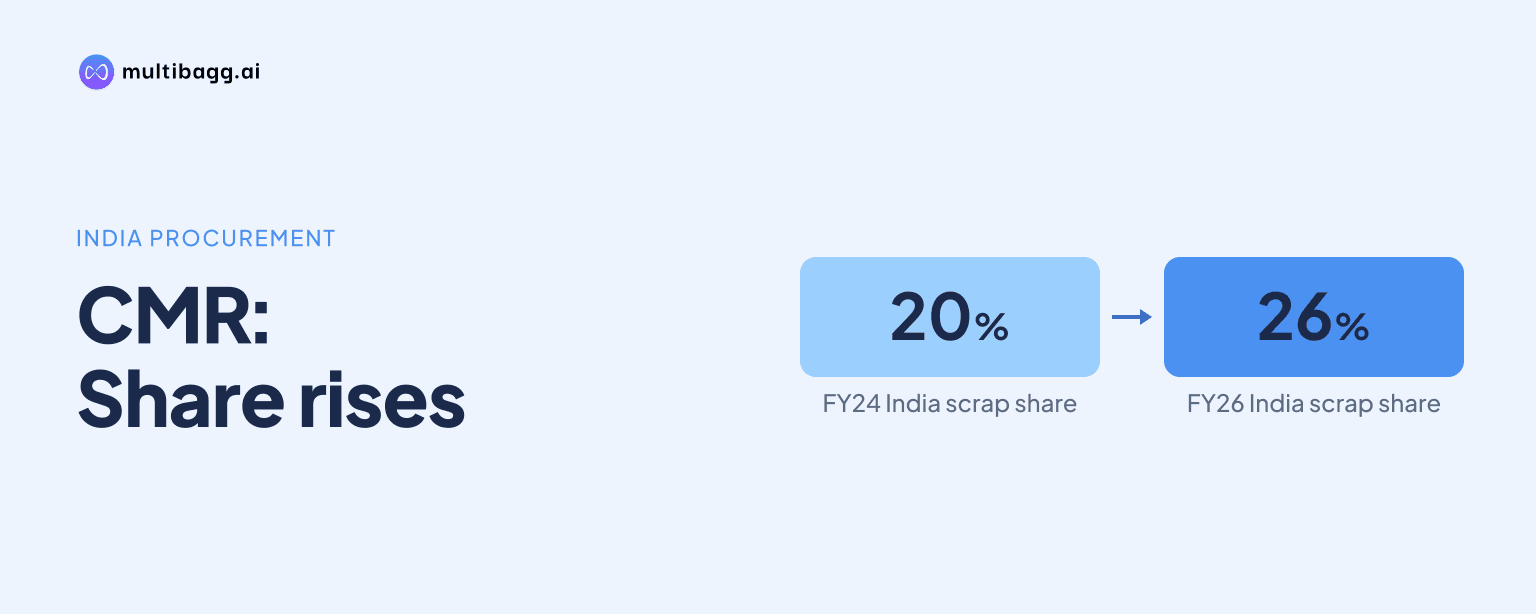
CMR Green Technologies increased India’s share of scrap procurement to 26% in FY26 from 20% in FY24, while retaining access to more than 1,000 yards across continents. CMR says the higher domestic mix is intended to reduce lead times and logistics costs, although 74% of its procurement still came from outside India in FY26.
Know CMR Green Technologies inside out
Results, valuation, peers and who's buying, in one view.
How has CMR changed its scrap procurement mix?
CMR increased domestic scrap procurement by 6 percentage points between FY24 and FY26. India represented 20% of procurement in FY24 and 26% in FY26, while the outside-India share fell from 80% to 74%. The presentation discloses a shift in procurement mix, not total scrap volumes for either period.
CMR states that the higher domestic share is designed to reduce lead time and logistics cost. The presentation does not quantify a saving in rupees, a reduction in delivery days or the effect of the mix change on margins. Its stated rationale is therefore operational rather than a disclosed financial outcome.
The FY26 mix remains predominantly international because outside India supplied 74% of procurement. CMR is not presenting domestic sourcing as a replacement for overseas supply; instead, the 26% India share indicates a larger domestic contribution alongside continued imports and international supplier access.
What global scrap access does CMR retain?
CMR retains access to more than 1,000 yards across continents while increasing Indian procurement. The presentation identifies the United States, United Kingdom, Belgium, Italy and China as its top five import countries, providing five named overseas markets for scrap sourcing.
CMR lists SIMS Limited, EMR, Radius Recycling, Indra Automobile Recycling and Gemini as key suppliers. It says a wholly owned United States sourcing subsidiary and supplier partnerships extending for a decade support preferential pricing and access to high-quality scrap, without disclosing contract volumes or supplier-specific purchase values.
The 1,000-plus-yard network remains relevant because 74% of CMR’s FY26 procurement mix was sourced outside India. The disclosed network therefore supports a procurement model that combines a growing domestic share with international collection, sorting and trading channels across the five named import countries.
Got a follow-up? Ask IRIS
How does domestic sourcing fit CMR’s product strategy?
CMR’s domestic-sourcing strategy supports an aluminium portfolio that includes standard aluminium ingots, liquid molten aluminium, billets and green sheet ingots. The company describes liquid aluminium as a just-in-time delivery product for locked-in customers, making lead time a stated operational consideration for at least one product format.
CMR identifies scale and volume growth, technology upgrades, customer-specific alloys, and a mix shift toward billets, sheet ingots and used beverage can recycling as levers for further margin expansion. Its Continuum-branded wrought billets use post-consumer scrap and are described as Environmental Product Declaration certified, while beverage cans are processed through sorting, de-coating and melting for the rolling value chain.
The company separately outlines a commodity-risk mechanism using London Metal Exchange, or LME, hedging, a lag-aware pricing model and customer pass-through. Average aluminium LME prices rose from $2,450 in Q1 FY26 to $3,226 in Q2 FY27, while earnings before interest, tax, depreciation and amortisation, or EBITDA, per kilogram moved from Rs 12.20 to Rs 12.56.
Across the six reported quarters from Q1 FY26 through Q2 FY27, LME prices ranged from $2,450 to $3,562 and EBITDA per kilogram ranged from Rs 11.00 to Rs 12.56. CMR attributes this earnings range to its hedging, pricing-lag and pass-through mechanism; the procurement slide separately attributes the domestic shift to lower lead time and logistics cost.
What demand base and expansion plans support CMR’s sourcing needs?
CMR serves more than 350 customers and describes key customer relationships as lasting 17 to 20 years. India generated 96.6% of geographical revenue in FY26, compared with 3.4% outside India, contrasting with the 74% outside-India share of scrap procurement in the same year.
CMR reports a 42% to 45% share of India’s automotive cast-alloy segment and supplies original equipment manufacturers and Tier-1 customers across passenger vehicles, commercial vehicles, two-wheelers and electric vehicles. Its product range also includes wrought aluminium supplied to Hindalco, zinc alloy ingots and furnace-ready scrap containing copper, brass, magnesium, stainless steel, zinc and lead.
As of March 31, 2026, CMR had 13 facilities across eight states. Its installed-capacity table shows 4.7 lakh metric tonnes per annum, or MTPA, in FY24, 5.1 lakh MTPA in FY25 and 6.2 lakh MTPA in FY26; management estimates capacity of more than 7.0 lakh MTPA across 15 plants in FY27E.
CMR had two plants under construction, at Shoolagiri in Tamil Nadu and Bawal in Haryana. Management guides for about Rs 200 crore of FY27 capital expenditure on greenfield and brownfield expansion, but the presentation does not provide an FY27 target for domestic scrap procurement or total procurement volumes.
Conclusion
CMR’s disclosed strategy is a measured rebalancing of supply rather than a withdrawal from global sourcing. India’s procurement share rose 6 percentage points to 26% in FY26, while the company retained a 1,000-plus-yard network and sourced 74% of its procurement from outside India.
The next points to watch are management’s FY27E plan for more than 7.0 lakh MTPA of capacity across 15 plants, the completion of two plants under construction and about Rs 200 crore of FY27 capital expenditure guidance. The presentation leaves unresolved whether India’s scrap share will rise beyond 26% or whether the stated logistics benefits will be quantified.