










CMR Green Technologies reports steadier alloy margins in FY27
Key highlights
- CMR estimates a 42-45% share of India’s automotive cast-alloy segment.
- CMR says key OEM and Tier-1 customer relationships span 17-20 years.
- Q2 FY27 adjusted EBITDA was Rs 12.6 per kg, versus Rs 11.0 per kg in Q2 FY26.
- Q2 FY27 billet volume grew 125.9% year on year and UBC recycling volume grew 169.8%.
powered by IRIS
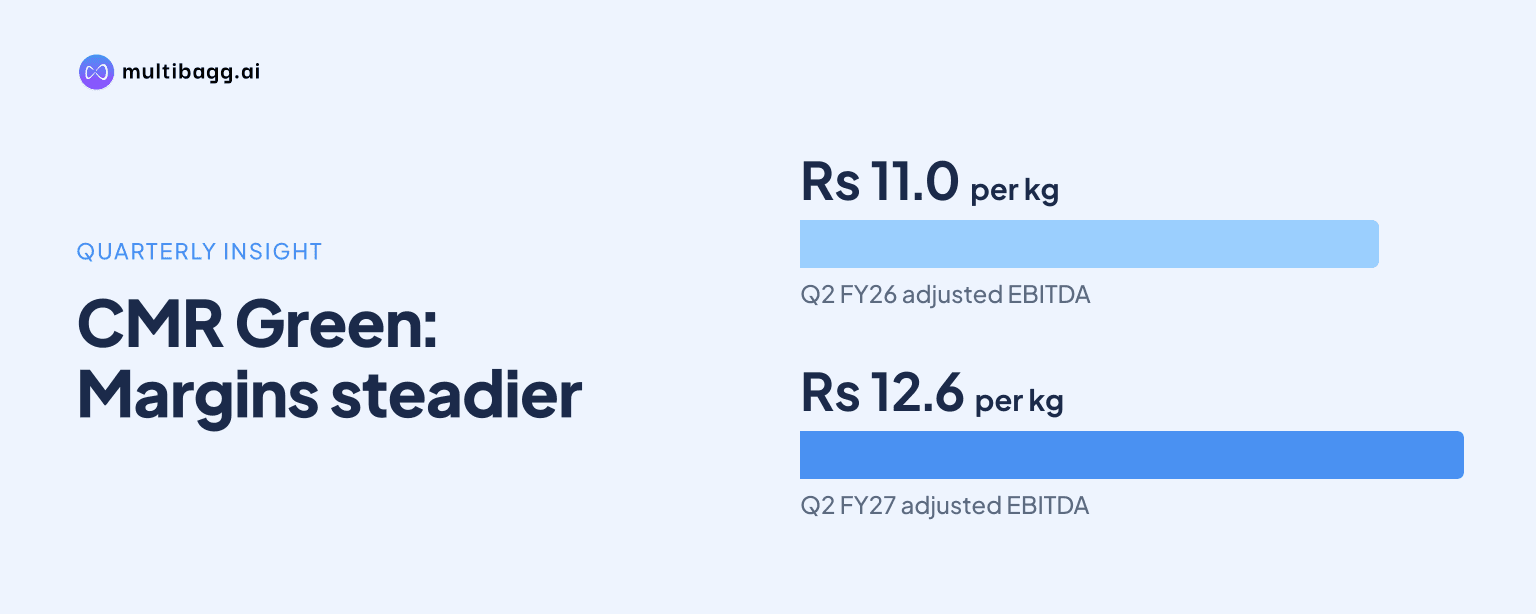
CMR Green Technologies reported adjusted EBITDA of Rs 12.6 per kg in Q2 FY27, compared with Rs 11.0 per kg a year earlier, while attributing per-kg profitability through metal-price fluctuations to hedging and customer price pass-through. Its automotive model also rests on qualified co-located supply and 17-20-year relationships with key customers.
Know CMR Green Technologies inside out
Results, valuation, peers and who's buying, in one view.
How does CMR make automotive alloy supply sticky?
CMR says its automotive-alloy supply becomes embedded through qualified, co-located integration with original equipment manufacturer, or OEM, and Tier-1 casting plants. The presentation describes these as long-standing supply arrangements rather than standard sales into an open commodity market, and puts relationships with key OEM and Tier-1 customers at 17-20 years.
CMR estimates that it holds a 42-45% share of India’s automotive cast-alloy segment. The company describes its demand base as model-agnostic because its recycled aluminium alloys serve qualified casting plants across OEMs, vehicle brands and powertrains, including internal-combustion-engine, hybrid and electric-vehicle platforms.
The end markets identified by CMR include passenger vehicles, commercial vehicles, two-wheelers and electric vehicles. This multi-segment exposure is paired with a finished-goods range of recycled aluminium alloy ingots and liquid metal, allowing CMR to serve casting requirements in more than one form.
Liquid or molten aluminium is CMR’s stated example of a more integrated delivery arrangement. It classifies liquid metal as a mid-tier product requiring just-in-time delivery and serving locked-in customers, while aluminium ingots remain the industry-standard base product; its output also includes billets, sheet ingots and other alloys.
How does CMR process scrap into finished alloys?
CMR sources scrap from more than 1,000 yards across continents and processes material at 13 plants before melting and alloying. Its stated sorting equipment includes X-ray transmission, or XRT, laser-induced breakdown spectroscopy, or LIBS, eddy-current sorting and colour sorting.
CMR says it carries out multi-stage quality checks on chemical composition and microstructure during melting and alloying. The resulting products include liquid metal, ingots, billets, sheet ingots and other alloys delivered to OEMs, Tier-1 suppliers, primary producers, and customers in construction, solar panels and electric vehicles.
Aluminium alloys accounted for 81% of CMR’s FY26 revenue, while zinc, steel, lead, copper, brass, magnesium and other products accounted for 19%. This mix shows that aluminium is the main revenue category, although the company also processes and sells several non-aluminium metals.
The company lists enterprise resource planning, or ERP, systems, an artificial-intelligence-powered supply chain, automated management information systems and machine scorecards as process-control tools. CMR also reports four granted patents, three patents in the pipeline and eight registered copyrights, alongside real-time cost monitoring across locations.
How did CMR’s per-kg profitability change in FY27?
CMR reported adjusted earnings before interest, tax, depreciation and amortisation, or EBITDA, of Rs 12.6 per kg in Q2 FY27, up from Rs 11.0 per kg in Q2 FY26. The measure is adjusted for income or loss from foreign-exchange and commodity hedging, and CMR says hedging and customer price pass-through helped maintain per-kg profitability during metal-price fluctuations.
The Q2 FY27 figure was Rs 0.2 per kg above Q1 FY27 and Rs 1.6 per kg above Q2 FY26, while H1 FY27 adjusted EBITDA per kg was Rs 1.0 higher than H1 FY26. These comparisons show that the reported per-kg measure rose from the prior-year periods while changing only modestly between the two FY27 quarters disclosed.
In absolute terms, adjusted EBITDA increased 30.5% year on year to Rs 150.7 crore in Q2 FY27, while revenue rose 59.2% to Rs 3,471.9 crore. CMR attributes revenue growth to higher sales volumes, improved realisations and favourable metal prices, with the hedging adjustment included in the EBITDA measure.
Got a follow-up? Ask IRIS
What volume trends supported CMR’s FY27 results?
CMR’s Q2 FY27 sales volume rose 14.4% year on year to 1,19,959 metric tonnes, or MT. Aluminium volume increased 24.0% to 98,289 MT, indicating that aluminium grew faster than total reported volume in the quarter.
Other-metal volume was 21,670 MT in Q2 FY27, compared with 98,289 MT for aluminium. CMR defines other metals as stainless steel, copper, brass, zinc, lead and magnesium, and the comparison shows aluminium remained the substantially larger reported volume category.
For H1 FY27, total sales volume increased 18.7% to 2,32,295 MT and adjusted EBITDA rose 28.9% to Rs 290.2 crore. H1 FY27 revenue reached Rs 6,594.6 crore, compared with Rs 4,074.0 crore in H1 FY26, while profit after tax increased to Rs 140.8 crore from Rs 113.9 crore.
Which products could expand CMR beyond cast alloys?
CMR identifies wrought alloy ingots, billets and closed-loop used beverage can, or UBC, recycling as products that widen its addressable market beyond automotive castings. Its post-consumer-scrap wrought billet product, Continuum, is described as environmental product declaration certified and aimed at extrusion-grade green-billet applications.
The company lists infrastructure, electric-vehicle mobility, electrical and power transmission, automotive and large-scale transportation, data centres and renewable energy as billet end uses. It also identifies construction, solar panels and electric vehicles as applications for billets and green sheet ingots, adding markets beyond the automotive cast-alloy base.
CMR calls beverage-can material supplied to Hindalco its newest frontier. Its UBC process uses advanced sorting, de-coating and melting to convert post-consumer cans into wrought aluminium for the rolling value chain, and the company describes this recycling route as supplying new metal to a primary producer rather than mining.
Q2 FY27 billet volumes increased 125.9% year on year and UBC recycling volumes increased 169.8%, although CMR did not disclose tonnage for either category. Management lists continued scale and volume growth, technology upgrades, customer-specific alloys, and a mix shift toward billets, sheet ingots and UBC recycling as levers for further margin expansion.
Conclusion
CMR’s reported FY27 performance combines higher volume with a per-kg profitability measure that moved from Rs 11.0 in Q2 FY26 to Rs 12.6 in Q2 FY27. The company attributes this outcome to hedging and customer price pass-through, while its 42-45% stated automotive cast-alloy share and 17-20-year key-customer relationships describe the integration underpinning its automotive supply model.
The next measure to watch is execution on management’s stated margin levers, particularly mix growth in billets, sheet ingots and UBC recycling. Q2 FY27 growth of 125.9% in billet volumes and 169.8% in UBC recycling volumes shows momentum, but CMR has not disclosed the tonnage, capacity additions or timetable for these newer segments.