










CMR Q2 FY27 revenue rises 59% as EBITDA per kg reaches Rs 12.6
Key highlights
- CMR's Q2 FY27 revenue rose 59.2% year on year to Rs 3,471.9 crore.
- Q2 FY27 aluminium sales volume increased 24.0% to 98,289 MT.
- CMR's Q2 FY27 adjusted EBITDA per kg rose to Rs 12.6 from Rs 11.0 in Q2 FY26.
- Billet volumes grew 125.9% and UBC recycling volumes grew 169.8% year on year in Q2 FY27.
powered by IRIS
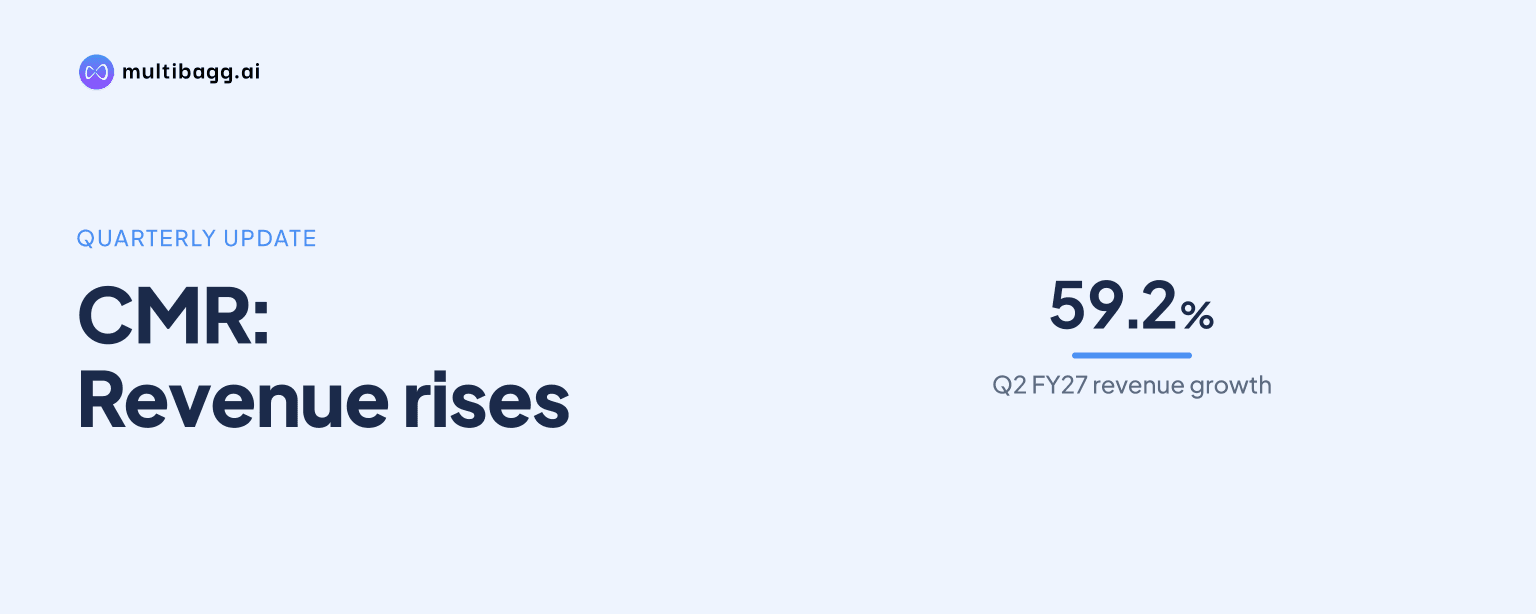
CMR reported Q2 FY27 revenue of Rs 3,471.9 crore, up 59.2% year on year, while adjusted EBITDA per kg reached Rs 12.6. The result combined a 24.0% increase in aluminium sales volume to 98,289 metric tonnes with higher realisations, while profit after tax rose 25.4% to Rs 72.6 crore.
Know CMR Green Technologies inside out
Results, valuation, peers and who's buying, in one view.
What drove CMR's Q2 FY27 revenue growth?
CMR's Q2 FY27 revenue growth was driven by higher sales volumes, improved realisations and favourable metal prices. Revenue reached Rs 3,471.9 crore, compared with Rs 2,180.6 crore in Q2 FY26, a 59.2% year-on-year increase. It was also Rs 349.2 crore above the Rs 3,122.7 crore reported in Q1 FY27, showing sequential growth during the first half of the financial year.
Sales volume rose 14.4% year on year to 1,19,959 metric tonnes (MT) in Q2 FY27. Aluminium accounted for 98,289 MT of that total, up 24.0% from 79,289 MT in Q2 FY26. The presentation identifies aluminium as CMR's core business and says the higher volume reflected continued demand across end-user segments, alongside improved price realisations.
CMR reported Rs 150.7 crore of adjusted earnings before interest, tax, depreciation and amortisation (EBITDA) in Q2 FY27, up 30.5% from Rs 115.5 crore a year earlier. Profit before tax rose 25.1% to Rs 94.3 crore, while profit after tax increased 25.4% to Rs 72.6 crore. Revenue therefore grew faster than both adjusted EBITDA and profit after tax in the quarter.
How did CMR's first-half FY27 performance compare with last year?
CMR's H1 FY27 revenue rose 61.9% year on year to Rs 6,594.6 crore, compared with Rs 4,074.0 crore in H1 FY26. The first half, or H1, included Rs 3,122.7 crore in Q1 FY27 and Rs 3,471.9 crore in Q2 FY27. The second-quarter revenue contribution was therefore higher than the first-quarter contribution by Rs 349.2 crore.
Adjusted EBITDA for H1 FY27 increased 28.9% to Rs 290.2 crore from Rs 225.2 crore in H1 FY26. Profit before tax increased 23.0% to Rs 184.0 crore and profit after tax increased 23.7% to Rs 140.8 crore, against Rs 113.9 crore in the prior-year half. These reported growth rates show that the first-half increase in revenue outpaced the increase in the two profit measures.
Total H1 FY27 sales volume rose 18.7% to 2,32,295 MT from 1,95,705 MT in H1 FY26. Aluminium volume increased to 1,88,846 MT from 1,48,750 MT, while other-metal volume declined to 43,449 MT from 46,955 MT. CMR defines other metals as stainless steel, copper, brass, zinc, lead and magnesium, making the aluminium increase the principal source of the total volume gain.
Got a follow-up? Ask IRIS
Which CMR products and segments recorded the highest volume growth?
CMR's aluminium segment recorded the largest disclosed volume contribution in Q2 FY27, with 98,289 MT sold versus 79,289 MT in Q2 FY26. Aluminium represented about 82% of the 1,19,959 MT of total quarterly sales volume, based on the segment figures disclosed. Other-metal volume was 21,670 MT, compared with 25,546 MT a year earlier, so the mix shifted toward aluminium.
Billet volumes increased 125.9% year on year in Q2 FY27, and used beverage can, or UBC, recycling volumes grew 169.8%. The presentation does not provide their absolute tonnage, but identifies both as diversified growth segments. CMR also lists billets, green sheet ingots and UBC recycling among the product areas intended to support a mix shift, alongside its base aluminium ingot business.
Aluminium alloys accounted for 81% of CMR's FY26 revenue, while zinc, steel, lead, copper, brass, magnesium and other products accounted for 19%. Its finished-goods range includes liquid aluminium, ingots, billets and sheet ingots. This FY26 revenue split and the Q2 FY27 aluminium-volume increase indicate that the larger business line was also the one expanding faster during the reported quarter.
How did CMR maintain EBITDA per kg despite metal-price changes?
CMR maintained Q2 FY27 adjusted EBITDA of Rs 12.6 per kg despite metal-price fluctuations through hedging and customer price pass-through mechanisms, according to the presentation. The company defines this EBITDA measure as EBITDA after adjustment for income or loss from foreign-exchange and commodity hedging. The metric increased from Rs 11.0 per kg in Q2 FY26 and Rs 12.4 per kg in Q1 FY27.
For H1 FY27, adjusted EBITDA per kg was Rs 12.5, compared with Rs 11.5 in H1 FY26. That Rs 1.0-per-kg increase accompanied 18.7% growth in total sales volume to 2,32,295 MT. CMR attributes revenue growth to both volume and improved realisations, while describing hedging and customer pass-through as the mechanisms used to manage changes in metal prices.
CMR identifies continued scale, technology upgrades, customer-specific alloy development and a mix shift toward billets, sheet ingots and UBC recycling as levers for further margin expansion. Its operating model spans global scrap sourcing, processing, melting and alloying, and delivery of finished products. The presentation lists 13 plants and more than 1,000 scrap yards across continents within that sourcing and manufacturing platform.
Conclusion
CMR's Q2 FY27 figures show revenue growth was supported by both aluminium volume and pricing rather than sales value alone. Revenue increased 59.2% to Rs 3,471.9 crore, aluminium volumes rose 24.0% to 98,289 MT, and adjusted EBITDA per kg improved to Rs 12.6 from Rs 11.0 a year earlier. Profit after tax nevertheless rose at a lower 25.4% rate, to Rs 72.6 crore.
The next reported periods will show whether CMR can sustain the H1 FY27 adjusted EBITDA per kg of Rs 12.5 while pursuing its stated mix shift into billets, sheet ingots and UBC recycling. Investors can also watch whether the 125.9% billet-volume growth and 169.8% UBC-recycling-volume growth translate into disclosed absolute volumes and a larger contribution within the 81% aluminium-alloys revenue base reported for FY26.