










CMR Green Technologies expands into billets and can recycling
Key highlights
- CMR reported Rs 3,471.9 crore of revenue in Q2 FY27, versus Rs 2,180.6 crore in Q2 FY26.
- Aluminium alloys represented 81% of CMR’s FY26 revenue, with other metals contributing 19%.
- CMR states it holds a 42-45% share of India’s automotive cast-alloy segment.
- India’s share of CMR scrap procurement increased to 26% in FY26 from 20% in FY24.
powered by IRIS
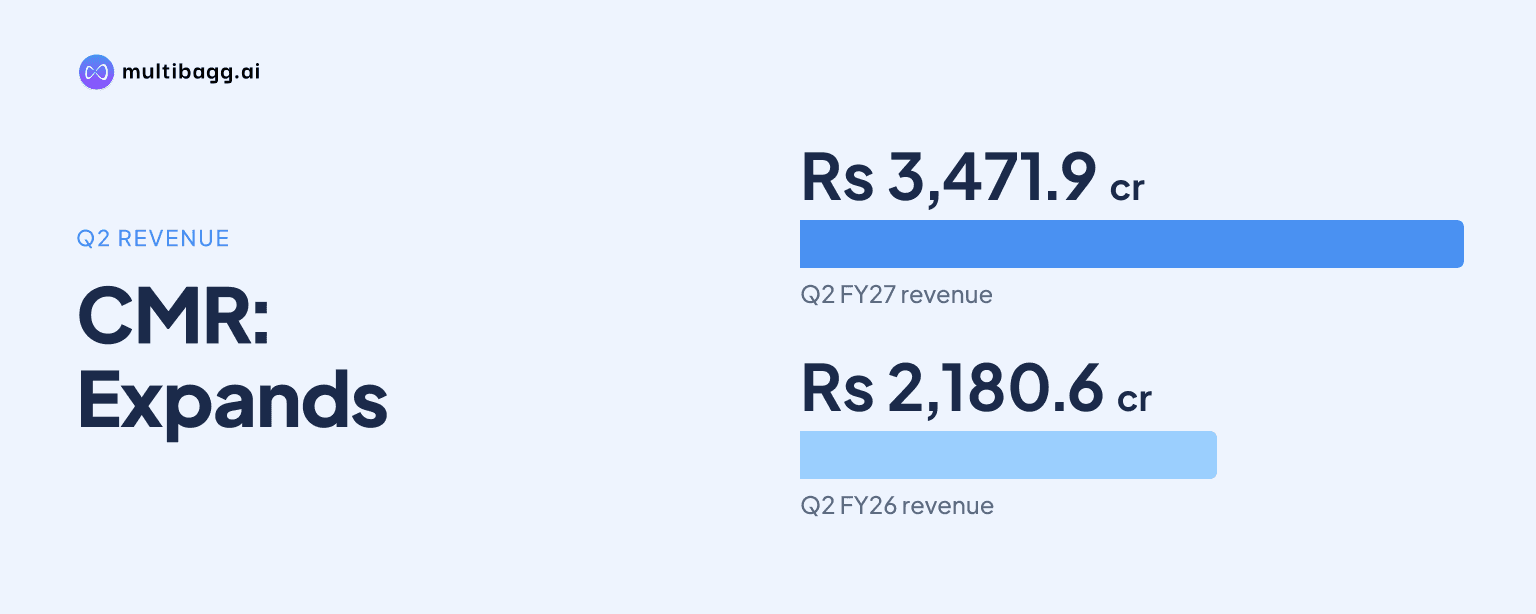
CMR Green Technologies is expanding beyond automotive cast alloys into green billets, sheet ingots and used-beverage-can recycling, while reporting Rs 3,471.9 crore of revenue in Q2 FY27. Management presents the product shift as a lever for further margin expansion and a route into extrusion, rolling and packaging value chains.
Know CMR Green Technologies inside out
Results, valuation, peers and who's buying, in one view.
How is CMR expanding beyond automotive cast alloys?
CMR is adding wrought billets, green sheet ingots and used-beverage-can recycling alongside its established recycled aluminium alloy products. Its FY26 revenue mix was 81% aluminium alloys and 19% zinc, steel, lead, copper, brass, magnesium and other metals, showing that aluminium alloys remain the principal business from which the newer product lines are being developed.
The expansion does not replace CMR’s automotive position. The company states that it holds a 42-45% share of India’s automotive cast-alloy segment and supplies recycled aluminium alloy as ingots and liquid metal to qualified casting plants serving internal-combustion-engine, hybrid and electric-vehicle platforms. Billets and sheet ingots instead extend the company’s use of secondary aluminium into wrought applications. CMR’s finished-goods range also includes liquid metal, ingots, billets or sheet ingots and other alloys.
Which products and end markets is CMR targeting?
CMR is targeting construction, solar and electric-vehicle applications with green billets and sheet ingots. The presentation describes wrought billets made from post-consumer scrap under the Continuum brand, with Environmental Product Declaration certification, and says these products take India’s secondary aluminium industry beyond castings into extrusion-grade green billets.
The listed applications for wrought billets cover infrastructure, electric-vehicle mobility, electrical and power transmission, automotive and large-scale transportation, data centres, and renewable energy. Management describes the initiative as a first-mover opportunity with a low carbon footprint, but the presentation does not disclose billet capacity, sales volume, revenue contribution or a commissioning timetable for this business.
CMR’s product ladder also retains conventional aluminium ingots as the industry-standard base product and liquid molten aluminium as a mid-tier offering with just-in-time delivery and locked-in customers. Alongside aluminium, it processes zinc alloy ingots for automotive and industrial die-cast components, plus furnace-ready scrap containing copper, brass, magnesium, stainless steel, zinc and lead for downstream users.
How does CMR’s beverage-can recycling model work?
CMR converts post-consumer used beverage cans, or UBC, into wrought aluminium for the rolling value chain through sorting, de-coating and melting. The company identifies beverage cans as its newest aluminium frontier and says it is supplying Hindalco, linking recycled can feedstock to a customer in wrought aluminium rather than solely to automotive casting applications.
The closed-loop proposition is to provide recycled metal to a primary producer instead of relying on newly mined metal. Management identifies customer lock-in, first-mover advantage and a low carbon footprint as features of the UBC model, while packaging is the only end-use application listed for this stream. No UBC throughput, recovery rate or commercial revenue figure is disclosed in the presentation.
Got a follow-up? Ask IRIS
What capabilities support CMR’s move into higher-value aluminium products?
CMR’s processing network includes 13 plants and procurement from more than 1,000 scrap yards across continents. The company lists XRT, LIBS, eddy-current and colour-sorting technologies, followed by chemical and microstructure checks during melting and alloying. These steps support the segregation of inputs used for wrought billets, sheet ingots and can recycling.
Customer integration remains a feature of the legacy alloy business that can support product development. CMR reports relationships of 17-20 years with key original equipment manufacturers, or OEMs, and Tier-1 customers, and says it serves more than 350 customers. Its automotive alloy supply is co-located with Tier-1 and OEM casting plants, while the presentation separately identifies Hindalco as a wrought-aluminium customer.
The financial backdrop shows higher group activity, although the presentation does not attribute the increase to billets or UBC recycling. Revenue rose to Rs 3,471.9 crore in Q2 FY27 from Rs 2,180.6 crore in Q2 FY26, while aluminium sales volume increased to 98,289 metric tonnes from 79,289 metric tonnes. EBITDA, after forex and commodity-hedging adjustments, increased to Rs 12.6 per kg from Rs 11.0 per kg over the same quarters.
What is changing in CMR’s supply chain and operating model?
CMR is increasing domestic scrap procurement as it broadens its recycling portfolio. India accounted for 26% of procurement in FY26, compared with 20% in FY24, while the share sourced outside India declined to 74% from 80%. Management says the shift can reduce lead time and logistics cost, although the presentation provides no quantified saving.
The company also operates a wholly owned United States sourcing subsidiary and cites decade-long supplier partnerships for access to scrap. Its largest import-source countries are the United States, United Kingdom, Belgium, Italy and China. The presentation identifies post-consumer scrap, multi-metal scrap processing and UBC recycling as distinct parts of its recycling portfolio before material becomes alloys, billets or furnace-ready scrap.
Conclusion
CMR’s strategy is to use its automotive cast-alloy base, where it reports a 42-45% market share, to enter wrought aluminium and packaging-linked recycling. Green billets and sheet ingots widen its potential end markets to construction, renewable energy, data centres and electric-vehicle-related applications, while UBC recycling adds a route from post-consumer cans to the rolling value chain.
The next disclosures to watch are commercial evidence of the mix shift, including billet and UBC volumes, capacity, customer additions and revenue contribution, none of which is specified in the presentation. Management has identified continued volume growth, technology upgrades, customer-specific alloys and a shift toward billets, sheet ingots and UBC recycling as its margin-expansion plan.