










CMR plans two plants and over 7 lakh MTPA installed capacity in FY27
Key highlights
- CMR targets more than 7 lakh MTPA of installed capacity in FY27E, versus 6.2 lakh MTPA in FY26.
- CMR had 6,15,150 MTPA of installed capacity across 13 facilities as of March 31, 2026.
- CMR is building plants at Shoolagiri, Tamil Nadu, and Bawal, Haryana, taking its FY27E plant count to 15.
- CMR has guided for approximately Rs 200 crore of FY27 greenfield and brownfield capex.
powered by IRIS
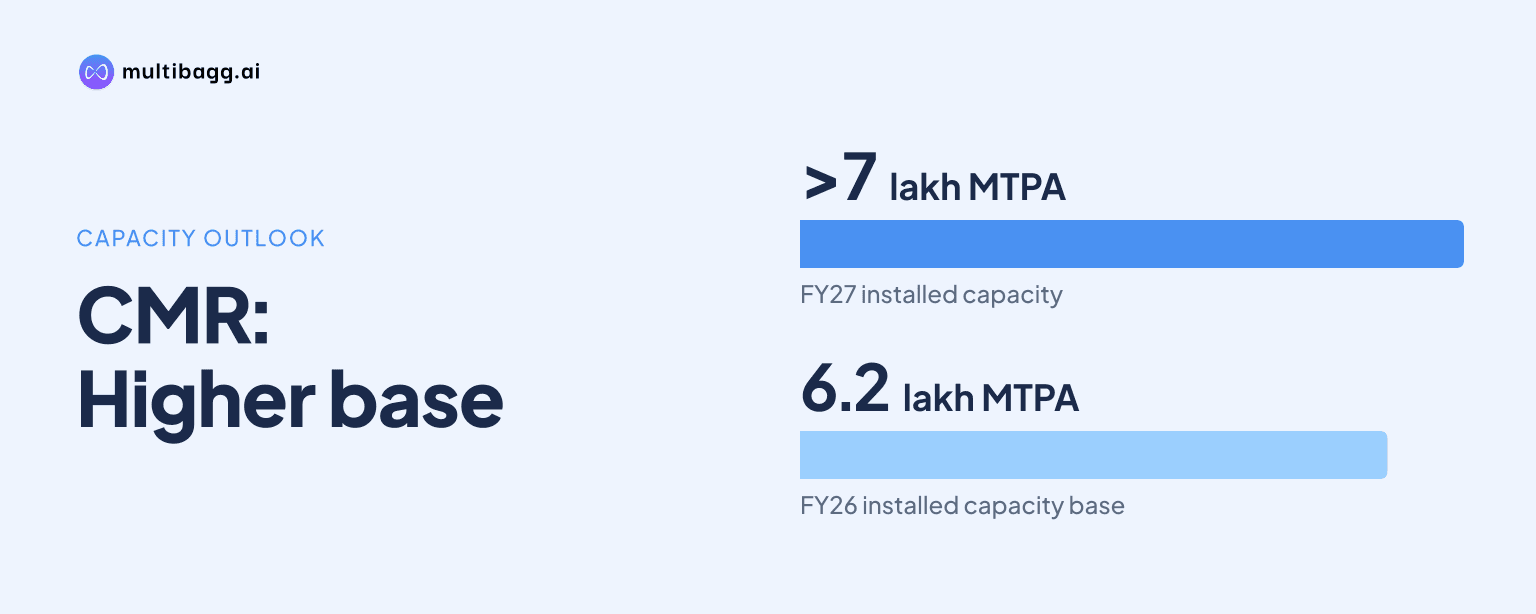
CMR plans to raise installed capacity from 6.2 lakh MTPA in FY26 to more than 7 lakh MTPA in FY27E through two plants under construction at Shoolagiri and Bawal, backed by management’s approximately Rs 200 crore FY27 capital-expenditure guidance for expansion.
Know CMR Green Technologies inside out
Results, valuation, peers and who's buying, in one view.
How much capacity does CMR plan to add in FY27?
CMR expects installed capacity to exceed 7 lakh MTPA in FY27E, compared with 6.2 lakh MTPA in FY26. MTPA means metric tonnes per annum. The presentation’s capacity chart records a progression from 4.7 lakh MTPA in FY24 to 5.1 lakh MTPA in FY25 and then 6.2 lakh MTPA in FY26, before the FY27E expansion target.
The planned move from 6.2 lakh MTPA to more than 7 lakh MTPA represents an increase of at least 0.8 lakh MTPA on the presentation’s rounded figures. CMR reported a more precise installed-capacity figure of 6,15,150 MTPA as of March 31, 2026. The distinction matters because the FY26 chart figure is rounded to one decimal place, while the March 2026 figure gives the installed base in tonnes.
CMR’s FY27E target pairs a capacity increase with a rise in plant count from 13 to 15. The historical sequence shows that installed capacity rose by 1.5 lakh MTPA between FY24 and FY26, while facilities increased by two over the same period. The FY27E plan signals a further two-facility addition rather than an announced change to the existing 13-facility network alone.
Which two CMR plants are under construction?
CMR has two plants under construction: one at Shoolagiri in Tamil Nadu and a second plant at Bawal in Haryana. The company describes the Shoolagiri site as being in a Future Mobility Park and says it positions CMR to directly serve electric-vehicle, or EV, component manufacturers. The Bawal second plant is being developed to cater to additional demand.
The two locations have different stated commercial purposes. Shoolagiri is linked specifically to direct service for EV-component manufacturers, whereas Bawal is linked to incremental demand more broadly. CMR did not provide an individual capacity figure, commissioning date, customer name or project-cost split for either plant on the disclosed page, so the expected contribution of each location to the 7 lakh-plus MTPA FY27E target is not specified.
CMR’s FY27 capital-expenditure guidance is approximately Rs 200 crore for greenfield and brownfield expansion. Greenfield expansion refers to building new facilities, while brownfield expansion refers to adding to or upgrading existing operations. The presentation does not allocate the approximately Rs 200 crore between Shoolagiri, Bawal and any brownfield work, nor does it disclose how much of the guidance has been spent.
The Bawal project is explicitly identified as a second plant, and Bawal also appears among CMR’s existing facility locations as of March 31, 2026. Shoolagiri, by contrast, is presented as a new Tamil Nadu site, with its Future Mobility Park location forming the stated connection to EV-component manufacturing demand.
Got a follow-up? Ask IRIS
Where does the FY27 expansion fit in CMR’s manufacturing network?
CMR reported 13 strategically located facilities across eight states as of March 31, 2026, with installed capacity of 6,15,150 MTPA. Its listed operating locations include Manesar, Haridwar, Bawal, Bhiwadi, Tatarpur, two units at Vanod, Halol, Jharsuguda, Pune, Tirupati, Chennai and Vallam. The FY27E plant target of 15 adds two sites to this 13-plant base.
The existing footprint combines northern, western, eastern and southern locations, and the two announced projects extend this network through a second Bawal facility and a new Shoolagiri site. CMR presents this state-wide presence as providing integrated and centralised operational benefits. It does not quantify logistics savings, plant utilisation, production by state or the share of capacity that will be assigned to EV-related components.
CMR’s manufacturing quality metrics provide context for the planned scale-up. The company reported multi-stage quality checks and minimal rejections of approximately 0.07% in FY26. It also disclosed an in-house research and development function recognised by the Department of Scientific and Industrial Research, or DSIR, alongside four granted patents, three patents in the pipeline and eight registered copyrights.
Those disclosed systems apply to a network that had expanded from 11 plants in FY24 to 13 in FY25, while capacity rose from 4.7 lakh MTPA to 5.1 lakh MTPA. Capacity then reached 6.2 lakh MTPA in FY26 without an increase in the stated 13-plant count. That comparison indicates that the FY26 capacity rise occurred within the existing facility count, while FY27E incorporates both additional capacity and two additional plants.
What operational factors could support CMR’s expansion plan?
CMR reported a procurement shift toward domestic scrap, with India accounting for 26% of sourcing in FY26 versus 20% in FY24. Outside-India sourcing correspondingly fell to 74% from 80%. The company says higher domestic sourcing reduces lead time and logistics cost, while its wholly owned US sourcing subsidiary and decade-long supplier partnerships provide preferential pricing and access to high-quality scrap.
The procurement network is relevant to a higher-capacity manufacturing base because recycled aluminium output depends on scrap availability. CMR identified the United States, United Kingdom, Belgium, Italy and China as its top five import countries, and listed suppliers including Sims Limited, EMR, Radius Recycling, Indra Automobile Recycling and Gemini. The presentation does not provide a forecast for scrap volumes required for the FY27 capacity target.
CMR also reported an aluminium-price risk-management mechanism based on London Metal Exchange, or LME, hedging, a lag-aware pricing model and customer pass-through. Average aluminium LME prices increased from $2,450 in Q1 FY26 to $3,226 in Q2 FY27, while EBITDA per kg moved from Rs 12.20 to Rs 12.56. EBITDA means earnings before interest, tax, depreciation and amortisation.
Across the six disclosed quarters, EBITDA per kg ranged from Rs 11 in Q2 and Q3 FY26 to Rs 12.56 in Q2 FY27, despite LME prices ranging from $2,450 to $3,562. CMR attributes that relative consistency to its hedging and pricing mechanisms. The presentation does not state whether the same EBITDA-per-kg range is a target for FY27 after the two new plants begin contributing.
Conclusion
CMR’s disclosed FY27E expansion is defined by two measurable changes: installed capacity is targeted to rise from 6.2 lakh MTPA in FY26 to more than 7 lakh MTPA, and plant count is expected to increase from 13 to 15. Shoolagiri is intended to directly serve EV-component manufacturers, while Bawal’s second plant is intended to meet additional demand.
The next disclosed item to watch is execution of management’s approximately Rs 200 crore FY27 greenfield and brownfield capital-expenditure guidance. The presentation does not give commissioning dates, project-level capacities, spending allocation or confirmed volumes for either new plant, leaving those items central to assessing progress toward the FY27E capacity target.