










CMS sees ATM dispense recover as off-site base contracts
Key highlights
- Currency in circulation reached a record Rs 43.5 lakh crore on 15 October 2026, up 13.5% year on year.
- India’s off-site ATM base declined to 73,000 in September 2026 from 88,000 in September 2024.
- CMS spent Rs 10.6 crore on transaction-linked ATMs in H1 FY27, down 63% year on year.
- CMS annualised Technology and Payments revenue reached Rs 508 crore in Q2 FY27.
powered by IRIS
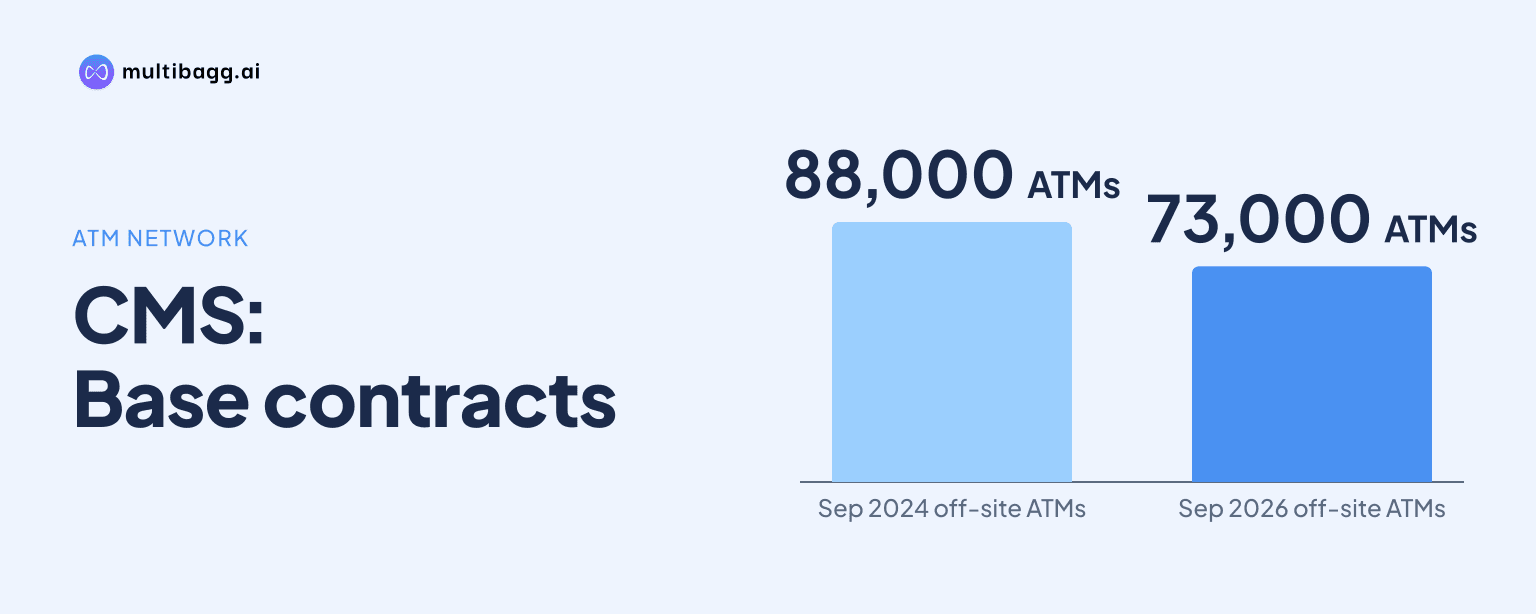
CMS said ATM cash dispense recovered in September 2026 as currency supply improved, after currency in circulation reached a record Rs 43.5 lakh crore on 15 October 2026. India’s off-site ATM base nevertheless fell to 73,000 at September 2026 from 88,000 two years earlier, as operators moved away from transaction-linked models.
Know CMS Info Systems inside out
Results, valuation, peers and who's buying, in one view.
Why is currency availability supporting ATM cash dispense?
Currency availability is supporting ATM cash dispense because currency in circulation, or CIC, reached Rs 43.5 lakh crore on 15 October 2026, according to CMS. That was up 13.5% year on year, the fastest CIC growth in five years according to the presentation, and three times the Rs 14.5 lakh crore reported in FY15.
CIC increased by Rs 1.8 lakh crore from Rs 41.7 lakh crore at FY26-end to Rs 43.5 lakh crore in H1 FY27. The CIC-to-gross domestic product ratio was estimated at about 12.0% in H1 FY27, versus 12.1% in FY26. CMS said the estimate used trailing 12-month nominal gross domestic product through September 2026 and assumed 10.3% nominal growth in Q2 FY27, matching Q1 FY27.
CMS said dispense across its managed ATMs was stable at about Rs 4.4 lakh per ATM per day over the preceding year before falling after February and March because of currency-supply issues. Its chart showed labeled daily-dispense observations ranging from Rs 3.66 lakh to Rs 4.72 lakh per ATM, and CMS said a recovery was visible in September as supply improved.
The measure is calculated on a same-ATM basis, meaning it tracks the same group of CMS-managed ATMs rather than a changing machine base. The presentation therefore links the September 2026 recovery to currency supply, while the Rs 3.66 lakh low and Rs 4.72 lakh high show the variation in dispense through the period.
How has India’s ATM base changed since September 2024?
India’s total automated teller machine, or ATM, base declined by 5,900 machines to 209,800 at September 2026 from 215,700 at September 2024. The base reached 206,700 at September 2025, then recovered by 3,100 machines in the following 12 months, but remained below the September 2024 level.
The composition changed as on-site ATMs increased by 9,000 to 137,000 over two years while off-site ATMs declined by 15,000 to 73,000. CMS said on-site machines were growing at about 4% a year, whereas off-site machines were shrinking because of weaker unit economics.
The quarterly data shows that the off-site decline had not reversed by September 2026. Off-site ATMs fell from 79,000 in June 2025 to 75,000 in September 2025, then to 74,000 in December 2025 and March 2026, before reaching 73,000 in June and September 2026. Total ATMs rose from 209,300 in March 2026 to 209,800 in September 2026, led by on-site additions.
Got a follow-up? Ask IRIS
Why are operators moving away from transaction-linked off-site ATMs?
Operators are moving towards fixed-price contracts because transaction-linked off-site ATMs have weaker unit economics, according to CMS. The off-site base fell from 88,000 in September 2024 to 73,000 in September 2026 as the sector shifted towards fixed-price operating arrangements.
CMS said it stayed out of most transaction-priced brown-label ATM, or BLA, tenders in FY24 and FY25, reducing annual capital expenditure from about Rs 200 crore to Rs 100 crore. This was a company response to the transaction-priced tender environment, rather than an industry-wide spending figure.
In May 2025, CMS stated its preference for fixed-price contracts and for transaction-linked ATMs to form a smaller share of its business. During FY26, CMS said all order wins were on fixed-fee models and it declined a Rs 700 crore transaction-priced contract.
The approach continued in H1 FY27, when CMS spent Rs 10.6 crore on transaction-linked ATMs, down 63% year on year. CMS said this expenditure was limited to contractual deployments. Its overall FY27 capital-expenditure plan is Rs 100 crore to Rs 125 crore, mainly for Technology and Payments rollouts.
What do these ATM trends mean for CMS’s operating mix?
The ATM trends mean CMS is directing investment towards fixed-fee contracts and Technology and Payments while limiting new transaction-linked ATM exposure. Its FY26 capital expenditure of Rs 351 crore funded fixed-price ATM contract rollouts and development of HAWKAI and ALGO MVS, compared with planned FY27 expenditure of Rs 100 crore to Rs 125 crore.
CMS reported annualised Technology and Payments revenue of Rs 508 crore in Q2 FY27, compared with Rs 375 crore in FY26 and Rs 263 crore in FY25. The business represented 20% of services revenue in Q2 FY27, and CMS said this was ahead of its FY30 goal, without disclosing a numerical FY30 revenue target in the presentation.
Managed Services revenue was Rs 321 crore in Q2 FY27, up 19% year on year and 5% quarter on quarter. Cash revenue was Rs 404 crore, up 2% year on year and unchanged from Q1 FY27. The different growth rates show Managed Services expanding faster than Cash during the quarter.
Managed Services earnings before interest and tax, or EBIT, margin was 10.6% in Q2 FY27, compared with 14.0% in Q2 FY26. CMS attributed the change to lower transaction-linked ATM revenue, higher depreciation from FY26 capital expenditure and the FSS acquisition. Cash EBIT margin was 19.1% in Q2 FY27, up from 14.9% a year earlier.
At the group level, services revenue rose 16.2% year on year to Rs 644 crore in Q2 FY27, while total revenue rose 6.7% to Rs 650 crore. CMS said product revenue was lower year on year because deliveries on public-sector bank recycler orders won during the year were scheduled for H2.
Conclusion
CMS’s presentation shows a split ATM market: higher CIC and improved supply supported a September 2026 recovery in same-ATM cash dispense, but the national ATM base remained smaller than in September 2024. On-site ATMs increased by 9,000 over two years, while off-site machines declined by 15,000, concentrating the structural change in transaction-linked operations.
The next point to watch is CMS’s FY27 plan to spend Rs 100 crore to Rs 125 crore mainly on Technology and Payments rollouts while limiting transaction-linked ATM deployment spending. The scheduled H2 delivery of public-sector bank recycler orders is also relevant to the comparison of product revenue with H1 FY27.