










CMS shifts all new ATM wins to fixed fees after capex cut
Key highlights
- CMS reduced H1 FY27 capital expenditure on transaction-linked ATMs 63% year on year to Rs 10.6 crore.
- CMS declined a Rs 700 crore transaction-priced contract in FY26 and said all new business wins use fixed-fee contracts.
- Transaction-linked ATMs were about 12% of Q2 FY27 revenue, while average daily cash dispense remained 10% below the prior-year level.
- CMS reaffirmed FY27 services-revenue guidance of Rs 2,650 crore to Rs 2,750 crore and a 27% EBITDA margin.
powered by IRIS
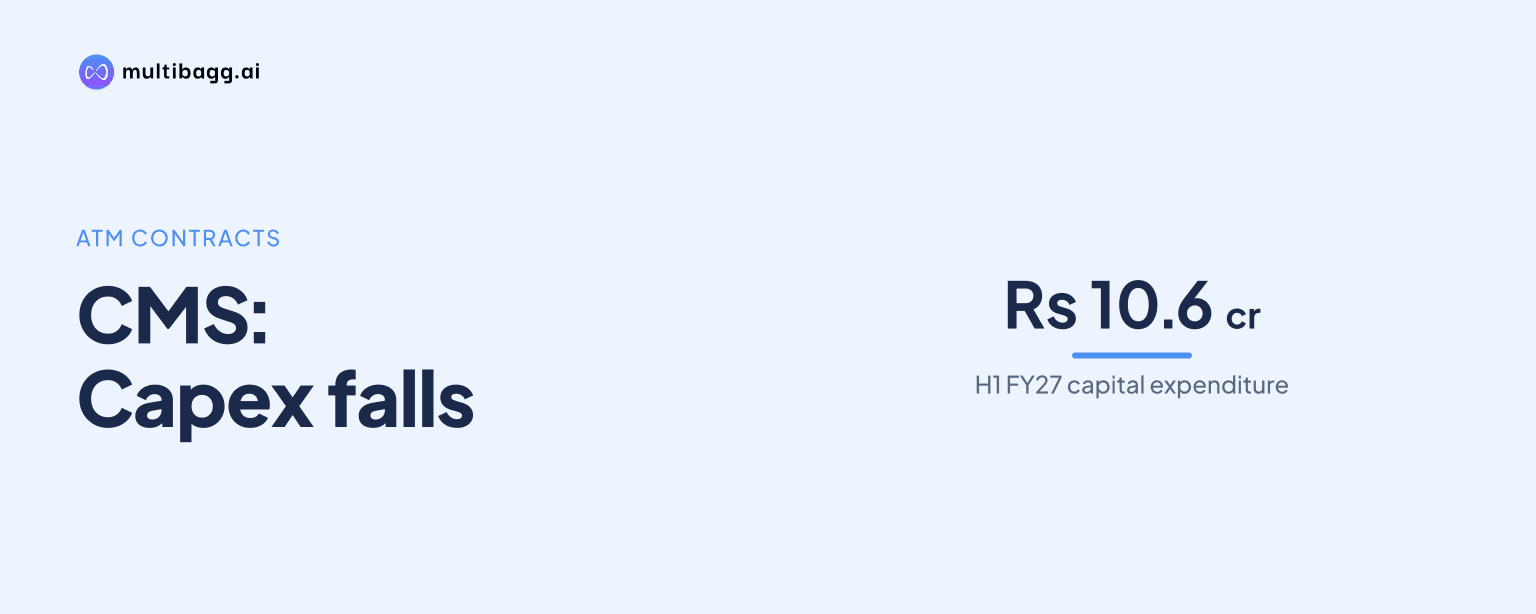
In the second quarter of financial year 2027 (Q2 FY27), CMS Info Systems Limited said all new business wins were on fixed-fee contracts after it cut first-half (H1) capital expenditure on transaction-linked automatic teller machines (ATMs) 63% year on year to Rs 10.6 crore and declined a Rs 700 crore deal in FY26.
Know CMS Info Systems inside out
Results, valuation, peers and who's buying, in one view.
Why has CMS moved away from transaction-linked ATM contracts?
CMS has moved away from transaction-linked ATM contracts because lower transactions reduced revenue per ATM while wage and fuel costs rose. Transaction-linked ATMs represented about 12% of Q2 FY27 revenue, and management said their revenue per ATM had fallen over the preceding 18 months, weighing on the earnings before interest and tax (EBIT) of the Managed Services segment.
The pressure came principally from currency-supply disruption rather than a reported fall in cash demand. Average cash dispensed per CMS-managed ATM each day had recovered 8% from its May low by Q2 FY27, but remained about 10% below the prior-year level. Management said a further recovery would directly support transaction-linked revenue, while noting that conditions had not fully normalised.
Higher input costs added pressure to contracts priced several years earlier. Statutory minimum wages rose between 6% and 60% in key states and fuel costs increased 8%, according to management. Revised pricing was in place across most private-sector bank and retail contracts, while public-sector bank pricing remained pending through an Indian Banks' Association working committee formed in August 2026.
What actions has CMS taken on ATM investment and bidding?
CMS cut H1 FY27 capital expenditure on transaction-linked ATMs to Rs 10.6 crore, down 63% year on year, and restricted spending to deployments already committed. Management said it had stayed out of most transaction-priced tenders from FY25 after identifying stress in that model, reducing new investment exposure before the FY27 supply disruption.
CMS also declined a Rs 700 crore transaction-priced contract in FY26 because its pricing was not acceptable to the company, according to Chief Executive Officer Rajiv Kaul. Management said all new business wins are now on fixed-fee contracts, replacing transaction-dependent pricing for new work.
The wider capital plan is also lower following the prior investment cycle. CMS reported H1 FY27 net capital expenditure of Rs 50 crore and guided for Rs 100 crore to Rs 125 crore in FY27, compared with Rs 351 crore in FY26. Management said the FY27 range would be below depreciation and about half its long-term average.
How is the ATM market changing for CMS?
CMS said the ATM market is moving toward fixed-price arrangements as banks change the mix of locations in their networks. India’s off-site ATM base fell from about 88,000 to 73,000 over two years following the exit of a large operator, while the overall ATM base held at about 2.1 lakh.
On-site ATMs grew by about 4% annually over that period as banks added machines and cash recyclers inside branches. CMS said this movement supports the fixed-price model it adopted earlier, although the existing transaction-linked ATM portfolio still accounted for about 12% of Q2 FY27 revenue.
The financial results show the difference between the affected portfolio and the broader business. Managed Services revenue, including cards, increased 19% year on year to Rs 321 crore in Q2 FY27, while EBIT was Rs 34 crore, or a 10.6% margin. Management attributed the segment outcome to lower transaction-linked ATM revenue, higher depreciation from prior capital expenditure and the FSS CashTech acquisition.
Cash Logistics revenue rose 2% year on year to Rs 404 crore, with EBIT of Rs 77 crore and a 19.1% margin. Group earnings before interest, tax, depreciation and amortisation (EBITDA) increased 24.8% to Rs 173 crore, at a 26.7% margin. Management cited price revisions, route optimisation, internal automation, and a higher mix of technology, payments and fixed-price contracts.
Got a follow-up? Ask IRIS
What business is CMS prioritising instead of transaction-priced growth?
CMS is directing growth capital toward integrated fixed-fee contracts and its technology and payments business rather than transaction-priced ATM expansion. Technology and payments reached 20% of Q2 FY27 services revenue, two quarters before management’s earlier expectation of crossing that level by Q4, and had an annualised quarterly revenue run rate of about Rs 500 crore.
The technology and payments share has risen from 7% of CMS revenue in FY22 to 20% in Q2 FY27. In H1 FY27, CMS won its second large public-sector bank branch remote monitoring mandate, covering a central command centre across 650 branches and monitoring for more than 8,000 branches. Its ALGO MVS software platform also added a third marquee bank for a rollout across 12,000 machines.
Management expects product revenue to step up in the second half of FY27 because two recycler orders won from public-sector banks in Q1 are scheduled for delivery then. CMS reported H1 order wins of Rs 700 crore, a 60% market share in ATM cash management and a 38% share in retail cash solutions, with execution of the order book identified as its near-term focus.
How does the fixed-fee shift affect CMS's FY27 outlook?
CMS reaffirmed FY27 guidance for services revenue of Rs 2,650 crore to Rs 2,750 crore, total revenue of Rs 2,750 crore to Rs 2,850 crore and an EBITDA margin of 27%. H1 FY27 services revenue rose 12.7% year on year to Rs 1,269 crore, while EBITDA increased 16.4% to Rs 346 crore at a 27% margin.
Cash flow improved as capital expenditure declined. H1 FY27 operating cash flow was Rs 177 crore, equal to 51% of EBITDA, compared with an outflow of Rs 117 crore in H1 FY26. CMS had net cash of Rs 473 crore on September 30, 2026, after returning Rs 168 crore through a June buyback.
Profit after tax (PAT) remained affected by the earlier investment cycle. H1 FY27 PAT was Rs 165 crore, compared with Rs 167 crore a year earlier, which management attributed to higher depreciation from last year’s investments. Management expects depreciation as a share of revenue to start declining from FY28 as those investments reach full-cycle scale.
Conclusion
CMS is retaining its ATM operations but changing the commercial terms under which it seeks growth. The company has reduced new exposure to transaction-dependent pricing, cut related H1 FY27 capital expenditure to Rs 10.6 crore and placed new wins on fixed fees, while technology and payments reached 20% of Q2 FY27 services revenue.
The next developments to watch are the conclusion of public-sector bank price revisions, second-half delivery of two recycler orders and whether average ATM cash dispense recovers from a level still 10% below the prior year. Management has reaffirmed FY27 services-revenue guidance of Rs 2,650 crore to Rs 2,750 crore, a 27% EBITDA margin and plans to build a good FY28 exit run rate through Q3 and Q4.