










CORONA IVF force reaches Rs 7 lakh monthly sales per rep
Key highlights
- CORONA’s 46-person IVF task force reached Rs 7 lakh PCPM sales per representative within six months.
- Management expects IVF productivity of Rs 8 lakh to Rs 9 lakh PCPM by year-end.
- CORONA covers about 75% to 80% of its targeted IVF market and about 2,500 infertility professionals.
- CORONA said it has no committed plan to expand the IVF team during CY27.
powered by IRIS
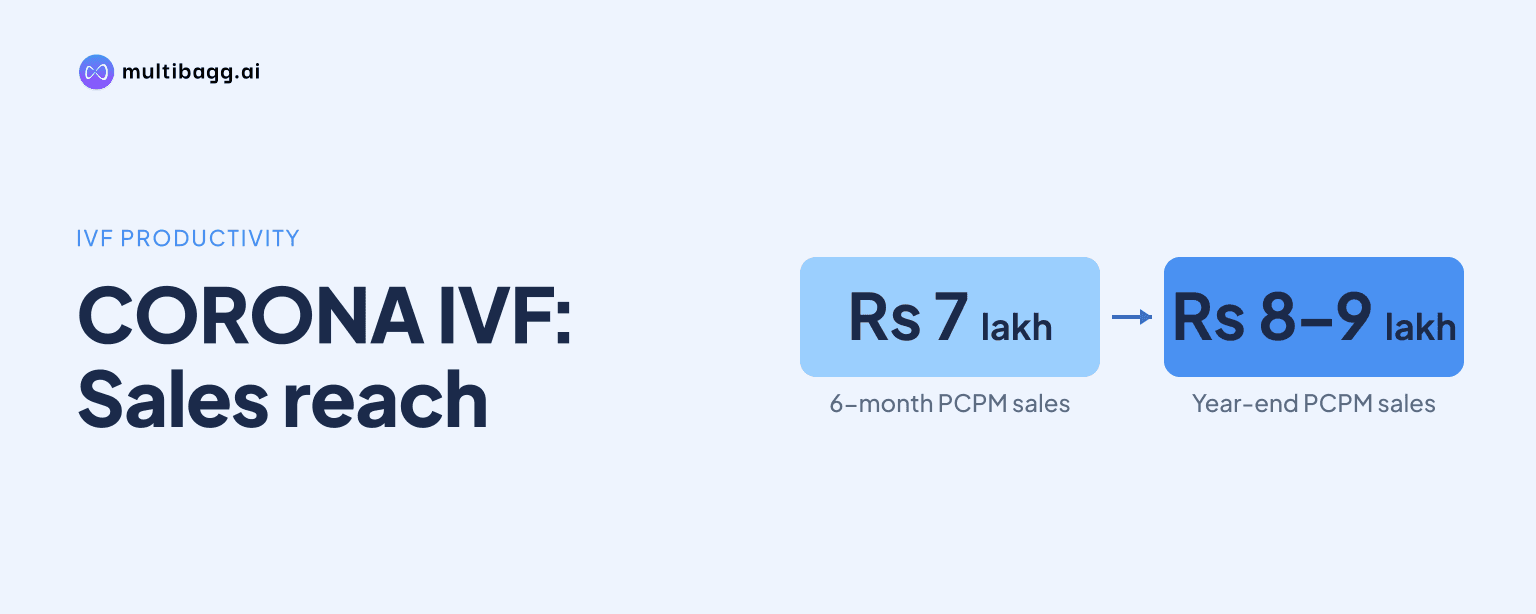
CORONA Remedies Limited’s 46-person infertility task force reached Rs 7 lakh in per-capita-per-month sales per representative within its first six months, and management said on November 2, 2026 that it was deferring team expansion while establishing the business across its current territories.
Know Corona Remedies inside out
Results, valuation, peers and who's buying, in one view.
How productive is CORONA’s IVF field force?
CORONA said its in-vitro fertilisation, or IVF, task force achieved Rs 7 lakh of per-capita-per-month, or PCPM, sales per representative after six months of operation. Managing Director and Chief Executive Officer Nirav Mehta said the company had deployed 46 people in the dedicated force, rather than the roughly 50 medical representatives, or MRs, referenced by an analyst. Management expects PCPM to reach Rs 8 lakh to Rs 9 lakh by year-end.
The IVF initiative began in calendar year 2026, or CY26, as CORONA’s initial entry into new therapy areas. Mehta said the business was still being streamlined after only two quarters of investment and effort. The Rs 7 lakh PCPM figure is reported performance after six months, whereas the Rs 8 lakh to Rs 9 lakh range is management’s expectation for year-end.
CORONA’s productivity objective is linked to a concentrated doctor universe. Management said each representative covers about 60 infertility professionals and leading gynaecologists, while the force reaches about 2,500 such doctors. It also estimated coverage at 75% to 80% of its market, with the remaining 20% including academic clinicians, government hospitals and some other hospitals.
The 46-person unit therefore has substantial coverage before any staffing increase. Management described a long runway in infertility within its existing territories, rather than identifying an immediate need for additional representatives. The operational measure to watch is whether the existing force moves from Rs 7 lakh PCPM toward the Rs 8 lakh to Rs 9 lakh expectation.
Why is CORONA deferring IVF team expansion?
CORONA said it has no plan to expand the IVF team in the first year of the business. Mehta also said the company would not expand in CY27 because the infertility operation had run for only six months and needed to become established within current territories.
However, Mehta later qualified that position by saying CORONA could consider expansion in the latter half of CY27 or early 2028 if required. The call did not set a hiring target for IVF or specify a productivity threshold that would trigger an increase. The disclosed position is therefore that expansion is deferred, rather than permanently ruled out.
The IVF stance is consistent with the wider field-force plan. CORONA added about 400 MRs in the fourth quarter of financial year 2026, or FY26, taking its total field team to 3,111 representatives. Management said it had no present plan to add MRs and would review the position upon entering FY28.
If CORONA ultimately resumes wider hiring, Mehta said it may add around 150 people sometime in FY28, although he stressed that this was not decided. That possible company-wide addition is separate from the 46-person infertility force. The call did not disclose whether any potential FY28 intake would include IVF representatives.
Got a follow-up? Ask IRIS
How does IVF fit into CORONA’s wider growth plan?
CORONA is using infertility as the first of several possible new-therapy initiatives. Management listed nephrology, gastroenterology, spine and rheumatology as therapies it may address in a coming quarter or year after establishing the infertility force in CY26. It said new-therapy expansion could be organic or inorganic, while noting that proposals under evaluation had not produced a concrete transaction.
The IVF build-out remains small beside CORONA’s India operations. India contributed 97% of total revenue in both Q2 FY27 and the first half of FY27, while India-business revenue increased 22.9% year on year in Q2 FY27. Total revenue rose 22.2% to Rs 441 crore in Q2 FY27 from Rs 361 crore in Q2 FY26.
Profit after tax increased 15.3% to Rs 60 crore in Q2 FY27 from Rs 52 crore a year earlier, while earnings before interest, tax, depreciation and amortisation, or EBITDA, rose 22.3% to Rs 96 crore from Rs 78.5 crore. Management attributed the slower profit-after-tax growth relative to revenue partly to higher depreciation and amortisation from newly commissioned facilities and acquired brands.
CORONA’s established brands remain its primary revenue base. Management said 33 Engine brands accounted for precisely 79% of business and grew 22%, while the company is seeking additional potential Engine brands across 11 divisions. IVF is consequently a specialty-force investment alongside, rather than a replacement for, the larger established portfolio.
The company also said its chronic business grew about 29% in Q2 FY27, compared with 14.9% growth in the chronic Indian pharmaceutical market. Management’s broader revenue framework is growth at 1.5 times the Indian pharmaceutical market, rather than a fixed 15% revenue-growth commitment. It expects lower double-digit market growth over the next three to four quarters, while describing the causes of the market acceleration as uncertain.
What does current IVF coverage mean for CORONA?
CORONA’s 75% to 80% reported market coverage indicates that the 46-person force is already reaching most of the targeted infertility professionals and leading gynaecologists. At about 60 doctors per representative, the team’s stated reach of about 2,500 doctors provides the base from which management intends to establish the business before expanding headcount.
Management identified the uncovered portion as including academic clinicians, government hospitals and some other hospitals. The call did not quantify sales from those settings or say whether they would be addressed by the existing 46 representatives. It also did not disclose IVF revenue, product-level sales or the unit’s contribution to Q2 FY27 revenue of Rs 441 crore.
This makes PCPM the clearest disclosed measure for monitoring the unit. A move from Rs 7 lakh to the expected Rs 8 lakh to Rs 9 lakh would represent Rs 1 lakh to Rs 2 lakh of additional monthly sales per representative. Whether that productivity is achieved without new hiring will inform management’s eventual decision on further IVF staffing.
Conclusion
CORONA has reported early operating scale in IVF, with 46 dedicated personnel generating Rs 7 lakh PCPM after six months and reaching about 75% to 80% of its targeted market. The specialty initiative sits within a much larger India business, which contributed 97% of revenue and grew 22.9% in Q2 FY27, while 33 Engine brands generated 79% of company business.
The next indicator is whether IVF productivity reaches management’s Rs 8 lakh to Rs 9 lakh PCPM expectation by year-end. Investors should also watch for clarity on the timing inconsistency in management’s staffing comments: it said there was no CY27 expansion plan, but also left open consideration in the latter half of CY27 or early 2028, while wider MR additions may be reviewed in FY28.