










Corona Remedies builds 38 brands above Rs 10 crore sales
Key highlights
- Corona Remedies had 38 brands with sales above Rs 10 crore at MAT Sep-26, up from 29 at MAT Sep-23.
- Four Corona Remedies brands exceeded Rs 100 crore in sales at MAT Sep-26, including one above Rs 200 crore.
- The company’s 33 engine brands contributed about 79% of domestic sales and recorded about 22% CAGR from MAT Sep-23 to MAT Sep-26.
- Chronic therapies accounted for 71.9% of Corona Remedies’ sales in FY26, up from 45.3% in FY16.
powered by IRIS
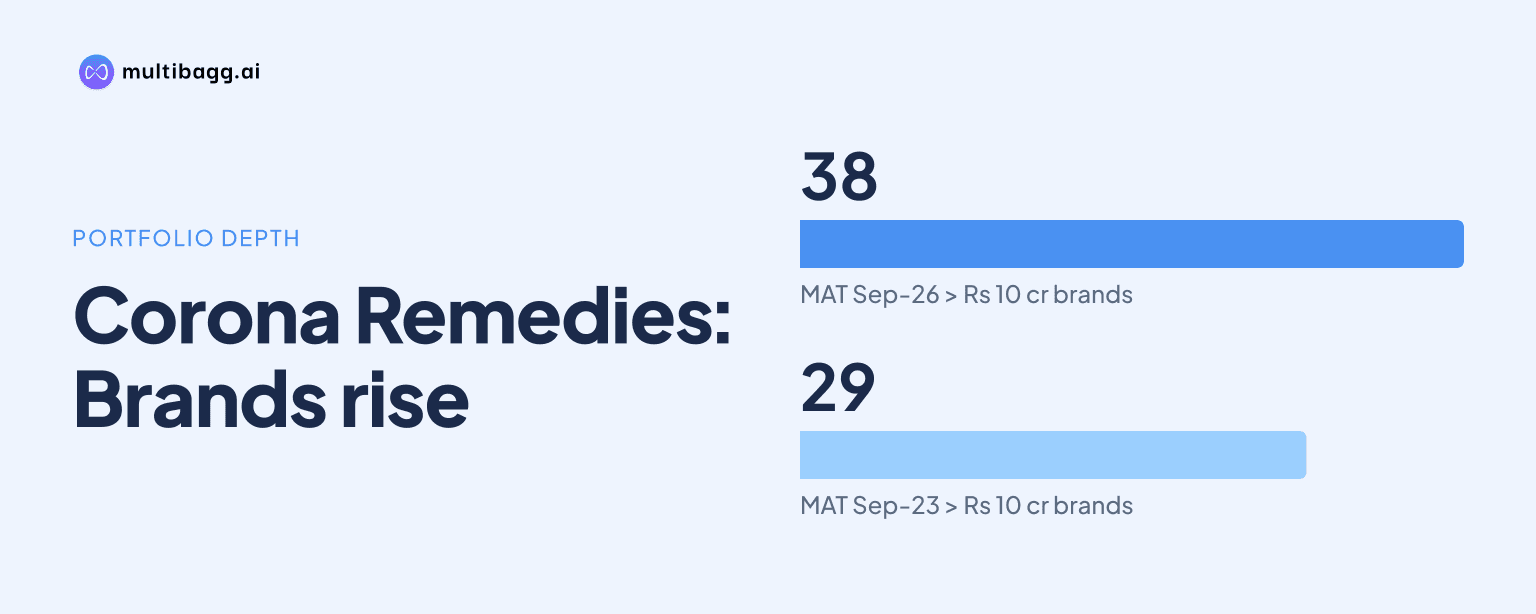
Corona Remedies Limited had 38 brands with sales above Rs 10 crore at moving annual total (MAT) September 2026, up from 29 at MAT September 2023. Its portfolio included its first brand above Rs 200 crore, while 33 engine brands contributed about 79% of domestic sales and recorded about 22% compound annual growth over the three-year period.
Know Corona Remedies inside out
Results, valuation, peers and who's buying, in one view.
How many Rs 10 crore brands has Corona Remedies built?
Corona Remedies had 38 brands above Rs 10 crore in sales at MAT Sep-26, compared with 29 at MAT Sep-23. The nine-brand increase included seven brands in the Rs 50 crore to Rs 100 crore range at MAT Sep-26, against one three years earlier, and one brand above Rs 200 crore for the first time.
The expansion was not confined to brands at the Rs 10 crore threshold. Corona Remedies had four brands above Rs 100 crore at MAT Sep-26, comprising three in the Rs 100 crore to Rs 200 crore band and one above Rs 200 crore, while neither band contained a brand at MAT Sep-23. The presentation names B-29, Myoril, Tricium, Cortel and Obimet as the top five brands.
What is Corona Remedies' engine-brand model?
Corona Remedies' engine-brand model comprised 33 brands contributing about 79% of domestic sales at MAT Sep-26. These brands recorded a compound annual growth rate (CAGR) of about 22% from MAT Sep-23 to MAT Sep-26, concentrating most domestic sales in a defined set of brands.
The four key therapies had different sales scale and mother-brand counts at MAT Sep-26. Women's Healthcare recorded Rs 514.1 crore and 32 mother brands, ahead of Cardio-Diabetes at Rs 456.2 crore and 19 brands. Pain Management recorded Rs 221.3 crore across five brands, while Urology recorded Rs 56.1 crore across eight.
Corona Remedies' growth rate exceeded that of the Indian pharmaceutical market (IPM) in each of the four therapies between MAT Sep-23 and MAT Sep-26. Urology showed the widest gap, at 42.8% for Corona Remedies against 13.7% for the IPM, followed by Pain Management at 27.7% against 8.2%; Women's Healthcare was 14.5% against 7.1%, and Cardio-Diabetes was 22.0% against 12.0%.
How have acquisitions added to Corona Remedies' brands?
Corona Remedies has acquired brands that it says have been significantly scaled up, including Dilo from GSK Pharmaceuticals Limited, Stelbid and Vitneurin from Glaxo Group Limited, and Thyrocab and Obimet from ABOTT India Limited. The disclosed list also includes Myoril from Sanofi Healthcare India Private Limited, seven distinct brands from Bayer Zydus Pharma Private Limited, and Wokadine from Dr. Reddy's Laboratories Limited.
The acquisition list overlaps with the top-five brand list at MAT Sep-26: Myoril and Obimet are among the brands named. This indicates that acquired products form part of the portfolio-building model, although the presentation gives no individual sales value for those products and does not identify the brand above Rs 200 crore.
Corona Remedies also disclosed two India-business collaborations. It has an in-licensing arrangement with Ferring Pharmaceuticals, Switzerland, for certain Women's Healthcare and Urology products, and has invested in La Chandra Pharmalabs Private Limited for backward integration of hormone active pharmaceutical ingredient (API) manufacturing. Women's Healthcare represented 27.5% of FY26 sales and Urology represented 2.9%.
Got a follow-up? Ask IRIS
How has Corona Remedies changed its portfolio mix?
Corona Remedies shifted its sales mix towards chronic therapies, which rose to 71.9% in financial year (FY) 2026 from 45.3% in FY16. Acute therapies moved in the opposite direction, falling to 28.1% from 54.7% over the same period.
Cardio-Diabetes recorded the largest gain among the named therapy shares, rising to 25.4% of sales in FY26 from 6.2% in FY16. Women's Healthcare increased from 23.7% to 27.5%, Pain Management from 6.3% to 11.4%, and Urology from 2.0% to 2.9%; the Others category declined from 63.7% to 32.8%.
Corona Remedies also reduced the West's share of its geographic sales mix to 45.2% in FY26 from 66.2% in FY16. The North increased to 20.0% from 13.8%, the South to 20.8% from 11.6%, and the East to 14.0% from 8.4%, although the West remained the largest region in FY26.
What is Corona Remedies planning for the portfolio next?
Corona Remedies plans to increase domestic IPM market share by improving medical representative productivity, expanding its prescriber base and increasing products prescribed per prescriber. The company also plans deeper engagement with super-specialist prescribers in metro, semi-metro and urban centres. At Sep-26, specialists accounted for 55% of Corona Remedies prescriptions against 35% for the IPM, while super-specialists accounted for 12% against 8%.
Its stated therapy plan includes further Women's Healthcare coverage among infertility specialists and in vitro fertilisation-focused chain hospitals, alongside expansion into nephrology, central nervous system, rheumatology, dermatology and gastroenterology. Corona Remedies also plans new products for unmet needs in existing therapies, targeted product expansions, acquisitions and in-licensing, and sales development in select overseas markets through its hormone portfolio, research and development capabilities and differentiated products.
Conclusion
Corona Remedies' 38 brands above Rs 10 crore at MAT Sep-26 show growth in both the number and scale of brands since MAT Sep-23, when it had 29. The emergence of four brands above Rs 100 crore, together with 33 engine brands contributing about 79% of domestic sales, coincided with a higher chronic-therapy share and a less West-weighted geographic mix.
The next development to watch is execution of Corona Remedies' stated plans for prescriber expansion, new launches, therapy entry and acquisitions or in-licensing. The company specifically identifies increased infertility and in vitro fertilisation coverage, entry into additional therapy areas and sales expansion in select overseas markets, but discloses no timing or financial targets for these initiatives.