










IOL funds Rs 500 crore expansion from internal accruals
Key highlights
- IOL plans approximately Rs 500 crore of internally funded investment across three manufacturing projects.
- Ibuprofen capacity is set to rise 50%, from 12,000 MTPA to 18,000 MTPA, with commissioning targeted in FY28.
- The formulation CDMO facility has planned annual capacity of 1,500 million tablets or equivalent volume and is expected to begin operations in FY27.
- Q2 FY27 EBITDA was approximately Rs 115 crore, compared with approximately Rs 64 crore in Q2 FY26.
powered by IRIS
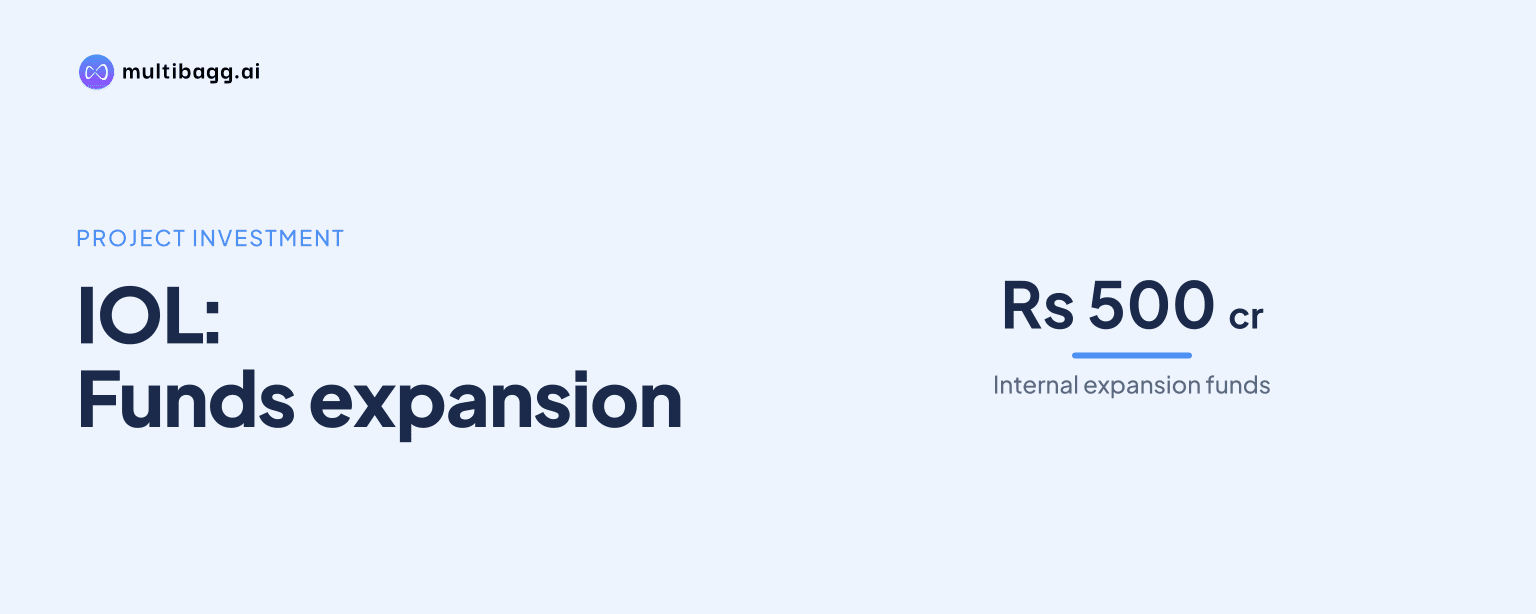
IOL Chemicals and Pharmaceuticals Limited plans to invest approximately Rs 500 crore from internal accruals in three manufacturing projects, comprising ibuprofen expansion, formulation CDMO and specialty chemicals. Management expects the CDMO and specialty-chemicals facilities to begin commercial operations in FY27, while the expanded ibuprofen facility is targeted for FY28.
Know IOL Chemicals & Pharmaceuticals inside out
Results, valuation, peers and who's buying, in one view.
What is IOL investing Rs 500 crore in?
IOL is investing approximately Rs 500 crore in a backward-integrated ibuprofen expansion, a formulation contract development and manufacturing organisation, or CDMO, facility, and a specialty-chemicals facility. Management announced the internally funded programme during the Q2 and H1 FY27 earnings call held on November 2, 2026, linking it to manufacturing scale, integration and portfolio expansion.
The ibuprofen project will raise annual capacity to 18,000 metric tonnes per annum, or MTPA, from 12,000 MTPA. The additional 6,000 MTPA represents a 50% increase from the present capacity. Management said the facility will be backward integrated and described the investment as a strategic measure to strengthen IOL’s position in domestic and global ibuprofen markets.
The formulation CDMO facility is designed for annual capacity of 1,500 million tablets or equivalent direct-compressible-grade volume. IOL said it will use active pharmaceutical ingredients, or APIs, already in its portfolio, including ibuprofen and paracetamol, to manufacture bulk tablets or customised formats such as blister packs. Management said IOL does not currently plan to pursue its own marketing authorisations for these products.
The third project is a dedicated specialty-chemicals facility under a long-term tolling arrangement with a leading global chemical company. IOL did not disclose the allocation of the approximately Rs 500 crore investment among the three projects, the identity of the chemical customer, the plant’s output capacity or its expected revenue contribution.
When will IOL’s projects begin commercial operations?
IOL expects its CDMO and specialty-chemicals projects to begin commercial operations during FY27, while it targets commissioning the ibuprofen expansion in FY28. These are management’s projected timelines, rather than completed operating milestones.
For the ibuprofen facility, management said equipment had already been ordered and the project was progressing in line with its projected target timeline. IOL also said the expansion reflects current capacity utilisation and customer engagements, not a short-term response to movements in ibuprofen pricing. It reported ibuprofen capacity utilisation of around 90% to 95% over the preceding three to four quarters.
The planned sequence means the CDMO and specialty-chemicals facilities could begin operations before the 6,000-MTPA ibuprofen addition. The CDMO plant can use APIs already made by IOL, while management said product development was under way with two to three customers. It did not disclose signed volume commitments, customer names or plant utilisation targets.
How will the projects change IOL’s manufacturing mix?
IOL’s programme extends its manufacturing model from APIs and chemicals into finished-dose formulations and contract specialty-chemical production. The CDMO facility is forward integration for the API portfolio, while the ibuprofen plant adds backward integration and the specialty-chemicals project introduces contract manufacturing under the disclosed tolling arrangement.
The CDMO project is aimed mainly at European export markets, management said. It described the business as customer-led and said development work was taking place with a few existing customers with whom IOL has long-term relationships. The intended products are formulations based on existing APIs, rather than proprietary branded medicines.
Management did not provide a revenue, margin or utilisation forecast for the 1,500-million-tablet CDMO capacity. It said it was too early to discuss margins, although it stated that CDMO generally commands better margins than API products. That statement was management’s general view and not a financial projection for IOL’s new facility.
The company’s existing mix was already changing in Q2 FY27. Non-ibuprofen products recorded approximately 70% year-on-year revenue growth and contributed 45% of pharmaceutical revenue, compared with 38% in Q2 FY26. Chemicals contributed approximately 7% of overall earnings before interest and tax, or EBIT, during Q2 FY27, compared with around 1% in the corresponding quarter a year earlier.
Got a follow-up? Ask IRIS
What financial performance supports IOL’s internal funding plan?
IOL said it will fund the approximately Rs 500 crore programme through internal accruals after reporting Q2 FY27 revenue from operations of approximately Rs 795 crore and profit after tax of approximately Rs 65 crore. The call did not disclose cash balances, annual project spending, debt funding or a capital-expenditure split by facility.
Q2 FY27 revenue rose approximately 40% year on year, while earnings before interest, tax, depreciation and amortisation, or EBITDA, increased nearly 80% to approximately Rs 115 crore from approximately Rs 64 crore in Q2 FY26. Profit after tax increased approximately 117% to approximately Rs 65 crore from approximately Rs 30 crore.
For H1 FY27, IOL reported revenue from operations of approximately Rs 1,551 crore, up approximately 39% year on year. EBITDA rose about 70% to approximately Rs 227 crore and profit after tax reached approximately Rs 130 crore, compared with approximately Rs 64 crore in H1 FY26. Exports accounted for approximately 28% of H1 FY27 revenue, while management said finance costs increased because of higher working-capital utilisation supporting greater business volume.
What does IOL expect for ibuprofen pricing and customer orders?
IOL expects ibuprofen prices to remain broadly at current levels for the next two to three quarters after reporting stable prices in recent quarters. Management said the pricing benefit was already reflected in the Q2 FY27 profit and loss account and did not identify further pricing gains for Q3 or Q4.
Management said the FY28 ibuprofen expansion should not be viewed solely through current market pricing or competitor activity. It said the project is a long-term strategic initiative, while acknowledging that global demand-supply conditions, pricing trends and competitive developments remain relevant to the business.
For API customers, IOL said commercial orders typically take six to eight months from the start of engagement. Management described order books for large customers as around four to six months, while average order-book size was around four to six quarters. It also said order books include clauses addressing volatile raw-material prices, without disclosing their scope or terms.
Conclusion
IOL’s approximately Rs 500 crore programme combines a 50% ibuprofen capacity increase with entry into formulation CDMO and tolling-based specialty-chemical manufacturing. The plan follows Q2 FY27 EBITDA of approximately Rs 115 crore, versus approximately Rs 64 crore in Q2 FY26, alongside a rise in non-ibuprofen products to 45% of pharmaceutical revenue.
The next disclosed milestones are commercial operations for the CDMO and specialty-chemicals facilities during FY27 and commissioning of the ibuprofen expansion in FY28. Management has said ibuprofen equipment is ordered and CDMO development is under way with two to three customers, but it has not disclosed customer volumes, project-level spending or profitability targets.