










IOL raises FY27 revenue outlook above 25%, keeps margin target
Key highlights
- IOL raised its FY27 revenue-growth expectation to more than 25% from an earlier 15% to 20% range.
- Management retained its FY27 EBITDA-margin expectation of 14% to 15%.
- IOL expects Q3 and Q4 FY27 performance to be more or less similar to the first half.
- IOL expects its ibuprofen capacity expansion from 12,000 tonnes to 18,000 tonnes to provide its main benefit in FY28-29.
powered by IRIS
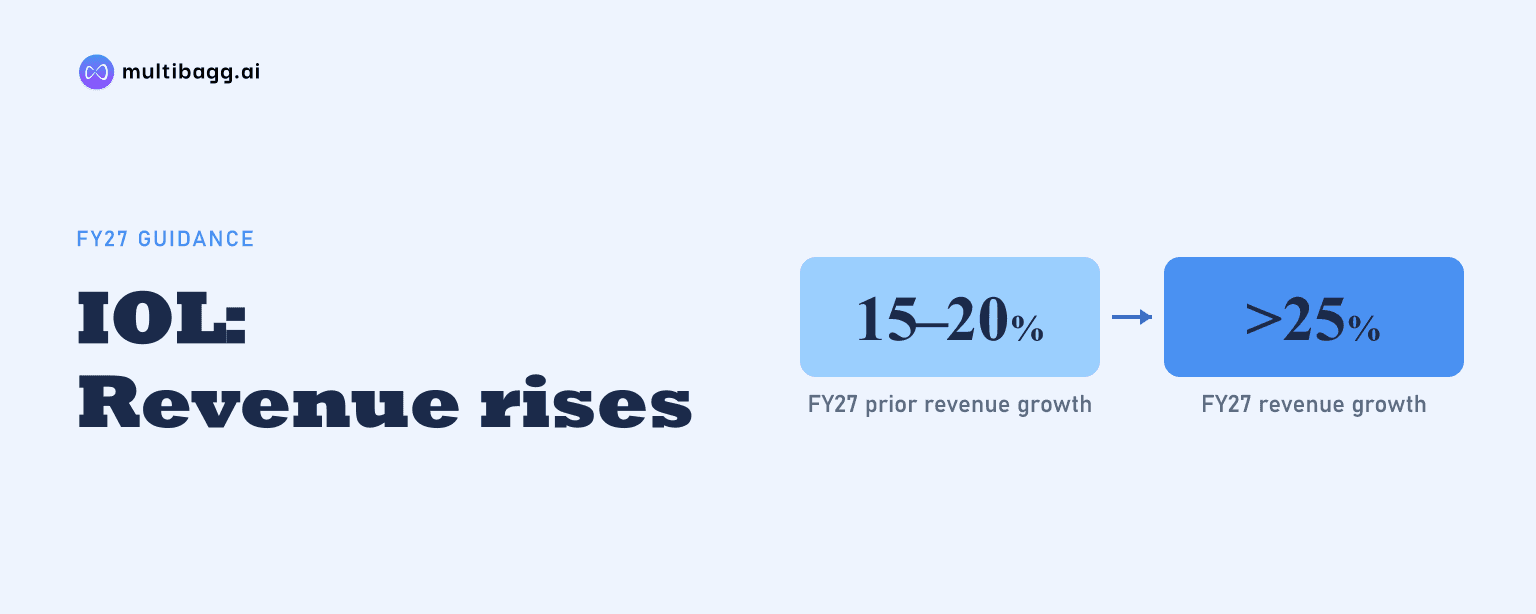
IOL Chemicals and Pharmaceuticals Limited expects FY27 revenue growth of more than 25%, up from its earlier 15% to 20% indication, while retaining a 14% to 15% earnings before interest, tax, depreciation and amortisation, or EBITDA, margin expectation. Management said the final two FY27 quarters should perform broadly in line with the first half.
Know IOL Chemicals & Pharmaceuticals inside out
Results, valuation, peers and who's buying, in one view.
What is IOL's FY27 revenue and EBITDA guidance?
IOL now expects FY27 revenue growth of more than 25% and EBITDA generation of 14% to 15%. Management said it had initially indicated revenue growth of around 15% to 20%, but raised its view after two quarters of FY27, when it said it had greater visibility on the remaining half-year.
IOL described the revised target as value growth against FY26 revenue, not a volume-only target. Management said growth should include volume, operational efficiencies, backward integration and research and development process improvements, and that the more-than-25% outlook is based on current capacities.
Management did not provide a numerical breakdown of volume, pricing and efficiency contributions. It said major products were operating at 95% to 100% capacity utilisation, and attributed growth to a mix of prices, higher utilisation and efficient procurement.
Why did IOL raise its FY27 revenue-growth outlook?
IOL raised the outlook because management expects the second half of FY27 to perform more or less similarly to the first half. In answering whether 25% was a cap, management said it was hopeful of better growth, although its stated full-year guidance remained “25% plus”.
The chemical segment benefited from 100% use of appropriate capacity for ethyl acetate and acetic anhydride, alongside better prices, management said. IOL increased ethyl acetate capacity at its existing plant from 1 lakh tonnes to 1.20 lakh tonnes; it said revenue growth reflected utilisation, export-market penetration and higher value from certain customers.
Pharmaceutical visibility includes ibuprofen, paracetamol and metformin, for which management cited order-book coverage of four to six quarters. Ibuprofen capacity utilisation has been around 90% to 95% for the past three or four quarters, while management said ibuprofen prices had remained at similar levels for more than one quarter.
Raw-material costs remain a variable in the outlook. Management said raw materials accounted for around 62% to 63% of company-wide consumption; in chemicals, around 60% to 70% of materials, including acetic acid, are imported, compared with no more than 20% to 22% in active pharmaceutical ingredients, or APIs.
Will IOL's second-half FY27 performance match the first half?
IOL expects Q3 and Q4 FY27 to deliver more or less the same performance as the first half. Management linked that view directly to its FY27 expectation of more than 25% revenue growth and said the two remaining quarters should broadly sustain the pace of the first two.
IOL also expects costs that lifted quarterly other expenses to about 14.5% of sales to decline in Q3 and Q4. Management said the usual range was 13.7% to 14%, and attributed the increase to power, fuel and shipping-freight costs, adding that it expects to pass on logistics costs to customers in coming months.
Management said power and fuel costs are generally higher in the second quarter because of the summer season and rising material costs. That expectation of lower costs in the second half is a management view, rather than a revised numerical EBITDA-margin target beyond the stated 14% to 15% FY27 range.
Ibuprofen pricing is another factor in the near-term outlook. Management said prices were already reflected in the profit and loss account and expects them to remain on a similar line for the next one or two quarters, but declined to forecast prices over two or three years because of market uncertainty.
Got a follow-up? Ask IRIS
What funding and capacity plans could affect IOL after FY27?
IOL planned capital expenditure of Rs 250 crore in the current year, with half spent in the first half and the remainder planned for the second half. As of September 30, 2026, management confirmed Rs 200 crore of short-term bank working-capital borrowing and agreed that this represented the peak requirement for the rest of FY27.
Management said increased operations and higher selling and input prices had raised working-capital needs, contributing to a slight increase in finance cost. It said existing facilities were not fully utilised and that it did not expect further borrowing in coming years because of operating cash flow and cash on hand.
IOL is expanding ibuprofen capacity from 12,000 tonnes to 18,000 tonnes, with commercialisation expected in the third or fourth quarter of FY28. Management said the project would have limited impact in FY28 because production and realisation would ramp only late in that year, with the principal benefit expected in FY28-29.
Management said the incremental ibuprofen output could be split broadly 50-50 between new customers and internal contract manufacturing organisation, or CMO, supply. It expects optimal utilisation in FY28-29, based on development visibility in API and CMO demand over the next two to three years.
When will IOL's CDMO business start contributing?
IOL expects its formulations contract development and manufacturing organisation, or CDMO, business to commercialise in FY28. Management said it had incurred around Rs 110 crore for the business and expects around Rs 125 crore of revenue initially, implying a projected initial asset turnover of about 1:1.
The CDMO target market is Europe, principally through existing customers with whom IOL has long-term relationships. Management said customer approvals generally take around one year, with a possible variation of three to four months, after validation, sample submission, documentation and country-specific filings.
IOL said it has local state licensing and European good manufacturing practice approval for the formulations facility. Validation batches from the new plant have been supplied to anchor customers, and management said complete validation could take one or two quarters.
Management expects CDMO margins to exceed API margins but did not provide a numerical margin forecast. For FY29, it did not offer a revenue target, but described a sustainable company-wide blended EBITDA margin of around 15% to 17%, distinct from its 14% to 15% FY27 expectation.
Conclusion
IOL's revised FY27 outlook indicates that management expects first-half momentum to continue through Q3 and Q4. The move from a 15% to 20% revenue-growth view to more than 25%, while retaining a 14% to 15% EBITDA-margin expectation, rests on high utilisation, chemical-segment pricing and operational measures rather than a disclosed single growth driver.
The next disclosures to watch are whether Q3 and Q4 remain in line with the first half, whether other expenses fall from about 14.5% of sales, and progress in FY28 for CDMO validation and ibuprofen expansion. Management expects the expanded 18,000-tonne ibuprofen capacity to provide its main benefit in FY28-29 and CDMO approvals to take around one year.