










IOL’s non-ibuprofen APIs reach 45% of pharmaceutical revenue
Key highlights
- IOL’s non-ibuprofen APIs contributed 45% of pharmaceutical revenue in Q2 FY27, versus 38% in Q2 FY26.
- IOL said non-ibuprofen API revenue grew approximately 70% year on year in Q2 FY27.
- Q2 FY27 revenue from operations was approximately Rs 795 crore, up approximately 40% year on year.
- IOL announced approximately Rs 500 crore of projects, including ibuprofen expansion to 18,000 MTPA from 12,000 MTPA.
powered by IRIS
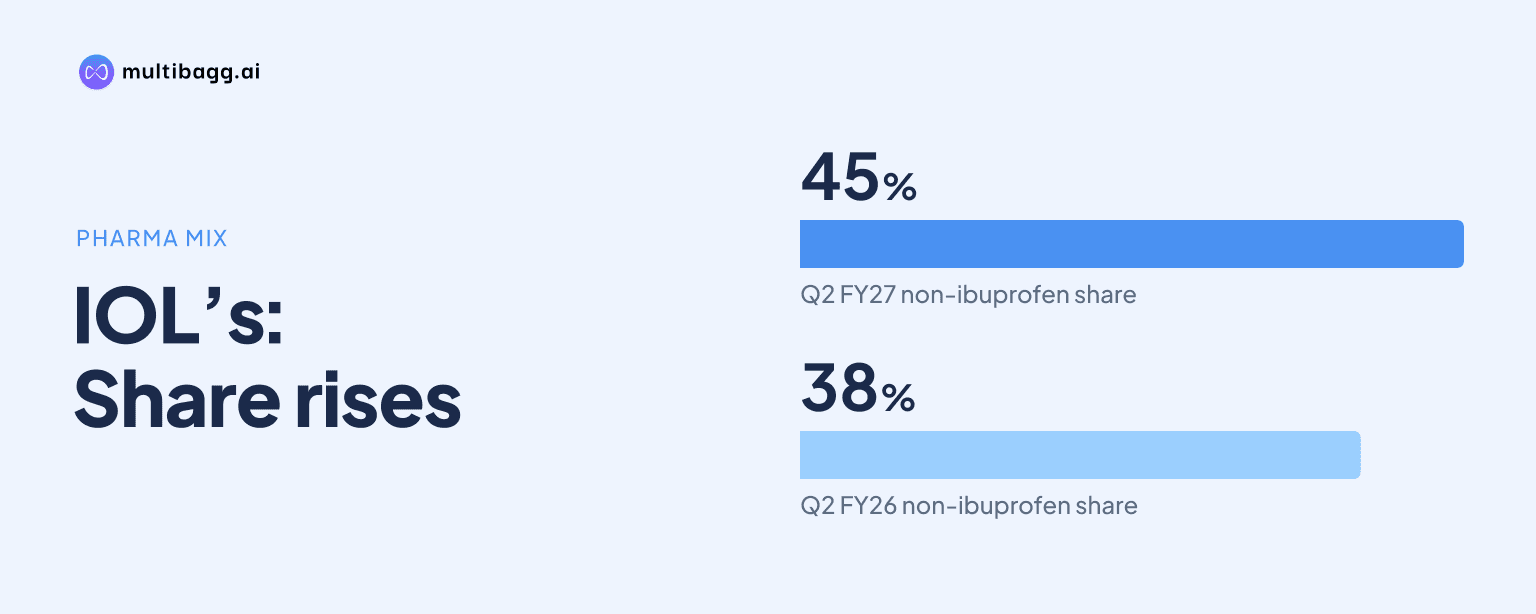
IOL Chemicals and Pharmaceuticals Limited said its non-ibuprofen active pharmaceutical ingredient (API) portfolio accounted for 45% of pharmaceutical revenue in the second quarter (Q2) of financial year 2026-27 (FY27), after revenue grew approximately 70% year on year and the share rose from 38% in Q2 FY26.
Know IOL Chemicals & Pharmaceuticals inside out
Results, valuation, peers and who's buying, in one view.
How much pharmaceutical revenue came from non-ibuprofen APIs?
IOL said non-ibuprofen APIs accounted for 45% of pharmaceutical revenue in Q2 FY27, compared with 38% in Q2 FY26. The 7-percentage-point rise indicates that products other than ibuprofen represented nearly half of the pharmaceutical business by revenue share during the quarter.
Management attributed approximately 70% year-on-year growth in the non-ibuprofen portfolio to the increasing scale and contribution of its diversified API range. The call did not disclose an absolute rupee value for pharmaceutical revenue or non-ibuprofen API sales, so the reported evidence of the shift is the portfolio’s growth rate and share of pharmaceutical revenue.
Ibuprofen remains an important business for IOL, management said. Its strategy combines ibuprofen capacity expansion, backward integration and process efficiencies with growth in other APIs, rather than presenting the 45% non-ibuprofen contribution as a replacement for ibuprofen.
How did product mix coincide with Q2 FY27 earnings?
IOL reported revenue from operations of approximately Rs 795 crore in Q2 FY27, up approximately 40% year on year, while earnings before interest, tax, depreciation and amortisation (EBITDA) rose nearly 80% to approximately Rs 115 crore. Management said demand across pharmaceuticals and chemicals, together with improved product mix, supported the revenue increase.
Profit after tax (PAT) was approximately Rs 65 crore in Q2 FY27, compared with approximately Rs 30 crore in Q2 FY26. EBITDA margin increased by 321 basis points, with one basis point equal to one-hundredth of a percentage point, to 14.4% from 11.2% a year earlier.
For the first half (H1) of FY27, revenue from operations increased approximately 39% year on year to approximately Rs 1,551 crore, EBITDA rose approximately 70% to approximately Rs 227 crore and PAT reached approximately Rs 130 crore from approximately Rs 64 crore in H1 FY26. IOL said finance costs increased during Q2 because higher working-capital utilisation supported increased business operations and volumes.
What changed in chemicals during Q2 FY27?
IOL’s chemicals business increased its contribution to overall earnings before interest and tax (EBIT) to approximately 7% in Q2 FY27 from around 1% in Q2 FY26. Management cited better realisations, operating efficiencies and disciplined procurement as the mechanisms behind the year-on-year change.
The chemicals improvement occurred alongside the pharmaceutical mix shift, rather than being identified as an effect of non-ibuprofen APIs. IOL described pharmaceuticals as the key contributor to overall performance, while chemicals made a meaningful improvement in operating profitability during the quarter.
Exports contributed approximately 28% of revenue in H1 FY27, providing a separate measure of IOL’s international business. The company linked its regulated-market plans to a Certificate of Suitability from the European Directorate for the Quality of Medicines and HealthCare (EDQM) for Fenofibrate-Process II, which took its total approvals to 22.
Got a follow-up? Ask IRIS
Which projects could expand IOL’s product mix after Q2 FY27?
IOL announced three manufacturing projects involving combined investment of approximately Rs 500 crore, funded through internal accruals. The projects cover ibuprofen backward integration and capacity expansion, a formulation contract development and manufacturing organisation (CDMO) facility, and a specialty-chemicals facility under a long-term tolling arrangement with a global chemical company.
The ibuprofen project is intended to raise capacity to 18,000 metric tonnes per annum (MTPA) from 12,000 MTPA, with commissioning targeted in FY28. Management said the initiative should be viewed as a long-term plan to strengthen domestic and global positioning, rather than solely as an installed-capacity response to current market conditions.
The formulation CDMO facility is planned for annual capacity of 1,500 million tablets or equivalent direct-compressible-grade volume, with commercial operations expected during FY27. Management said it is intended initially to convert existing portfolio APIs, including ibuprofen and paracetamol, into tablets or customised formats such as blister packs, and developments were under way with two or three customers.
The specialty-chemicals project is also expected to commence commercial operations during FY27. Management said the tolling facility is intended to establish contract manufacturing and build long-term engagement with a global customer, while European Union Registration, Evaluation, Authorisation and Restriction of Chemicals (EU-REACH) registrations for triacetin secured in Q2 FY27 are intended to support access to international markets.
What did management say about ibuprofen pricing and API orders?
IOL said ibuprofen prices had been stable for recent quarters and management assumed they would remain broadly at the same level over the next two to three quarters. That assessment reflected management’s view of global demand-supply conditions, pricing trends and competitive developments, not a formal financial forecast.
Management said an API customer generally takes around six to eight months from the start of engagement to commercial orders. It described typical order-book duration for large customers as around four to six months, while average order-book size was stated as around four to six quarters.
IOL said its order books include clauses that address cost changes when prices are volatile. Equipment for the FY28 ibuprofen expansion had already been ordered as of the November 2, 2026 earnings call, and management said the project was proceeding in line with its planned timeline.
Conclusion
The Q2 FY27 results combined a higher contribution from diversified pharmaceutical products with improved chemicals profitability: non-ibuprofen APIs added 7 percentage points to their pharmaceutical revenue share, while chemicals added approximately 6 percentage points to their share of overall EBIT. Revenue of approximately Rs 795 crore and EBITDA margin of 14.4% reflected the wider improvement across the two businesses.
The next disclosed milestones are commercial operations at the CDMO and specialty-chemicals projects during FY27, followed by commissioning of the 18,000-MTPA ibuprofen facility in FY28. Management’s stated expectation that ibuprofen prices remain broadly stable for the next two to three quarters, alongside progress with two or three CDMO customers, will provide further indicators of execution.