










IOL says European CDMO approvals may take about one year
Key highlights
- IOL said European CDMO customer approvals generally take around one year, with a three-to-four-month variation.
- IOL expects to invest about Rs 110 crore in CDMO and initially generate about Rs 125 crore of revenue.
- The formulation CDMO facility is designed for 1,500 million tablets annually or equivalent direct-compressible-grade volume.
- IOL reported Q2 FY27 revenue of Rs 795 crore and EBITDA of Rs 115 crore, versus Rs 64 crore EBITDA in Q2 FY26.
powered by IRIS
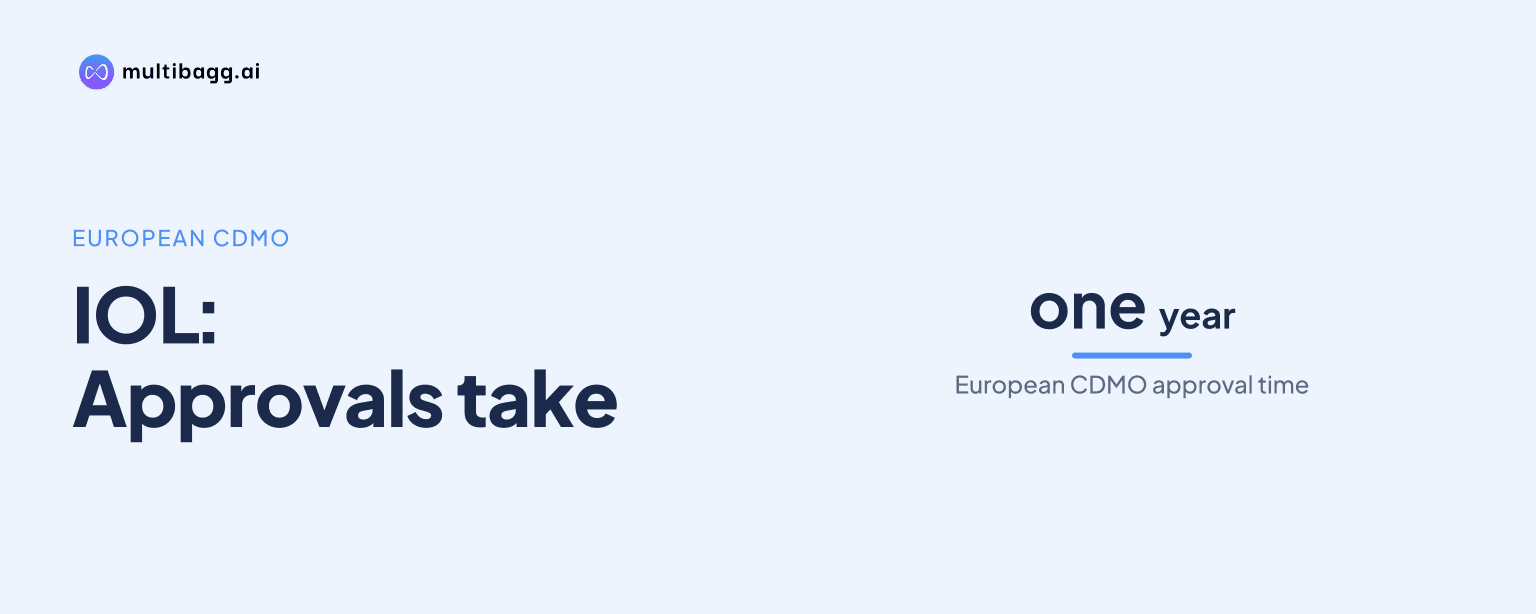
IOL said European customer approvals for formulation CDMO products generally take about one year after validation, with a variation of three to four months. Although IOL expects its formulation CDMO facility to commence commercial operations in FY27, customer documentation and country-level approvals will determine when European volumes can ramp up.
Know IOL Chemicals & Pharmaceuticals inside out
Results, valuation, peers and who's buying, in one view.
How long will IOL's European CDMO approvals take?
IOL expects the approval process to take around one year, varying by roughly three to four months depending on the customer and the market in which that customer operates. Management described a sequence in which IOL first completes validation, submits samples, prepares documentation and then the customer seeks approval in its respective European country. This makes the approval timeline customer- and country-specific rather than a single facility-wide clearance.
IOL has received European Good Manufacturing Practice, or GMP, certification for its formulation CDMO facility, while management said local state licensing approvals are in place before starting the plant. The European GMP certification met an additional customer requirement identified by management, but it does not remove the need for customers to file product documentation in their respective countries. The remaining process will continue as customer-specific filings.
What will IOL manufacture for European CDMO customers?
IOL plans to manufacture bulk tablets and customised formats, including blister-packed products, from active pharmaceutical ingredients, or APIs, already in its portfolio. Management named ibuprofen and paracetamol as examples and said the facility can make tablets from any API in the current portfolio. IOL does not currently plan to pursue its own marketing authorisations, or MAs, for these formulations.
IOL said its CDMO export target is mainly Europe and that development work is under way with two to three customers. Management described the model as customer-led and focused on existing customers with whom it has long-term relationships. That approach links the initial product pipeline to established API relationships rather than to a disclosed portfolio of independently marketed finished-dose products.
The formulation plant is designed for annual capacity of 1,500 million tablets or an equivalent volume of direct-compressible grades. It forms part of three announced manufacturing projects with combined investment of about Rs 500 crore, funded through internal accruals. Management said the CDMO and specialty chemicals projects are expected to commence commercial operations during FY27, while the ibuprofen expansion is targeted for FY28.
What is IOL spending on the CDMO facility and what revenue does it expect?
IOL indicated investment of about Rs 110 crore in the new CDMO business and initially expects about Rs 125 crore of revenue from it. Management described that expectation as roughly 1:1 asset turnover in the initial phase. It did not disclose a firm revenue ramp schedule, customer volume commitments or a date when the Rs 125 crore revenue level would be reached.
Management said it was too early to quantify CDMO margins, while stating that CDMO generally commands a higher margin than API products because it is forward integration of the API business. This is management's expectation rather than reported profitability from an operating CDMO facility. The call therefore provides an investment and initial revenue indication, but not a disclosed earnings contribution or utilisation level for FY27.
IOL planned total capital expenditure of Rs 250 crore in FY27, with half already spent in the first half and the balance planned for the second half. The company also reported short-term bank working-capital borrowing of Rs 200 crore as of September 30, 2026, which management said represented the peak requirement for the rest of the year. These figures place the CDMO build-out within a wider investment programme that also includes ibuprofen and specialty chemicals.
Got a follow-up? Ask IRIS
How do IOL's existing operations support the CDMO launch?
IOL's existing API portfolio provides the starting materials for the planned formulation operation, including ibuprofen, paracetamol and other current APIs. Management said major products were operating at 95% to 100% capacity utilisation, while ibuprofen capacity had run at around 90% to 95% for the previous three to four quarters. IOL is expanding ibuprofen capacity from 12,000 metric tonnes per annum, or MTPA, to 18,000 MTPA through a backward-integrated facility.
Management said the incremental ibuprofen output could be split roughly 50-50 between new API customers and internal CDMO supply, though it did not provide a binding allocation. The ibuprofen project is expected to be commercialised late in FY28, probably in the third or fourth quarter, and management said its real benefit would come in FY28-FY29. That timeline concerns the ibuprofen expansion, not a disclosed utilisation target for the formulation CDMO plant.
For the API business, IOL said it generally takes six to eight months for a customer to move from the beginning of engagement to commercial orders. Management also described the order book for large customers as around four to six months, with an average size of four to six quarters, primarily for ibuprofen, paracetamol and metformin. The roughly one-year European formulation approval sequence adds a separate regulatory step beyond the API sales cycle.
When could IOL's CDMO facility contribute at scale?
IOL has not given an FY28 or FY29 CDMO utilisation target, but its disclosed sequence points to a lag between FY27 commissioning and commercial customer approvals. The facility is expected to start commercial operations during FY27, after which validation, samples, documentation and country filings may take about one year. Actual ramp-up will depend on the timing of each customer's validation and approval process.
IOL entered this period with revenue from operations of Rs 795 crore in Q2 FY27, up about 40% year on year, and earnings before interest, tax, depreciation and amortisation, or EBITDA, of Rs 115 crore, up from Rs 64 crore in Q2 FY26. For H1 FY27, revenue reached Rs 1,551 crore and EBITDA was Rs 227 crore. Management guided to more than 25% revenue growth for FY27 and an EBITDA margin of 14% to 15%, based on existing operations rather than a stated CDMO contribution.
Conclusion
IOL's formulation CDMO project extends its API business into finished tablets and customised packaging for mainly European export customers, with a planned Rs 110 crore investment and initial revenue expectation of about Rs 125 crore. The key qualification is timing: European GMP certification is in place, but individual customers still need validation, documentation and country approvals that management said generally require around one year.
The next points to watch are FY27 commercial commissioning of the CDMO facility, progress with the two to three customers under development, and the pace of European country filings after validation. Management also plans to spend the remaining half of its Rs 250 crore FY27 capital expenditure in the second half, while the separate ibuprofen expansion is expected to be commercialised late in FY28.