










IOL expects half of new ibuprofen capacity to feed CDMO
Key highlights
- IOL expects about 50% of incremental ibuprofen capacity to feed internal CDMO supply and about 50% to serve new API customers.
- The ibuprofen project expands capacity from 12,000 tonnes to 18,000 tonnes and is expected to commercialise late in FY28.
- IOL said existing ibuprofen capacity has run at roughly 90% to 95% utilisation for the last three to four quarters.
- IOL reported H1 FY27 revenue of Rs 1,551 crore and EBITDA of Rs 227 crore, with a 14.5% EBITDA margin.
powered by IRIS
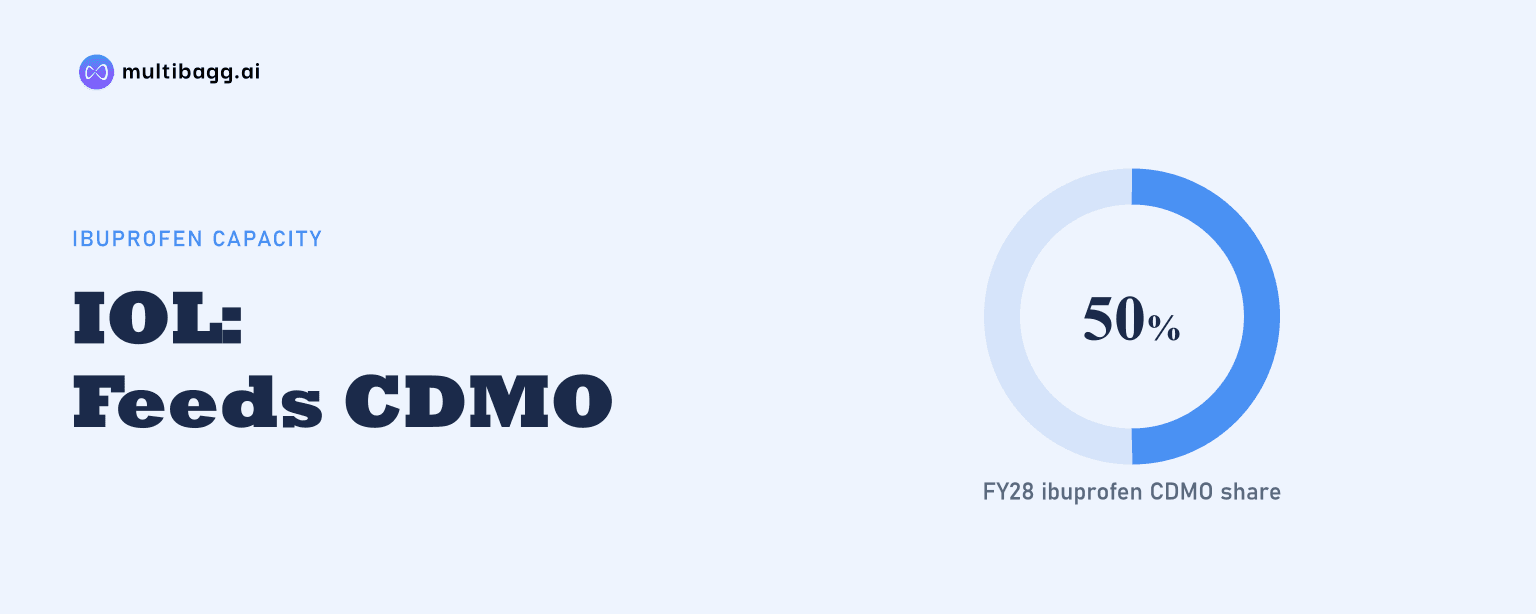
IOL Chemicals and Pharmaceuticals Limited expects roughly half of the 6,000-tonne ibuprofen capacity addition to supply its formulation contract development and manufacturing organisation, or CDMO, business, with the rest intended for new active pharmaceutical ingredient, or API, customers. Management expects late-FY28 commercialisation and says the main benefit should start in FY29.
Know IOL Chemicals & Pharmaceuticals inside out
Results, valuation, peers and who's buying, in one view.
How will IOL use its new ibuprofen capacity?
IOL expects the added ibuprofen capacity to be split roughly 50:50 between new API customers and internal CDMO supply. Management said the expansion from 12,000 tonnes to 18,000 tonnes would serve a mix of new API developments and the formulation contract-manufacturing plant, rather than being dedicated solely to merchant API sales.
The 6,000-tonne increase supports two routes to market: API supply to customers and conversion of IOL's own API portfolio into finished formulations for CDMO customers. Management described the project as a long-term initiative based on customer developments and expected utilisation over the next two to three years, rather than a response to current ibuprofen pricing or peer actions.
Management did not specify binding volumes for either channel or disclose a revenue figure for the ibuprofen addition. Its 50:50 indication was presented as a probable broad mix, dependent on new API customer developments and the utilisation of the formulation plant, leaving the eventual allocation subject to customer approvals and orders.
When will IOL's new ibuprofen project contribute?
IOL expects the ibuprofen expansion to be operational in FY28, probably in the third or fourth quarter, leaving limited time for production ramp-up and revenue realisation in that year. Management said the more meaningful benefit should begin in FY29 rather than during the initial FY28 commercialisation period.
Equipment for the project has already been ordered, and management said the project was in line with its target timelines. IOL said it expects optimum utilisation in FY28-29, although it did not provide a quarterly utilisation target for the planned 18,000-tonne facility or identify a commissioning month.
The timetable follows utilisation of roughly 90% to 95% at existing ibuprofen capacity for the previous three to four quarters, according to management. In a separate response, IOL said major products were running at 95% to 100% utilisation, indicating that the project is intended to add supply rather than depend only on higher loading at current plants.
What is IOL's CDMO strategy for ibuprofen formulations?
IOL's CDMO strategy is to convert APIs in its existing portfolio, including ibuprofen and paracetamol, into bulk tablets or customer-specific formats such as blister packs. Management said it does not currently plan to pursue its own marketing authorisations, or MAs, and instead intends to manufacture for customers under the CDMO model.
The primary target is the European market, where development work is under way with a few existing customers with whom IOL has long-term relationships. Management also said it was working with two to three customers at the time of the call, but did not disclose their names, products, annual volumes or contracted commitments.
IOL characterises the CDMO move as forward integration from API production. Management said it was too early to quantify CDMO margins, while stating that CDMO generally commands better margins than API products and that IOL expects a higher margin than its API or chemicals businesses. That is management's expectation rather than a reported financial outcome.
The formulation facility has local state licensing approvals and European good manufacturing practice, or GMP, certification in place, management said. For European customers, the process involves validation, sample submission, documentation and country-specific filings, which management said generally take about one year, with a variation of three to four months.
Got a follow-up? Ask IRIS
What demand and pricing conditions is IOL assuming?
IOL is assuming broadly stable ibuprofen prices for the next two to three quarters rather than a further near-term increase. Management said prices had been stable in the previous quarters, were unchanged in the reported quarter and were already reflected in the profit and loss account.
That view differed from an analyst's suggestion that market realisations had increased. Management declined to forecast ibuprofen prices over two to three years, calling such a forecast risky amid changing global demand-supply conditions, competitive developments and market dynamics; it presented the capacity project as based on customer visibility instead.
For API products, IOL said a customer typically takes six to eight months from initial engagement to commercial orders. Management separately described the order book for large customers as around four to six months, with an average order-book size of four to six quarters, primarily for ibuprofen, paracetamol and metformin; it also said contracts include clauses for volatile prices.
How does the expansion fit IOL's financial plan?
IOL reported revenue from operations of Rs 795 crore in Q2 FY27, up about 40% year on year, while earnings before interest, tax, depreciation and amortisation, or EBITDA, rose about 80% to Rs 115 crore. In H1 FY27, revenue increased about 39% to Rs 1,551 crore and EBITDA rose about 70% to Rs 227 crore, lifting the EBITDA margin to 14.5% from 11.8% in H1 FY26.
Management's FY27 outlook is for revenue growth of 25% or more and EBITDA generation of 14% to 15%. It said Q3 and Q4 should deliver broadly similar performance, while describing a 15% to 17% company-wide blended EBITDA margin as a sustainable target; these are management targets, not reported results.
IOL planned total capital expenditure of Rs 250 crore in FY27 and said it had spent half in H1, with the remainder scheduled for H2. Management separately said the CDMO investment was about Rs 110 crore and projected initial revenue of around Rs 125 crore, while confirming that Rs 200 crore of short-term bank working-capital borrowing as of September 30, 2026 represented peak working-capital needs for the year.
Conclusion
IOL's ibuprofen expansion is intended to broaden its business model as well as add API capacity. The indicated 50:50 allocation between new API customers and internal CDMO supply links the 6,000-tonne addition to formulation manufacturing for European export customers, while existing ibuprofen utilisation of roughly 90% to 95% provides the operating context for the expansion.
The next points to watch are commercialisation in the later part of FY28, the pace of customer validation and country-specific approvals, and the eventual split between merchant API and internal CDMO consumption. Management expects the principal benefit in FY29 and currently assumes ibuprofen prices will remain broadly stable for the next two to three quarters.