










IOL’s Cost-Plus Chemical Plant Starts Batches in November
Key highlights
- IOL expects to start specialty-chemical batches by the end of November after the dedicated plant was almost commissioned.
- The plant will manufacture a new product for one global customer under a cost-plus tolling agreement.
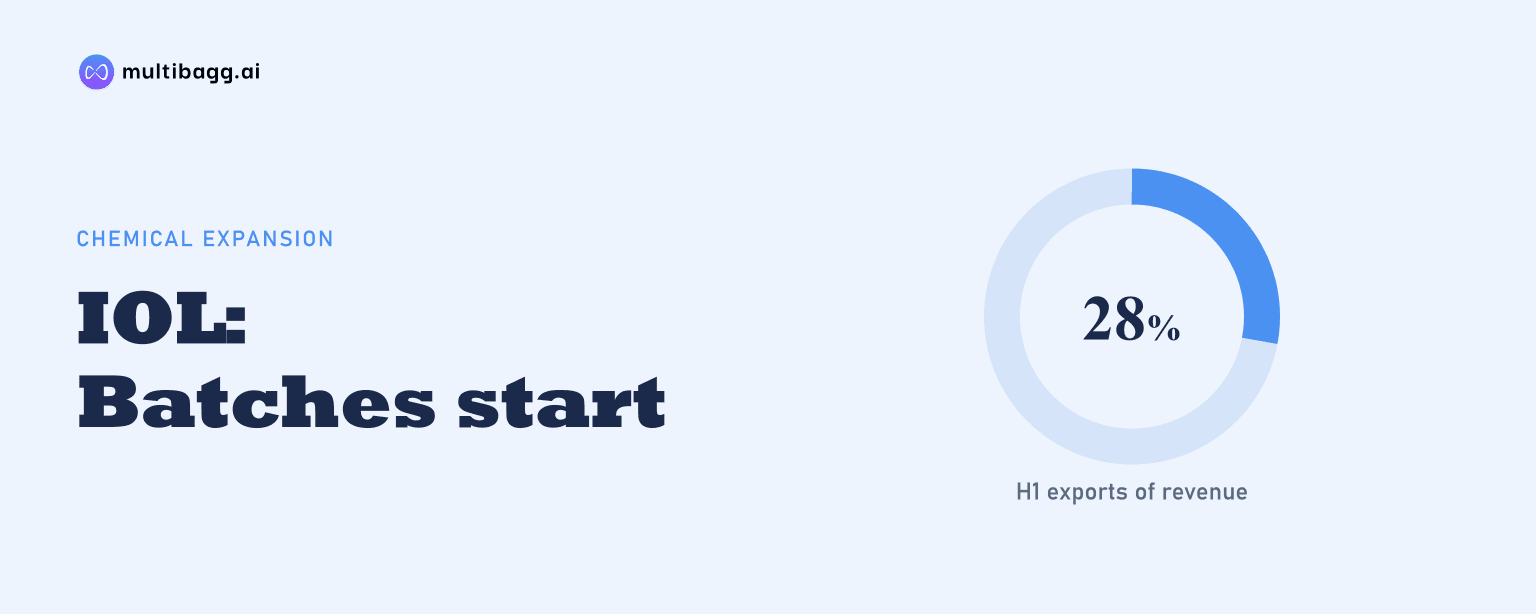
- Exports accounted for about 28% of IOL’s H1 revenue, led by ethyl acetate penetration and the non-Ibu segment.
- Management expects formulations CDMO commercialisation in FY28 and optimum utilisation across FY28 and FY29.
powered by IRIS
IOL expects to begin batches at its dedicated specialty-chemical plant by the end of November for one global customer under a cost-plus tolling arrangement. The plant was almost commissioned when management discussed it during the FY27 call, and production will ramp gradually in line with the customer’s requirements rather than enter full utilisation immediately.
Know IOL Chemicals & Pharmaceuticals inside out
Results, valuation, peers and who's buying, in one view.
When will IOL’s specialty-chemical plant start production?
IOL expects to start batches at the specialty-chemical facility during November, probably by the end of the month, because the plant was almost commissioned. Management said output would then be increased slowly and gradually according to the customer’s requirements, rather than through an immediate full-capacity ramp-up.
The November start concerns a new product that IOL had not manufactured previously. Management did not disclose the product name, the customer name, the chemistry or the end application because both sides are covered by confidentiality arrangements. It said only that the product has many applications and that the facility was established specifically for this customer.
The project is separate from IOL’s pharmaceutical formulations CDMO, or contract development and manufacturing organisation, facility. Management said the formulations CDMO business would be commercialised in FY28, with optimum utilisation expected across FY28 and FY29. By contrast, the November specialty-chemical project is a chemicals CMO, or contract manufacturing organisation, arrangement that is approaching operational batches now.
What is IOL’s contract and pricing model for the plant?
IOL’s specialty-chemical plant will operate under a tolling agreement on a cost-plus pricing model for a certain quantity. Management described the arrangement as CMO rather than CDMO and said the global customer provides and validates the manufacturing process. IOL will manufacture the contracted product rather than market it to unrelated buyers.
That structure differs from IOL’s chemical sales model for products such as ethyl acetate, where revenue can reflect volume, capacity use, export penetration and customer mix. Management said ethyl acetate capacity was expanded from 1 lakh tonnes to 1.20 lakh tonnes, and it did not provide a volume-versus-price revenue split. The dedicated specialty-chemical plant, however, is tied to the customer’s process and production requirement.
Management said the cost-plus arrangement gives IOL visibility of realisations and profits. It did not disclose a revenue commitment, minimum volume, contract duration, margin percentage or the plant’s capacity. Therefore, the transcript supports the existence of a defined commercial mechanism, but not a quantified contribution to FY27 revenue or earnings.
The customer was described only as one of the renowned chemical manufacturing companies globally. Management also said the plant was dedicated to that customer, which limits the scope to infer wider market demand from the arrangement. The company specifically said it is not selling the product in the open market, so it did not provide a total addressable market estimate.
Got a follow-up? Ask IRIS
Why does the dedicated plant matter to IOL’s chemicals strategy?
The dedicated plant matters because management views it as an entry point into chemical CDMO opportunities, while the immediate arrangement is a CMO contract. IOL said the project can deliver operational advantages, manufacturing experience and visibility of revenue and profits. Those benefits are linked to executing a customer-provided, customer-validated process at a dedicated facility.
The initiative sits alongside broader capacity and product expansion across IOL’s chemical and pharmaceutical operations. Management said it had announced Rs 500 crore of investment in new businesses and capacity additions, while its stated 25%-plus revenue-growth expectation was based on existing capacities. It also cited capacity additions in pantoprazole, minoxidil and clopidogrel during the prior year.
IOL’s management presented different indicative asset-turnover expectations by segment. It said chemical operations typically have roughly 1:3 asset turnover, active pharmaceutical ingredient, or API, operations roughly 1:1, and CDMO projects roughly 1:1 to 1:1.25; the company-wide blended estimate was about 1:1.75. These figures were broad management estimates, not a disclosed return projection for the November plant.
For comparison, management had earlier discussed a pharmaceutical CDMO investment of about Rs 110 crore and expected about Rs 125 crore of revenue from that business initially. It said margins in CDMO were expected to exceed those of its existing API and chemicals businesses, but did not attach that observation to the dedicated specialty-chemical plant. No capital cost or revenue estimate for the chemicals project was disclosed.
How does this project compare with IOL’s other growth drivers?
IOL’s new specialty-chemical contract differs from its export-led and capacity-led growth drivers because production is for one customer under an agreed cost-plus formula. Exports represented about 28% of H1 revenue, with management attributing export progress to ethyl acetate penetration and the non-Ibu segment. The tolling project, in contrast, is not an open-market export product programme.
The company’s existing chemical business also has a different procurement profile. Management said roughly 60% to 70% of chemical raw materials for certain products, including acetic acid, are imported, while API raw-material imports are not more than 20% to 22%. Across the company, raw-material consumption was about 62% to 63%, according to management. The transcript does not state whether the tolling customer supplies any material inputs.
In API operations, management said ibuprofen prices had remained around the same level for more than one quarter and expected a similar range over the next one or two quarters. It declined to forecast prices two or three years ahead. The cost-plus manufacturing arrangement is different in mechanism because management said its realisations and profits are visible under the customer contract, although it did not quantify the effect of changes in input costs.
IOL also described operational priorities that apply across its businesses, including backward integration, product-mix improvement, impurity reduction and better quality. For paracetamol, management said the company is backward integrated into acetic anhydride and para-amino phenol, while around 50 tonnes per month of acetic anhydride were being sold through merchant sales. The specialty-chemical plant instead relies on a customer-provided process, making process execution central to its initial ramp-up.
Conclusion
The November project places a new, dedicated manufacturing line alongside IOL’s open-market chemical portfolio, export activity and pharmaceutical expansion. Its relevance lies in the contractual production model and the customer’s validated process, while the undisclosed product, capacity, contract period and financial contribution prevent a quantified assessment against IOL’s broader Rs 500 crore investment programme.
The next point to watch is whether batches begin by the end of November and how quickly IOL increases production in line with the customer’s requirement. Management also expects the separate formulations CDMO business to commercialise in FY28 and reach optimum utilisation across FY28 and FY29, while it has stated a 25%-plus revenue-growth expectation based on existing capacities.