










Credo Brands Marketing Limited Q2 profit rises 45% as margin widens
Key highlights
- Mufti’s Q2 FY27 revenue reached a record Rs 189.3 crore, up 16% year on year.
- Mufti’s Q2 FY27 PAT rose 45% year on year to Rs 27.3 crore, with PAT margin at 14.4%.
- Mufti’s Q2 FY27 gross margin increased 150 basis points year on year to 58.6%.
- Mufti’s working-capital days rose to 217 in H1 FY27 from 196 in FY26.
powered by IRIS
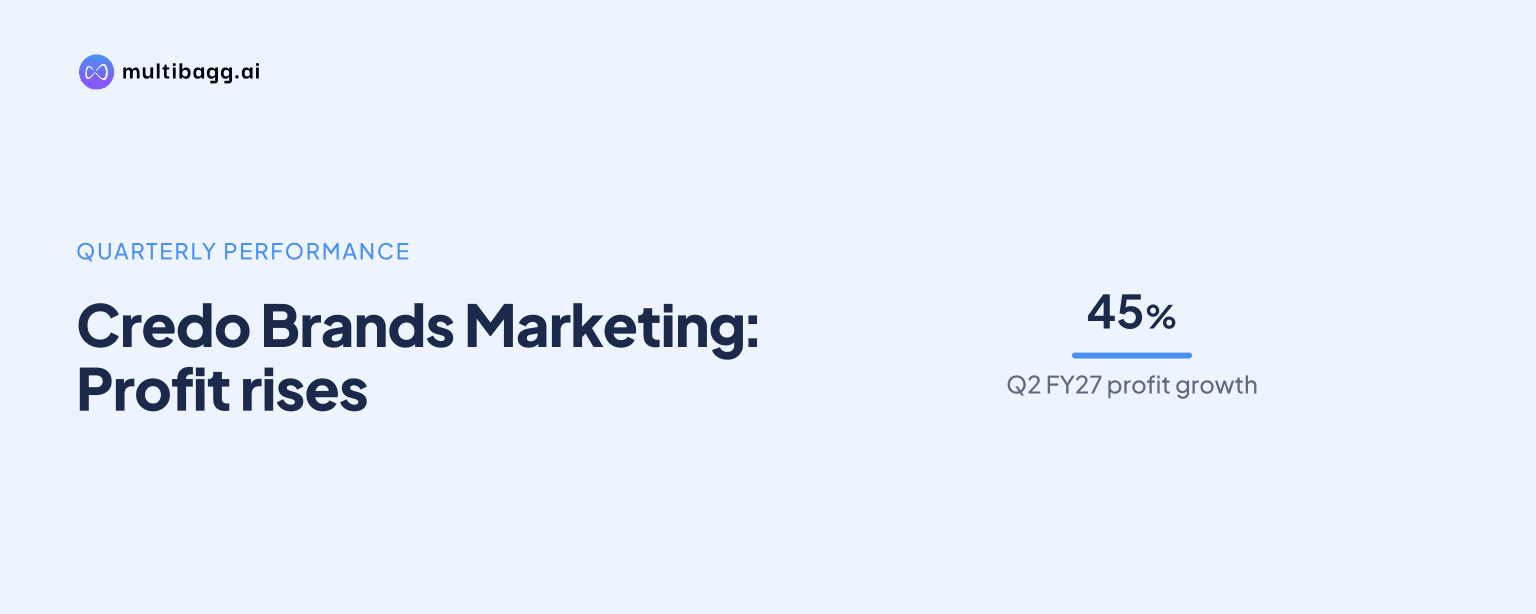
Credo Brands Marketing Limited reported Q2 FY27 profit after tax of Rs 27.3 crore, up 45% year on year, as gross margin widened 150 basis points to 58.6% and revenue reached a record Rs 189.3 crore. The company markets menswear under the Mufti brand, which is referred to here as Mufti.
Know Credo Brands Marketing inside out
Results, valuation, peers and who's buying, in one view.
How did Mufti’s Q2 FY27 earnings compare with last year?
Mufti’s Q2 FY27 profit after tax, or PAT, was Rs 27.3 crore, compared with Rs 18.8 crore in Q2 FY26, a 45% year-on-year increase. Revenue from operations rose 16% to Rs 189.3 crore from Rs 163.7 crore, which management described as the company’s highest-ever quarterly revenue. PAT margin increased to 14.4% from 11.5%, a rise of 290 basis points, where one basis point equals one-hundredth of a percentage point.
Gross profit rose 19% to Rs 111 crore in Q2 FY27 from Rs 93.5 crore in Q2 FY26, exceeding the 16% revenue increase. Gross margin consequently rose to 58.6% from 57.1%. Management attributed the H1 FY27 gross-margin improvement to a richer product mix and better price realisations, and said average selling prices rose across shirts, T-shirts and bottomwear.
What drove Mufti’s faster profit growth in Q2 FY27?
Mufti’s earnings before interest, tax, depreciation and amortisation, or EBITDA, grew 24% to Rs 59.5 crore in Q2 FY27 from Rs 48.1 crore a year earlier. EBITDA margin increased 200 basis points to 31.4%. Employee cost rose by Rs 0.8 crore to Rs 9.7 crore and other expenses increased by Rs 5.3 crore to Rs 41.8 crore, while gross profit rose by Rs 17.5 crore.
Below EBITDA, depreciation increased to Rs 19 crore from Rs 18.4 crore, while finance cost fell to Rs 6.2 crore from Rs 6.4 crore. Profit before tax increased to Rs 36.6 crore from Rs 25.2 crore, despite tax rising to Rs 9.3 crore from Rs 6.4 crore. The resulting Rs 8.5 crore increase in PAT produced the reported 45% growth.
Bottomwear represented 45.2% of Q2 FY27 product mix, ahead of shirts at 38.3% and T-shirts at 13.2%. In H1 FY27, bottomwear represented 42.7% while shirts accounted for 41.6%, meaning bottomwear had a larger share in the quarter than in the six-month period. The presentation does not quantify each category’s contribution to gross-margin expansion.
How did Mufti’s first-half FY27 results differ from Q2?
Mufti reported H1 FY27 revenue of Rs 314.6 crore, up 11% from Rs 283.6 crore in H1 FY26, while PAT increased 18% to Rs 29.6 crore from Rs 25.1 crore. Gross profit grew 12% to Rs 188.2 crore and gross margin rose 80 basis points to 59.8%. The H1 gross margin was 1.2 percentage points above the Q2 level of 58.6%.
The H1 profitability trend was less pronounced than the Q2 result. EBITDA increased 9% to Rs 86.1 crore, but EBITDA margin declined 50 basis points to 27.4% from 27.9%. The operating highlights state that PAT margin increased 50 basis points to 9.4%, while the detailed profit-and-loss table shows a 60-basis-point increase from 8.9%, leaving a 10-basis-point difference within the presentation.
Sales-channel mix also differed between the quarter and half year. Exclusive brand outlets, or EBOs, accounted for 47.1% of Q2 sales and 52.7% of H1 sales, while multi-brand outlets, or MBOs, accounted for 36.0% and 28.7%, respectively. Online sales were nearly unchanged at 11.9% in Q2 and 11.8% in H1.
Got a follow-up? Ask IRIS
What are Mufti’s store, cash-flow and working-capital indicators?
Mufti had 419 stores in Q2 FY27, including 57 under the New Mufti 2.0 identity. Management said it opened 14 New Mufti 2.0 stores during the quarter, including 12 renovated stores. It said the format uses improved design, merchandise curation and service, and that it will prioritise store productivity over store count.
The balance sheet reported zero borrowings at September 2026, while management described Mufti as debt-free. Lease liabilities totalled Rs 218 crore, comprising Rs 172.7 crore of non-current lease liabilities and Rs 45.3 crore of current liabilities. Total equity rose to Rs 455.4 crore at September 2026 from Rs 438.6 crore at March 2026, while cash and cash equivalents declined to Rs 12.8 crore from Rs 52.4 crore.
Working-capital days rose to 217 in H1 FY27 from 196 in FY26 and 184 in FY25. Inventory days increased to 69 from 65, debtor days rose to 162 from 147, and creditor days declined to 14 from 16. Net cash from operating activities fell to Rs 4.2 crore from Rs 32.4 crore in H1 FY26 as the working-capital outflow rose to Rs 71.9 crore from Rs 33.7 crore.
How consistent have Mufti’s margins and retail productivity been?
Mufti’s gross margin was 58.4% in FY26, compared with 57.2% in FY25 and 56.9% in FY22. Management said gross margins have remained above 57% consistently, although the FY22 figure in its table is 56.9%. H1 FY27 gross margin of 59.8% was above the FY26 level, while Q2 FY27 gross margin was 58.6%.
Retail revenue per square foot was Rs 11,719 in FY26, down from Rs 11,928 in FY25 but above Rs 9,324 in FY22. EBITDA margin was 26.0% in FY26, compared with 29.1% in FY25 and 32.9% in FY23. At September 30, 2026, trailing-12-month return on capital employed was 14.6% and return on equity was 11.9%.
Conclusion
Mufti’s Q2 FY27 performance combined 16% revenue growth with 45% PAT growth, supported by a 150-basis-point increase in gross margin and a 200-basis-point improvement in EBITDA margin. The quarter grew faster than the 11% revenue and 18% PAT increases reported for H1 FY27, while bottomwear formed a larger share of Q2 sales than of the half-year mix.
The next disclosed operating markers are the development of the 57 New Mufti 2.0 stores and management’s plan to reshape the 419-store network around productivity. Management’s focus on merchandise mix, store experience and brand-building will be relevant alongside whether working-capital days, which reached 217 in H1 FY27, and operating cash flow of Rs 4.2 crore change as the season develops.