










MUFTI positions premium stores for brand experience
Key highlights
- MUFTI lists its reinvented brand identity at 14 locations across 13 cities.
- MUFTI identifies six intended benefits from premiumising the store experience.
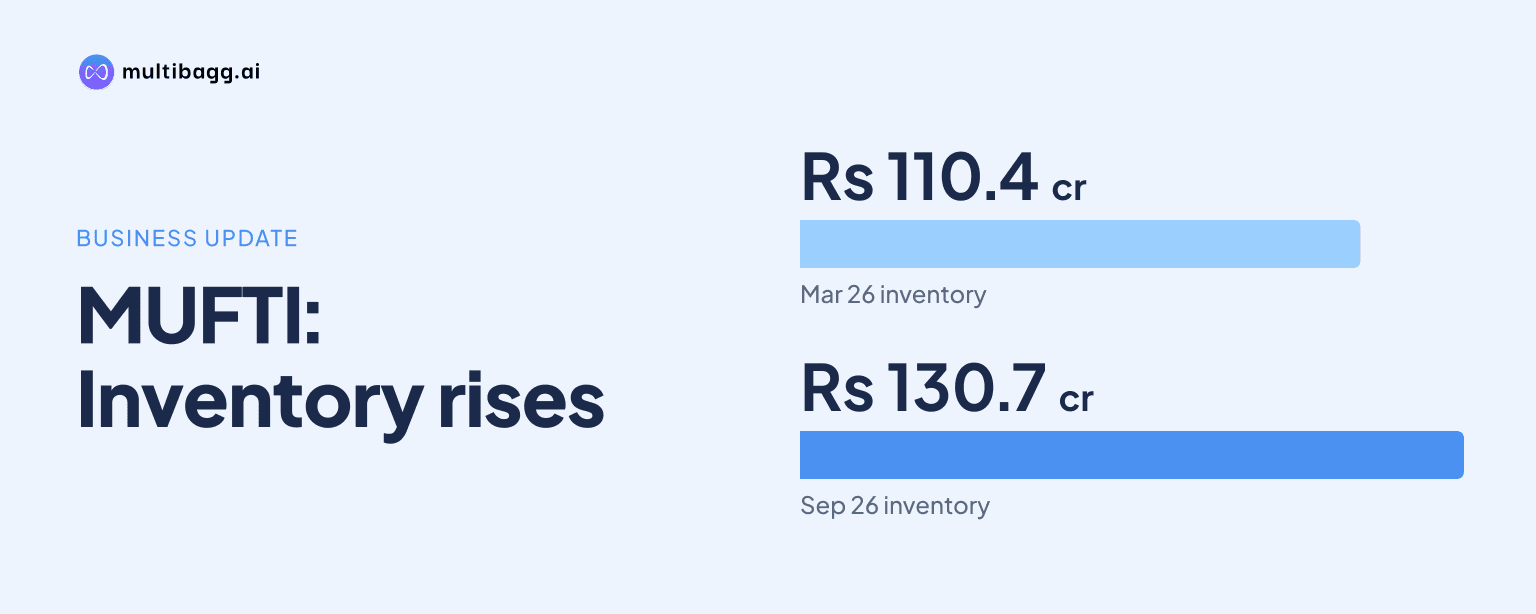
- Inventory rose to Rs 130.7 crore at Sep-26 from Rs 110.4 crore at Mar-26.
- Net cash from operating activities was Rs 4.2 crore in H1 FY27, versus Rs 32.4 crore in H1 FY26.
powered by IRIS
MUFTI is pursuing premiumisation through MUFTI 2.0 and a reinvented identity listed at 14 locations, while management says premium stores, experiential flagships and high-impact retail zones are intended to build long-term customer and brand value. The presentation identifies six expected benefits, including engagement, repeat visits and conversion rates.
Know Credo Brands Marketing inside out
Results, valuation, peers and who's buying, in one view.
What does MUFTI 2.0 involve?
MUFTI 2.0 is MUFTI's premium store and brand-identity proposition, presented as a way to “rekindle demand and unlock the next phase of growth.” The presentation describes premium design and elevated style alongside a new identity rooted in 28 years of authenticity. It does not disclose a separate revenue, margin, traffic or conversion metric for MUFTI 2.0.
MUFTI identifies six intended outcomes from premiumising the store experience: a better customer experience, higher customer engagement, stronger loyalty and repeat visits, increased conversion rates, stronger brand differentiation and support for an omnichannel strategy. These are management's stated objectives rather than reported operating results. The presentation also does not state the total store base, the number of stores converted, a conversion timetable or a numerical store-productivity target.
Why is MUFTI investing in premium store experiences?
MUFTI says it is strategically adding premium stores and investing in experiential flagship stores to create long-term value for customers and build brand value. Its identified retail zones are malls, high streets and airports, which the presentation characterises as high-impact locations. This approach places physical stores at the centre of the brand's premiumisation plan rather than presenting them simply as points of sale.
The 28-year authenticity statement links the redesigned identity to the brand's existing history while positioning it for what MUFTI calls India's premium evolution. The presentation does not provide changes in product pricing, product categories or customer demographics to accompany this positioning. It therefore establishes the intended customer proposition but not the commercial contribution of premium design or elevated style.
MUFTI also includes omnichannel support among the six benefits expected from the new store experience. This indicates that management sees stores as part of a wider customer journey, alongside their role as premium retail environments. However, the material provides no details on online fulfilment, store-based delivery, customer-data use or digital marketing processes at the 14 listed locations.
Where has MUFTI listed its reinvented brand identity?
MUFTI lists its reinvented brand identity at 14 sites across Hyderabad, Mangalore, Surat, Patna, Bengaluru, Nasik and Gorakhpur. The first seven locations are Himayat Nagar, Hyderabad; City Centre Mall, Mangalore; Parle Point, Surat; Saguna, Patna; Commercial Street, Bengaluru; City Center, Nasik; and College Road, Nasik. The two Nasik entries mean the 14-site list includes more than one location in the same city.
The remaining seven listed locations are Orion Mall, Gorakhpur; Hitawala Complex, Udaipur; Savedi Road, Ahmednagar; Borivali, Mumbai; Mall of Mysore, Mysore; Bhumi World FO Mall, Bhiwandi; and Kalawad Road, Rajkot. The mix includes malls, commercial streets, city-centre sites and local roads, consistent with MUFTI's stated focus on malls, high streets and airports. The presentation does not provide opening dates, store sizes, sales or store-level conversion outcomes for any of the 14 sites.
Got a follow-up? Ask IRIS
How does MUFTI's retail model support premium stores?
MUFTI management says it deliberately retains inventory risk in its channel-partner model. According to the presentation, MUFTI takes back unsold stock at the end of a season and liquidates it profitably, while maintaining fresh merchandise at retail touchpoints. Management says it has had no material write-offs in its history, but the presentation does not quantify inventory liquidation proceeds or markdown rates.
Management says franchisee stock is backed by security deposits, while multi-brand outlet, distributor and large-format-store relationships have operated for years without material bad-debt losses. MUFTI describes its channels as including multi-brand outlets, large-format stores and exclusive-brand-outlet formats comprising FOFO, COCO and margin models. FOFO means franchisee-owned, franchisee-operated, while COCO means company-owned, company-operated; the presentation does not provide revenue or store counts by channel.
MUFTI says it intentionally maintains low payable days by paying suppliers promptly, often in cash, to seek better prices, priority production slots and timely deliveries. Management presents this as a mechanism for product availability and consistent quality. The source does not disclose supplier-payment days, purchase-price savings or production capacity associated with this approach.
What financial context does the presentation provide?
MUFTI's inventory and trade receivables both increased between Mar-26 and Sep-26, providing context for management's description of a working-capital-intensive retail model. Inventory rose by Rs 20.3 crore to Rs 130.7 crore, while trade receivables increased by Rs 48.9 crore to Rs 285.2 crore. Cash and cash equivalents on the balance sheet declined to Rs 12.8 crore from Rs 52.4 crore over the same period.
MUFTI reported net cash from operating activities of Rs 4.2 crore in H1 FY27, compared with Rs 32.4 crore in H1 FY26. The cash-flow statement records a Rs 71.9 crore change in working capital in H1 FY27, against Rs 33.7 crore in H1 FY26, while profit before tax increased to Rs 39.8 crore from Rs 33.5 crore. These figures do not isolate spending or cash generation associated with premium stores or the 14 listed identity locations.
Conclusion
MUFTI's presentation sets out a premiumisation strategy based on MUFTI 2.0, experiential flagship stores and a reinvented identity at 14 listed locations. Management links the initiative to six intended customer and channel outcomes, while its retained-inventory-risk model, secured franchisee stock and prompt supplier payments are presented as mechanisms supporting fresh merchandise and multi-channel retail operations.
What to watch next is whether MUFTI discloses further locations, a store-conversion schedule or measured outcomes in engagement, repeat visits and conversion rates. The presentation does not set a completion target for the format programme, disclose store-level productivity, or quantify the amount of the Rs 71.9 crore H1 FY27 working-capital movement attributable to premium-store activity.