










Mufti has 57 premium-format stores after Q2 renovations
Key highlights
- Mufti said 57 stores carried the Mufti 2.0 identity as of November 4, 2026.
- Mufti said 14 stores were opened under the New Mufti 2.0 identity in Q2 FY27, including 12 renovated stores.
- Mufti reported Q2 FY27 revenue of Rs 189.3 crore, up 16% year on year.
- Exclusive brand outlets contributed 53% of H1 FY27 sales mix, and Mufti had 419 EBOs on September 30, 2026.
powered by IRIS
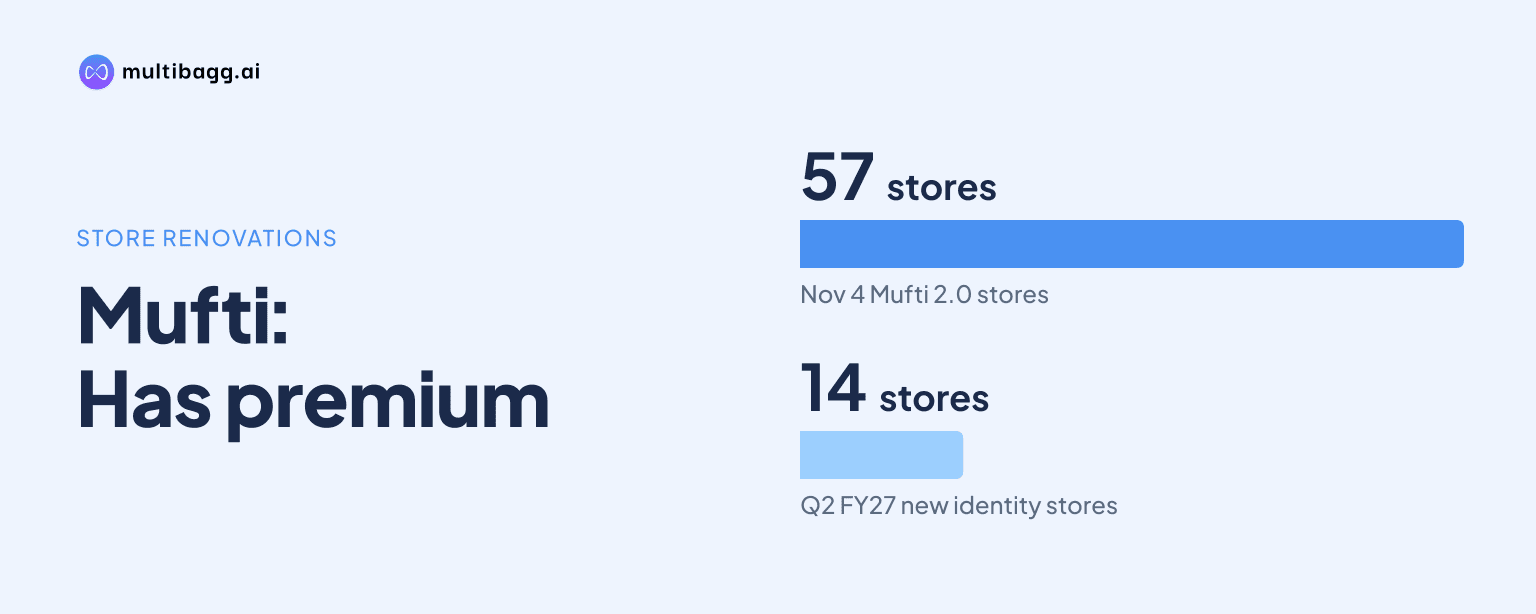
Credo Brands Marketing Limited said Mufti had 57 stores under its Mufti 2.0 premium identity as of November 4, 2026, following 14 Q2 FY27 stores opened under the format, including 12 renovated stores. Management said the multi-year programme is focused on retail productivity rather than expanding store count alone.
Know Credo Brands Marketing inside out
Results, valuation, peers and who's buying, in one view.
How far has Mufti 2.0 reached?
Mufti 2.0 had reached 57 stores as of November 4, 2026. During Q2 FY27, Mufti said it opened 14 stores under the New Mufti 2.0 identity, including 12 renovated stores. Management described the format as an elevated customer experience based on store design, merchandise curation and service.
The 57-store figure sits within Mufti's network of 419 exclusive brand outlets, or EBOs, as of September 30, 2026. The two figures are reported at different dates, and the release does not disclose sales, conversion rates or throughput separately for the Mufti 2.0 stores. It said new-format premium stores in strategic locations received encouraging customer response.
Management said Mufti 2.0 is a multi-year journey rather than a programme with a disclosed store-count target or completion date. Its stated approach includes selective store rationalisation and expansion into premium retail destinations, with the intended medium- to long-term outcome being higher throughput per store.
What changed in Mufti's store strategy during Q2 FY27?
Mufti said its store strategy prioritises productivity over pure store-count expansion. The 14 Q2 FY27 stores opened under the new identity, including 12 renovated stores, show that the rollout uses renovations alongside openings. Management said the format is becoming the template for how the brand should look and feel across the network.
Management cited positive same-store sales growth, or SSSG, in H1 FY27 and called Q2 FY27 the third consecutive quarter of positive SSSG. The release does not disclose the SSSG percentage or quantify the sales contribution of renovated stores. It therefore supports a directional improvement in comparable-store sales, rather than a calculation of Mufti 2.0 productivity.
Mufti linked the premiumisation programme to sharper merchandise, richer product mix and better price realisations. Management said average selling prices were rising and that shirts, T-shirts and bottom wear all showed healthy sales improvement. In H1 FY27, shirts accounted for 42% of product mix and bottom wear for 43%, making them the two largest disclosed categories.
How did Mufti perform financially in Q2 FY27?
Mufti reported Q2 FY27 revenue of Rs 189.3 crore, up 16% from Rs 163.7 crore in Q2 FY26, while profit after tax rose 45% to Rs 27.3 crore. Management called Rs 189.3 crore its highest-ever quarterly revenue and said H1 FY27 growth was supported by positive SSSG.
Gross margin increased 150 basis points to 58.6% in Q2 FY27 from 57.1% a year earlier. Earnings before interest, tax, depreciation and amortisation, or EBITDA, increased 24% to Rs 59.5 crore, and EBITDA margin rose 200 basis points to 31.4% from 29.4%.
For H1 FY27, revenue increased 11% to Rs 314.6 crore from Rs 283.6 crore, while gross profit rose 12% to Rs 188.2 crore. EBITDA grew 9% to Rs 86.1 crore, but EBITDA margin declined 50 basis points to 27.4% from 27.9%; this differed from the 200-basis-point Q2 margin expansion. Management attributed the H1 gross-margin increase of 80 basis points to 59.8% to richer product mix and better price realisations.
Got a follow-up? Ask IRIS
Which channels and products matter to Mufti 2.0?
Mufti's EBO channel accounted for 53% of H1 FY27 sales mix, making it the largest disclosed channel and central to the store-format programme. Multi-brand outlets, or MBOs, represented 29% of sales, online channels 12%, large-format stores, or LFS, 4%, and other channels 2%.
The 419 EBOs reported on September 30, 2026 operate alongside MBOs, LFS and online channels in Mufti's multichannel distribution network. Mufti said its omnichannel strategy connects online discovery with offline conversion and vice versa. The release does not disclose whether the 57 Mufti 2.0 stores deliver a different sales mix or performance from the rest of the EBO base.
Bottom wear and shirts together made up 85% of H1 FY27 product mix, with bottom wear at 43% and shirts at 42%. T-shirts accounted for 12%, outerwear 1% and other products 2%. Management said better fabrics, improved fits and finishes, and sharper designs are part of the merchandise upgrade being paired with the revised store experience.
What else is Mufti investing in alongside store upgrades?
Mufti spent 6.7% of H1 FY27 revenue on marketing and advertising while investing in digital activity through Google and Meta. Management cited the Prateik x Mufti, Flow Linen and Havana campaigns as brand-building efforts and described the early effects of increased branding expenditure as green shoots rather than a quantified outcome.
The company said its digital programme covers content-led consumer engagement, digital storytelling and performance marketing. These initiatives are intended to link online and offline consumer engagement, alongside the 57-store Mufti 2.0 rollout. The release gives no marketing-spend target, campaign budget or timetable beyond describing Mufti 2.0 as a multi-year journey.
Mufti reported working-capital days of 217 as of September 30, 2026, return on capital employed of 14.6%, and return on equity of 11.9% for H1 FY27. Management also said the company had a debt-free balance sheet. The release does not allocate expenditure between store renovations, new stores, merchandise changes and digital marketing.
Conclusion
Mufti's 57-store Mufti 2.0 base shows that its premiumisation strategy is being implemented through both openings and renovations, with 12 of the 14 Q2 FY27 stores opened under the identity involving renovations. The programme coincided with 16% Q2 revenue growth to Rs 189.3 crore, a 150-basis-point increase in gross margin, and management's statement of three consecutive quarters of positive SSSG.
The next disclosure to watch is how Mufti extends the 57-store format while maintaining its stated productivity focus, since management has not provided a store-count target or completion date. Updates on SSSG, the performance of renovated stores and the relationship between premiumisation and the 53% EBO sales mix would help track the multi-year plan.