










MUFTI Plans 8-10% FY27 Revenue Spend on Brand Building
Key highlights
- MUFTI spent 6.7% of revenue on brand-building in H1 FY27 and plans about 8-10% for FY27.
- MUFTI reported about 2% year-on-year growth in sales from its own website in H1 FY27.
- MUFTI had 1,785 touchpoints, including 419 EBOs, as of September 30, 2026.
- MUFTI reported more than 2.5 million customers in its Muftisphere database.
powered by IRIS
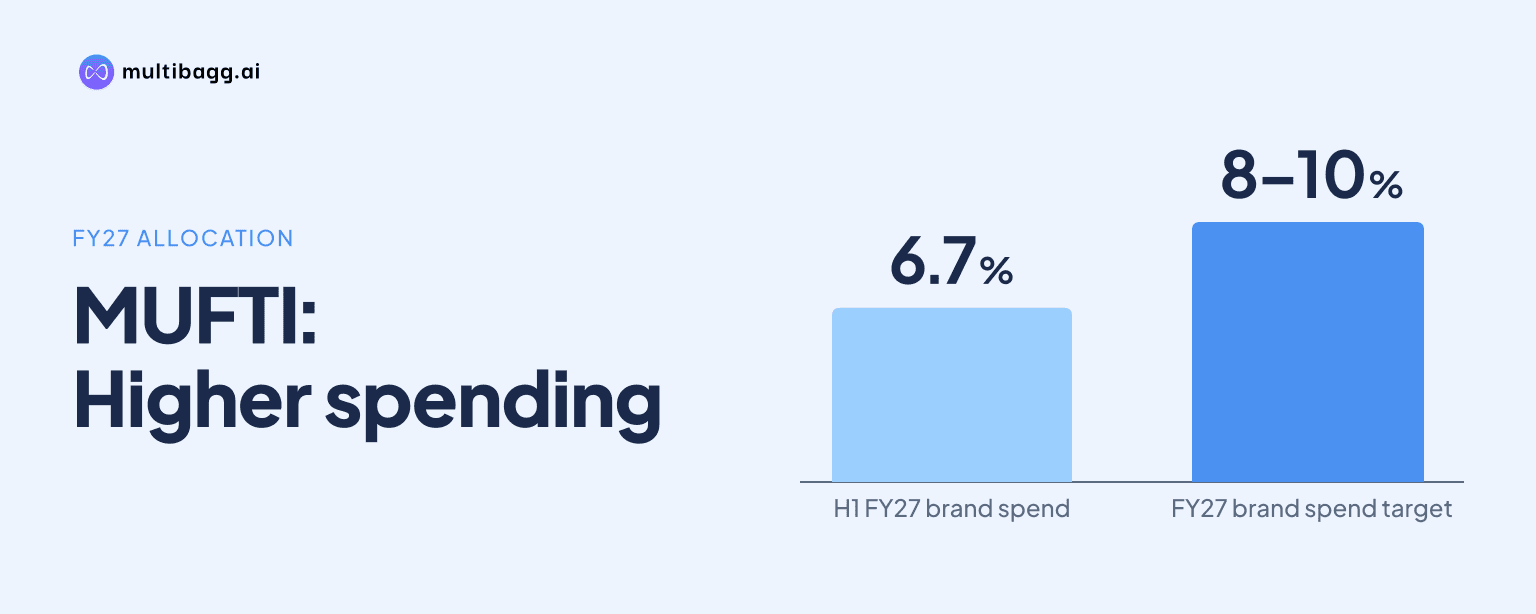
MUFTI plans to spend about 8-10% of FY27 revenue on brand-building, compared with 6.7% in H1 FY27, as it expands its direct-to-consumer, or D2C, focus through Google and Meta. MUFTI says sales from its own website grew about 2% year on year in H1 FY27, while higher advertising costs may affect profitability.
Know Credo Brands Marketing inside out
Results, valuation, peers and who's buying, in one view.
Why is MUFTI raising brand-building expenditure in FY27?
MUFTI is raising brand-building expenditure to support its D2C focus and increase digital visibility through Google and Meta. The company says these platforms can meet customers amid shifting consumer behaviour, attract new customers, drive traffic and improve conversion rates. Its planned FY27 range of about 8-10% of revenue is above the 6.7% share reported for H1 FY27.
The plan represents a rise of 1.3 to 3.3 percentage points against the H1 FY27 revenue share, although MUFTI does not disclose a rupee marketing budget, FY27 revenue forecast or quarterly spending schedule. Management states that the approach may increase advertising and marketing costs and affect profitability. The disclosed trade-off is therefore greater digital reach against a possible effect on earnings.
How will MUFTI use Google and Meta for D2C?
MUFTI plans to use Google and Meta for high-visibility digital touchpoints and campaigns targeted by location, demographics, interests and behaviour. The company says this targeting can improve brand relevance and return on investment, particularly among younger, digitally native customers. It provides no platform-specific budgets, customer-acquisition costs, click-through rates or conversion targets for FY27.
The digital effort is intended to complement MUFTI’s offline channels rather than replace them. As of September 30, 2026, MUFTI had 1,785 touchpoints, including 419 exclusive brand outlets, or EBOs, in 227 towns and cities, and it reported presence in 563 cities in India. Management says digital discovery can lead to offline conversion, while offline discovery can also lead to online conversion.
MUFTI’s channel mix also includes multi-brand outlets, or MBOs, large-format stores, or LFS, and EBO formats such as franchisee-owned franchisee-operated, company-owned company-operated and margin models. The presentation does not provide an online-versus-offline revenue split or a target share of sales for D2C. Its stated mechanism is an omnichannel connection between digital visibility and its physical network.
What does MUFTI’s own-website growth show?
MUFTI says sales from its own website grew about 2% in H1 FY27 compared with the same period last year. This is the only own-website growth measure disclosed in the presentation, and it shows year-on-year progress while the company increases its brand-building allocation. MUFTI does not specify whether the measure is based on gross merchandise value, net sales, orders or customers.
The 2% figure does not establish the size of MUFTI’s website business because the presentation gives no absolute website-sales value, prior-year sales base, online margin or proportion of total revenue. MUFTI does report a database of more than 2.5 million customers on Muftisphere. That customer base sits alongside the company’s stated effort to expand digital visibility and traffic.
MUFTI also uses online channels in its merchandise lifecycle. Fresh stock is supplied to EBOs, MBOs and LFS partners, followed by full-price sales and end-of-season sale, or EOSS, activity; merchandise unsold after that is returned to MUFTI. The company says returned offline inventory is sold profitably through online channels and factory outlets, and it reports no material inventory write-offs in its history.
Got a follow-up? Ask IRIS
How could the FY27 marketing plan affect profitability?
MUFTI says its Google- and Meta-led approach may increase advertising and marketing costs and affect profitability. The disclosed comparison is between brand-building expenditure of 6.7% of revenue in H1 FY27 and a plan of about 8-10% for FY27. MUFTI does not quantify the expected profit effect or provide an earnings before interest, taxes, depreciation and amortisation, or EBITDA, target.
Management places the expenditure within a model designed to keep merchandise fresh across retail touchpoints. MUFTI says it takes back unsold stock from channel partners at season-end and liquidates it profitably, while its merchandise-lifecycle slide says higher inventory is compensated by better EBITDA margins. No EBITDA margin percentage, period comparison or projection is provided for FY27.
The presentation also identifies a supply base of 50 fabric and accessories suppliers and more than 50 manufacturing partners. MUFTI says its average relationship with manufacturing partners exceeds 10 years and that manufacturing is outsourced. These arrangements are presented as supporting prompt product introduction, not as a quantified protection against higher FY27 marketing costs.
Which campaigns support MUFTI’s brand-building activity?
MUFTI identifies recent campaigns including Prateik x MUFTI, Popa and Corduroy, alongside Slow Summer 2026, Slow Living, The Detour and the Loose Jean Summer Series. The campaign set includes collaboration-led, product-led and seasonal creative messages. MUFTI does not disclose spending, reach, sales or conversion outcomes for any individual campaign.
The Corduroy campaign describes a shirt as “The Lightest Corduroy Shirt in the World” and qualifies that statement with “based on how we feel.” This is advertising copy rather than a product-performance metric. MUFTI also lists lounge wear, daily casuals, party wear and holiday casuals in its merchandise architecture, but provides no FY27 revenue target for those categories.
Conclusion
MUFTI’s FY27 plan combines a larger revenue-linked brand-building allocation, Google- and Meta-led digital activity, and an omnichannel network of 1,785 touchpoints. The company reported about 2% growth in own-website sales in H1 FY27, but has not disclosed the website’s revenue contribution or a digital-sales target. Its presentation explicitly identifies advertising costs and profitability as the central financial trade-off.
The next items to watch are whether MUFTI spends within its stated 8-10% FY27 range and provides updated own-website growth figures. Management has not quantified the profitability effect, digital conversion rate or channel-level sales mix, leaving those measures unresolved as the D2C plan progresses.