










Crizac targets 25%-26% EBITDA margin amid AI hiring costs
Key highlights
- Crizac targets a steady-state EBITDA margin of 25% to 26%.
- Q2 FY '27 operating EBITDA was Rs 33 crore, down 44% year on year, with margin at 32%.
- A Rs 57 crore termination fee paid in FY '26 will not recur in FY '27.
- Crizac said salary cost should be about 3% to 4% of sales over the medium to long term.
powered by IRIS
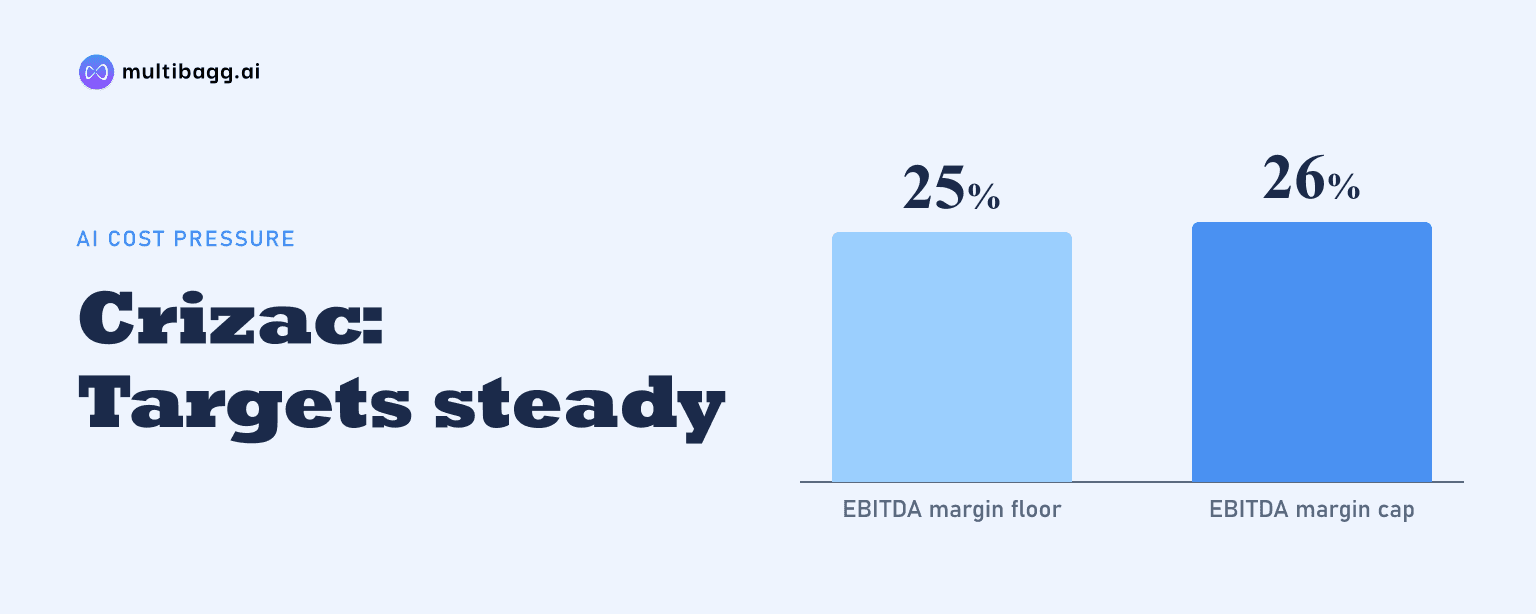
Crizac Limited said on its FY '27 earnings call that it expects a steady-state EBITDA margin of 25% to 26%, as investment in artificial intelligence, technology and staffing may absorb savings from a Rs 57 crore termination fee that will not recur. Management expects FY '27 revenue and profit to remain in line with FY '26.
Know Crizac inside out
Results, valuation, peers and who's buying, in one view.
Why is Crizac targeting a 25%-26% EBITDA margin?
Crizac is targeting an EBITDA margin of 25% to 26%, according to Manish Agarwal's response to an investor question about steady-state profitability. The target follows a Q2 FY '27 operating EBITDA margin of 32%, below 36.3% in Q2 FY '26, and an H1 FY '27 margin of 30.6% on operating EBITDA of Rs 93 crore.
The absence of a prior expense is not expected to flow directly into profit. An analyst noted that Crizac paid Rs 57 crore in termination fees in FY '26, compared with Rs 21.5 crore in FY '25. Management confirmed that the Rs 57 crore charge was one-time, had been paid and closed, and would not recur in FY '27.
Management nevertheless said higher expenditure could absorb much of that benefit. When asked whether flat revenue could make EBITDA higher by Rs 57 crore, Manish Agarwal said the premise was valid but pointed to heavy investment in AI, technology and manpower. He said Crizac's guidance and assumption remained that both revenue and profit in FY '27 would be in line with FY '26.
What changed in Crizac's Q2 and H1 FY '27 margins?
Crizac's Q2 FY '27 EBITDA margin fell 418 basis points year on year to 32%, mainly because operating income declined while its cost base rose for team building, technology investment and expansion. Operating EBITDA was Rs 33 crore in Q2 FY '27, down 44% from Rs 59 crore in Q2 FY '26. A basis point is one-hundredth of a percentage point.
The quarterly comparison also showed improvement from Q1 FY '27. Q2 EBITDA margin increased 233 basis points from 29.8% in Q1, which management attributed to a lower cost of service. That sequential recovery occurred although external disruption sharply affected Q2 revenue, with revenue recognition tied to university confirmation of student enrollment.
Profit after tax, or PAT, moved differently from operating EBITDA. Q2 FY '27 PAT was Rs 36.9 crore, down 23.7% year on year, while PAT margin was 33.2%. Management said the smaller decline versus EBITDA reflected Rs 8.5 crore of other income, lower depreciation of Rs 3.8 crore versus Rs 6.1 crore a year earlier, and a lower tax charge.
For H1 FY '27, Crizac reported PAT of Rs 84 crore, down 10.7%, with a PAT margin of 26.3% and earnings per share of Rs 4.8. The company said depreciation changed because it moved from the written-down-value method to the straight-line method from April 1, 2026, applied prospectively. That accounting-method change is separate from the operating-cost investments cited in the EBITDA outlook.
Got a follow-up? Ask IRIS
How is Crizac increasing spending on people and technology?
Crizac said salary cost should settle at about 3% to 4% of sales over the medium to long term, after employee cost rose from 1% of sales in FY '24 to 2% in FY '25 and 3% in FY '26. An analyst said the ratio was close to 7% in the most recent quarter, and management said lower revenue magnified costs that are more or less fixed in nature.
Management identified two reasons for the higher employee base: staff added through acquisitions and recruitment of technology personnel for the AI initiative. The workforce expansion is therefore part of the cost structure behind the 25%-26% EBITDA-margin target rather than a temporary quarterly item. Crizac did not provide a separate rupee figure for incremental hiring costs on the call.
Technology investment includes an in-house commitment made in March 2026 to develop EduMentor, an AI-led student-university matching and mentorship platform. Crizac said its technology platform processes more than 2 lakh applications from 92 countries and had a rolling 12-month student-enrollment rate of 12.8%, making technology central to its operating model.
The company also linked investment to its broader network. Crizac works with more than 600 institutions and more than 18,500 counselling partners, of which 4,942 were active in H1. Management said these relationships, alongside technology and compliance capabilities, support the platform as visa and immigration policies become more restrictive in several destination markets.
Can flat FY '27 revenue support Crizac's margin plan?
Crizac said FY '27 revenue and profit should be in line with FY '26 despite the Q2 disruption, because it expects Q3 FY '27 revenue to grow 10% to 12% over Q3 FY '26. Management said students behind this expected Q3 revenue largely had admissions and visas in place, while a large share of applications for Q4 had already been received and was being processed.
The timing of enrollment is central to that outlook. Crizac recognizes revenue only after a university confirms enrollment, typically 45 to 90 days after a course begins. Management said Q2 revenue mainly reflected applications processed in Q1 and earlier, the period most affected by disruption, while work completed in Q2 should be recognized in Q3.
The seasonal revenue mix also matters for fixed employee costs and the margin trajectory. Management said H1 normally accounts for 30% to 35% of annual revenue and H2 for 65% to 70%, both in revenue and student recruitment. It expects deferred students to support Q3 and Q4, but that expectation depends on applications, deposits and visas converting into enrollment.
Cash generation gives Crizac capacity to maintain its investment programme while considering acquisitions. The company reported free cash of Rs 595.8 crore at September 30, 2026, up from Rs 469.3 crore in March 2026, and H1 operating cash flow of Rs 126.9 crore, equal to 136% of operating EBITDA. Management cautioned that part of this cash conversion reflected favourable working-capital timing and should normalize over the year.
Conclusion
Crizac's 25%-26% EBITDA-margin target indicates that management does not expect the end of the Rs 57 crore termination fee to create a comparable uplift in reported profitability. Instead, management expects investment in AI, technology capability and workforce additions to offset that saving while it maintains guidance for FY '27 revenue and profit to match FY '26. The Q2 margin of 32% and H1 margin of 30.6% show the effect of intake timing and the enlarged cost base.
The next markers are Q3 FY '27 revenue growth of 10% to 12% year on year and the conversion of Q4 applications into enrolled students. Investors can also watch whether salary cost moves toward management's 3% to 4% medium- to long-term range, whether destinations outside the UK convert their 9.5% share of H1 applications into more than the current 1.4% share of revenue, and whether Crizac completes an acquisition under its stated synergy and value criteria.