










Crizac lifts UK visa share to 6% as overall market contracts
Key highlights
- Crizac’s UK sponsored study-visa share rose to 6.0% in FY26 from 3.5% in FY24.
- Crizac’s UK student count increased 53% to 23,576 between FY24 and FY26, while total UK study visas fell 12% to 391,572.
- Crizac’s ex-India student count rose 124% to 11,050 between FY24 and FY26, lifting its segment share from 1.5% to 3.7%.
- H1 FY27 operating income fell 18.3% to Rs 303.9 crore and operating EBITDA declined 24.9% to Rs 93 crore.Ï
powered by IRIS
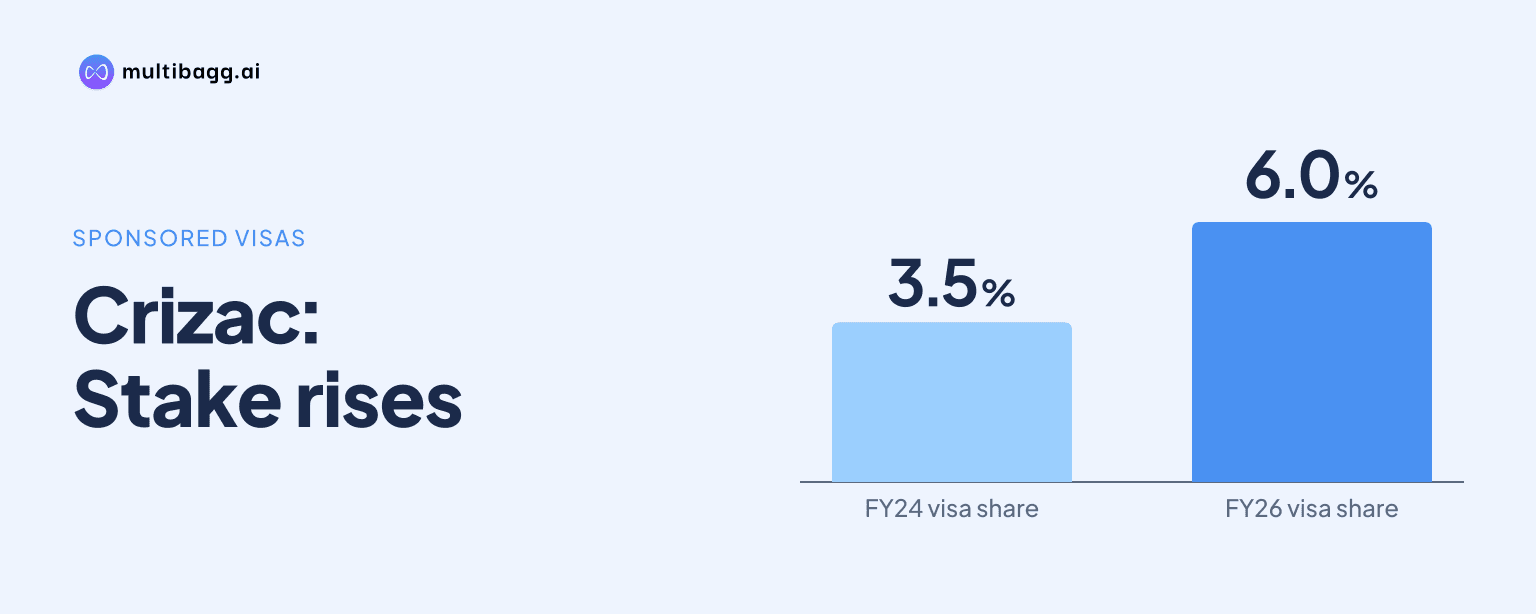
Crizac raised its share of UK sponsored study visas for main applicants to 6.0% in FY26 from 3.5% in FY24. Its UK student count increased 53% to 23,576, while total UK study visas fell 12% to 391,572 over the same April-to-March financial-year comparison.
Know Crizac inside out
Results, valuation, peers and who's buying, in one view.
How did Crizac reach 6% of UK study visas?
Crizac reached a 6.0% share by increasing its UK student count in each of the three reported financial years while the total visa market declined. Its student count rose from 15,441 in FY24 to 19,514 in FY25 and 23,576 in FY26. UK sponsored study visas granted to main applicants, excluding dependants, fell from 446,029 in FY24 to 403,257 in FY25 and 391,572 in FY26.
Crizac calculates its share as its student count divided by UK study visas granted. Between FY24 and FY26, it added 8,135 students while the total market declined by 54,457 visas. The presentation describes these movements as 53% growth in Crizac students against a 12% fall in UK study visas.
These figures use a financial year running from April to March, with FY26 covering April 2025 to March 2026. Crizac separately presents calendar-year UK visa figures for 2025, so that series is not directly comparable with its FY24-to-FY26 market-share calculation.
Did Crizac gain share among Indian and non-Indian students?
Crizac gained share in both Indian and ex-India UK student visa segments, although India remained the larger source of its UK students. Its Indian student count rose from 10,506 in FY24 to 12,526 in FY26, and its share of Indian UK study visas increased to 13.9% from 9.0%. Total Indian study visas granted declined from 116,215 to 90,425 over the same period.
The ex-India segment delivered the faster increase in Crizac student numbers. Crizac’s ex-India student total increased from 4,935 in FY24 to 7,964 in FY25 and 11,050 in FY26, while ex-India visas fell from 329,814 to 301,147. Its calculated share in this segment rose from 1.5% to 2.6% and then 3.7%.
Crizac reported that India represented 55.3% of H1 FY27 applications by source country, compared with 25.5% for Asia excluding India and 18.7% for Africa. It also reported operations across more than 90 source countries, but its UK visa-share disclosure does not identify individual ex-India countries or explain the causes of their higher student volumes.
Got a follow-up? Ask IRIS
What pressures remain in the UK student market?
Crizac continues to operate amid UK immigration, university-finance and recruitment-compliance pressures. Its calendar-year data shows UK study visas issued increased 3% to 407,787 in 2025 from 397,033 in 2024, while UK net migration fell to 171,000 in 2025 from a 2022 peak of 891,000. This calendar-year visa movement is separate from the financial-year market-share data.
University finances are relevant because universities are Crizac’s institutional partners. The presentation cites 35.8% of English higher-education providers reporting deficits in 2024-25 and 42.7% forecast to report deficits in 2025-26. Under its flat-student-numbers scenario, the share could reach 58.0% by 2028-29, while its downside scenario places it at 70.0%.
Crizac says tightening rules increase the importance of structured recruitment and compliance processes. Its platform includes application screening, document verification, compliance and quality checks, automated workflows and real-time application updates. The company also cites the UK Agent Quality Framework and BCA compliance as raising oversight requirements, but it provides no quantified forecast of their effect on revenue or student enrolments.
How exposed is Crizac to the UK despite its share gain?
Crizac remains highly concentrated in the UK, which accounted for 98.6% of H1 FY27 revenue and 90.5% of applications by destination. Ireland accounted for 2.8% of applications but 0.6% of revenue, while New Zealand accounted for 2.5% of applications and 0.3% of revenue. The UK was therefore the company’s stated key destination market during H1 FY27.
H1 FY27 operating income was Rs 303.9 crore, down 18.3% from Rs 371.8 crore in H1 FY26. Operating earnings before interest, tax, depreciation and amortisation were Rs 93 crore, down 24.9% from Rs 123.9 crore, and the operating margin declined to 30.6% from 33.3%. The supplied figures do not attribute these changes solely to UK visa conditions.
Revenue timing can also separate reported financial performance from application or visa activity. Crizac says it receives remuneration upon successful enrolment and recognises revenue upon enrolment confirmation, typically 45 to 90 days after course commencement. Quarterly operating income was Rs 201.2 crore in Q1 FY27 and Rs 102.7 crore in Q2 FY27, compared with Rs 209.5 crore and Rs 162.3 crore, respectively, in FY26.
Conclusion
Crizac’s FY24-to-FY26 disclosures show rising penetration across the UK market, Indian students and ex-India students, even as visa volumes in all three categories declined. The gains occurred alongside substantial destination concentration: the UK generated 98.6% of H1 FY27 revenue, while operating income and operating earnings before interest, tax, depreciation and amortisation were lower year on year.
The next issue is whether Crizac can sustain student growth as UK university finances and compliance requirements remain unresolved. Management’s disclosed response includes a five-year EduMentor roadmap using artificial intelligence and machine learning for mentor onboarding, credentialing and student matching, while enrolment-linked revenue recognition 45 to 90 days after course commencement remains relevant to quarterly results.