










mastertrust digital brokerage share fell to 52% in Q2 FY27
Key highlights
- mastertrust reported a 52% digital brokerage revenue share in Q2 FY27, versus 60% in Q2 FY26.
- mastertrust recorded 6.08 million digitally executed orders and 27,759 monthly active digital users in Q2 FY27.
- mastertrust's seven platforms span trading, analytics, mutual-fund investing and customer servicing.
- mastertrust reported 7,451 singlepoint transactions and 18,362 active SIPs in Q2 FY27.
powered by IRIS
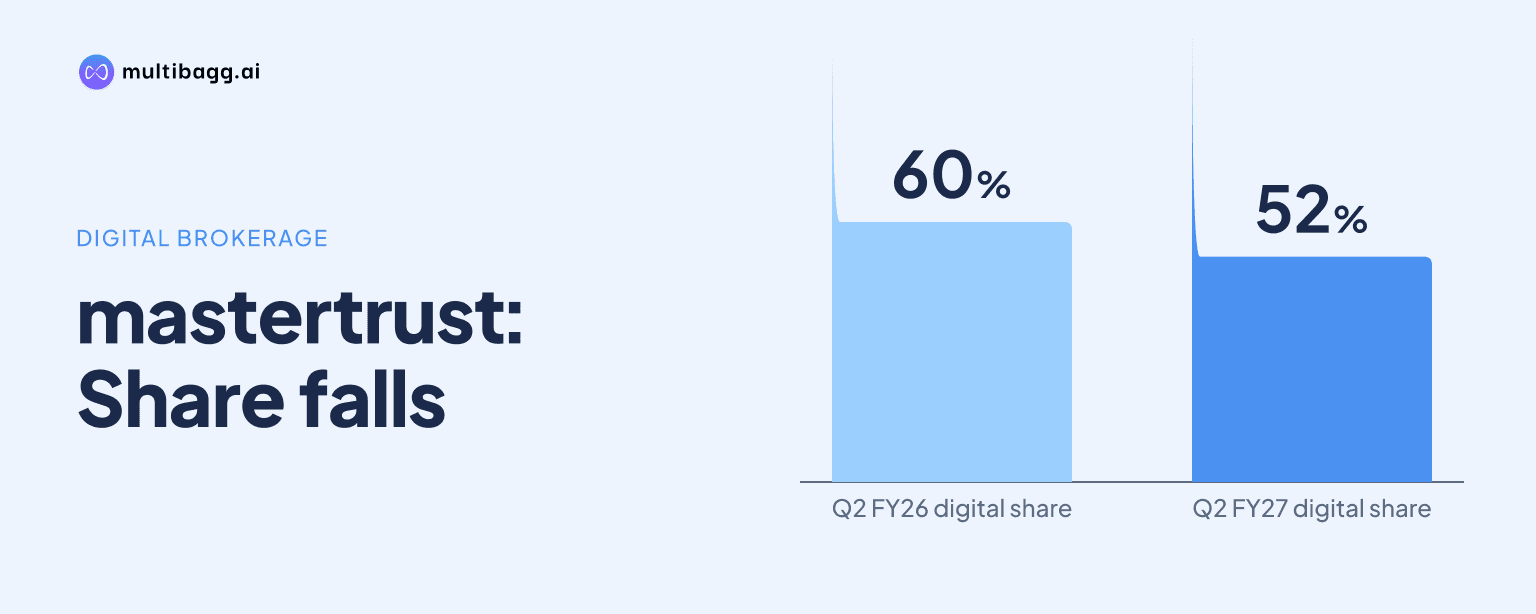
mastertrust reported a 52% brokerage revenue share in its digital-adoption disclosure for Q2 FY27, down from 60% in Q2 FY26, while recording 6.08 million digitally executed orders across seven platforms. The quarter also included 27,759 monthly active digital users and a reported 4.6 rating.
Know Master Trust inside out
Results, valuation, peers and who's buying, in one view.
Why did mastertrust's digital brokerage revenue share fall to 52%?
mastertrust reported a 52% brokerage revenue share in Q2 FY27, 8 percentage points below Q2 FY26's 60% and 4 percentage points below Q1 FY27's 56%. The measure rose to 62% in Q3 FY26, then declined to 59% in Q4 FY26, 56% in Q1 FY27 and 52% in Q2 FY27.
The presentation does not disclose the reason for the decline or define the calculation of brokerage revenue share beyond its placement in the digital-adoption section. Therefore, the source does not establish whether the movement reflected customer activity, pricing, platform use, product mix or another factor. The 6.08 million digital orders reported in Q2 FY27 demonstrate digital activity, but do not explain the revenue-share change.
The wider revenue mix also shifted between the two Q2 periods. Brokerage and allied represented 24.82% of total revenue in Q2 FY26 and 22.87% in Q2 FY27, while principal strategies increased from 38.02% to 42.43%. These segment figures are separate from the digital-adoption metric, so mastertrust does not state that either movement caused the other.
How much digital activity did mastertrust report in Q2 FY27?
mastertrust reported 6.08 million digitally executed orders and 27,759 monthly active digital users in Q2 FY27. The presentation places those figures alongside seven digital platforms, the 52% brokerage revenue share and a 4.6 rating, with each metric marked as pertaining to Q2 FY27.
The two activity measures cover different things: orders count digital executions, while monthly active digital users indicate the reported active-user base. The presentation provides no earlier-period figures for digital orders or active users. It also does not disclose orders per user, revenue per order, the scale behind the 4.6 rating or how that rating was compiled.
mastertrust reported a wider operating network of more than 4.40 lakh registered customers, 63 branches and more than 1,550 business partners across 22 states and Union Territories in Q2 FY27. The company says its physical network complements digital platforms with relationship-based support, but does not disclose how many registered customers used an individual platform.
Which seven platforms make up mastertrust's digital ecosystem?
mastertrust lists Agnik, masterweb, masterswift 2.0, Rest API, mt Quant, mt wealth and singlepoint as its seven digital platforms. The company describes the combined offering as an ecosystem for customers to analyse, trade, invest, manage and service their accounts.
Agnik is a mobile application for retail investors and active traders, covering equities, futures and options, commodities, exchange-traded funds, initial public offerings and mutual funds. Its stated functions include option-chain and Trading View charts, multiple order types, portfolio tracking, margin trading facility, or MTF, and instant pledge. masterswift 2.0 is a desktop platform for active, futures-and-options and high-volume traders, with low-latency execution, strategy alerts, back testing, risk controls and audit trails.
masterweb provides browser-based multi-segment trading, with live quotes, market depth, real-time profit and loss, more than 100 chart indicators, option-chain features, MTF and online pledge. Rest API is aimed at developers, algorithmic traders and institutional users, offering programmatic order execution, real-time market-data connectivity and system integration. mastertrust describes the API as designed for scalable algorithmic workflows, without providing Q2 FY27 user, order or revenue data for it.
mt Quant supports historical strategy back testing, performance and risk evaluation, optimisation and comparison before deployment. The product can test multi-leg strategies of up to 24 legs and use Greeks or premium-based conditions, with Excel and HTML exports. The presentation does not disclose mt Quant adoption, order volume or revenue in Q2 FY27.
Got a follow-up? Ask IRIS
How do mastertrust's service and investment products support digital engagement?
mastertrust reported 7,451 singlepoint transactions and 18,362 active systematic investment plans, or SIPs, on mt wealth in Q2 FY27. singlepoint is a digital customer-service platform, while mt wealth is a paperless mutual-fund investment and SIP-management platform.
singlepoint enables customers to raise and track online service requests through a digital or paperless workflow. Its stated features include re-KYC, or know-your-customer, functionality for account reactivation or customer-detail updates. The 7,451 Q2 FY27 transactions quantify activity on the service platform, but mastertrust does not provide a comparison period or an average request-resolution time.
mt wealth supports SIP management, mutual-fund purchases and redemptions, and digital access to mutual-fund investments. The 18,362 active SIPs are recurring investment instructions rather than a disclosed count of users, assets or inflows. mastertrust does not report the value of these SIPs or the platform's revenue contribution for Q2 FY27.
What technology and operating plans does mastertrust disclose next?
mastertrust says it is exploring artificial-intelligence-led applications to improve productivity, customer engagement and decision-making speed. Its customer-facing initiatives include AI-assisted payout processing, research and insights, process automation, and voice bots for dormant-client reactivation and eKYC drop-off, which the presentation identifies as in development.
For its principal strategies division, mastertrust outlines a process involving research inputs, trading-idea identification, conversion into trading logic, automated back testing, strategy evaluation and human trader review. Management's stated objective is to reduce the time from research and idea generation to testing, enabling faster and broader strategy development. These are plans and objectives rather than reported Q2 FY27 outcomes.
The technology infrastructure includes two data centres and more than 12 National Stock Exchange co-location racks. The primary data centre is at Sify Rabale in Navi Mumbai, while the disaster-recovery site in Noida is more than 1,000 kilometres away in a different seismic zone. mastertrust also reports ISO 27001:2022 certification, daily application and database backups, weekly backup-integrity testing and regular disaster-recovery-site activation.
Conclusion
mastertrust's Q2 FY27 figures show that digital brokerage revenue share declined to 52% from 60% a year earlier, even as the company recorded 6.08 million digitally executed orders across seven platforms. At the company level, brokerage and allied's revenue mix fell from 24.82% to 22.87% between the two Q2 periods, while principal strategies rose from 38.02% to 42.43%.
The next disclosures to watch are comparable figures for digital orders, active users, singlepoint transactions and active SIPs, as the presentation provides only Q2 FY27 values for those measures. Management also identifies AI voice bots as in development and is exploring AI-led service and strategy workflows, alongside operation of its two-site data-centre architecture and more than 12 exchange co-location racks.