










Crizac Q2 operating income fell 36.7% as enrolments slipped
Key highlights
- Crizac’s Q2 FY27 operating income fell 36.7% year-on-year to Rs 102.7 crore.
- Q2 FY27 operating EBITDA declined 44.0% to Rs 33 crore, while the margin fell to 32.2%.
- Crizac processed more than 2 lakh applications through 4,942 active counselling partners in H1 FY27.
- Crizac recorded 6,499 enrolments from 92,108 unique applicants in H1 FY27, with a rolling 12-month enrolment rate of 12.8%.
powered by IRIS
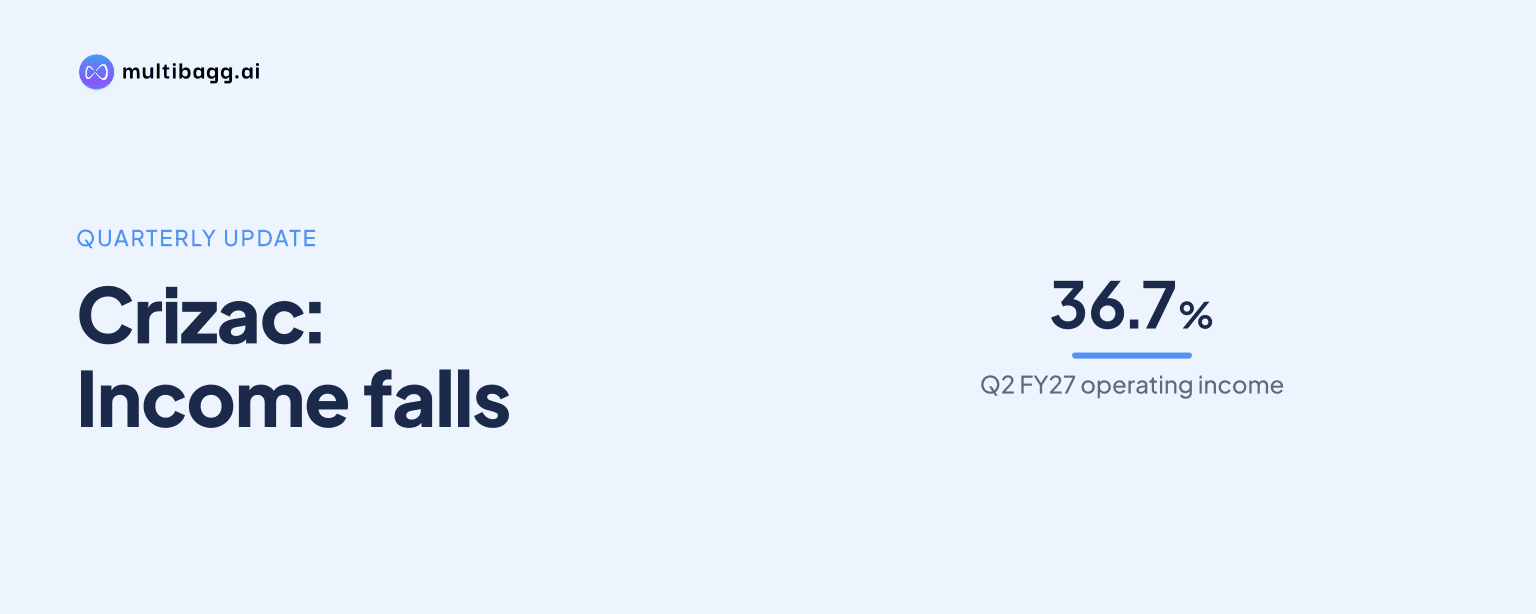
Crizac Limited reported Q2 FY27 operating income of Rs 102.7 crore, down 36.7% year-on-year, after travel disruption, flight cancellations and currency movements prompted mainly postgraduate students to defer overseas-study plans. Operating EBITDA, or operating earnings before interest, tax, depreciation and amortisation as defined by Crizac, fell 44.0% to Rs 33 crore.
Know Crizac inside out
Results, valuation, peers and who's buying, in one view.
Why did Crizac’s Q2 operating income fall?
Crizac’s Q2 FY27 operating income fell because international travel disruption and flight cancellations between February and June, together with currency movements in key source markets, caused students to postpone plans. Operating income was Rs 102.7 crore in Q2 FY27, compared with Rs 162.3 crore in Q2 FY26, a year-on-year decline of 36.7%.
Management said the deferrals were mainly among postgraduate students and described Q2 as an exception caused by external events rather than a change in underlying demand. Crizac said deferred students were already returning for upcoming Q3 intakes and that it expected this trend to continue into Q4 FY27.
Crizac’s revenue recognition process makes enrolment timing relevant to reported income. The company receives remuneration after successful student enrolment and recognises revenue upon enrolment confirmation, typically 45 to 90 days after course commencement.
The operating base recorded in H1 FY27 included more than 2 lakh applications processed through 4,942 active counselling partners. Active counselling partners are those that submitted applications during the period, according to Crizac’s definition.
How did Crizac’s Q2 and H1 FY27 profits change?
Crizac reported lower operating EBITDA, profit before tax and profit after tax in Q2 FY27 alongside the decline in operating income. Operating EBITDA fell 44.0% year-on-year to Rs 33 crore, while profit before tax fell 38.1% to Rs 40.1 crore and profit after tax attributable to owners fell 23.7% to Rs 36.9 crore.
The Q2 FY27 operating EBITDA margin was 32.2%, compared with a profit before tax margin of 36.1% and a profit after tax margin of 33.2%. Crizac reported earnings per share of Rs 2.11 for Q2 FY27.
For H1 FY27, Crizac reported operating income of Rs 303.9 crore, down 18.3% year-on-year, and operating EBITDA of Rs 93 crore, down 24.9%. H1 profit after tax was Rs 84 crore, down 10.7% year-on-year, with an operating EBITDA margin of 30.6%.
Management attributed the Q2 operating EBITDA decline to lower operating income and a higher cost base from team build-out, technology and expansion. The H1 FY27 profit after tax margin was 26.3%, below the Q2 FY27 margin of 33.2% as reported in the presentation.
How seasonal is Crizac’s operating income?
Crizac’s reported quarterly history shows higher operating income in the second half in FY25 and FY26. In FY26, operating income increased from Rs 209.5 crore in Q1 and Rs 162.3 crore in Q2 to Rs 278.6 crore in Q3 and Rs 391.7 crore in Q4.
Crizac identifies April to June as the summer intake period, with seasonally lower revenue contribution, and July to September as a minor intake period that transitions towards peak intakes. The autumn or fall intake occurs from October to December and is associated with stronger enrolment-linked revenue recognition.
The winter or spring intake, from January to March, is identified by Crizac as the peak revenue period and is supported by multiple intake cycles. This timing is the basis for management’s expectation that the second half of FY27 will be stronger than the first half.
Management’s commentary states that Q2 operating income declined sequentially from Rs 101.2 crore in Q1 FY27. That statement is inconsistent with both Q2 FY27 operating income of Rs 102.7 crore and the quarter-wise table, which reports Q1 FY27 operating income of Rs 201.2 crore.
Got a follow-up? Ask IRIS
What does Crizac expect for the second half of FY27?
Crizac expects H2 FY27 to be significantly stronger than H1 FY27 and to deliver growth over H2 FY26, according to management. The expectation is based on the application pipeline, the return of deferred students for upcoming intakes and the concentration of key intakes in the second half.
Management said Crizac was on track to maintain its FY26 performance in FY27, but this is a management expectation rather than a reported outcome. The company also said that its assessment of returning deferred demand applied to Q3 FY27 and was expected to continue into Q4 FY27.
Crizac had more than 600 partner universities and operated across 15 destination countries and more than 90 source countries in H1 FY27. It recorded 6,499 enrolments from 92,108 unique applicants, while its rolling 12-month student enrolment rate was 12.8%.
The top 10 university partners generated Rs 204.9 crore in H1 FY27, equal to 67.4% of revenue. Crizac also reported revenue per university partner of Rs 2.03 crore and revenue per active counselling partner of Rs 60 lakh for the six months ending September 2026.
How is Crizac responding to visa and market pressures?
Crizac is pursuing destination expansion, acquisitions and technology investment in response to constrained markets, according to management. Inova Consultancy Limited, acquired through Crizac’s wholly owned UK subsidiary, was consolidated in Q2 FY27.
Management said Inova strengthens UK and European university partnerships and marks Crizac’s entry into the Netherlands. The company’s timeline also records the July 2026 acquisition as expanding its presence in Mexico and the Netherlands.
Crizac said it began deploying technology investments in March 2026, including EduMentor, to make its platform AI-ready. Its platform connects students, counselling partners and universities, with applications processed through AI-powered machine-learning automation, according to the presentation.
Crizac also reported a rising share of UK study visas despite lower overall visa volumes. UK sponsored study visas granted to main applicants fell from 4,46,029 in FY24 to 3,91,572 in FY26, while Crizac students increased from 15,441 to 23,576 and its share rose from 3.5% to 6.0%.
For Indian students, UK study visas fell from 1,16,215 in FY24 to 90,425 in FY26, while Crizac students increased from 10,506 to 12,526. Crizac’s share of this segment increased from 9.0% to 13.9%, although management identified tighter visa and immigration policies as a recurring industry risk.
Conclusion
Crizac’s Q2 FY27 setback combined deferred enrolments with a higher cost base: operating income fell 36.7% to Rs 102.7 crore and operating EBITDA declined 44.0% to Rs 33 crore. The company’s H1 FY27 results also declined, but its historical quarterly pattern shows that Q3 and Q4 contributed more operating income than the first half in FY25 and FY26.
The next results to watch are Q3 and Q4 FY27 operating income, the conversion of deferred postgraduate demand into enrolments and management’s stated aim to maintain FY26 performance in FY27. Crizac also needs to clarify the inconsistency between management’s stated Q1 FY27 operating income of Rs 101.2 crore and the Rs 201.2 crore shown in its quarterly operating-income table.