










Crizac UK provided 98.6% of H1 FY27 revenue despite network
Key highlights
- Crizac generated 98.6% of H1 FY27 revenue from the UK, compared with 90.5% of applications.
- Crizac reported H1 FY27 operating income of Rs 303.9 crore, down 18.3% year over year.
- H1 FY27 Op EBITDA fell 24.9% to Rs 93 crore, while the margin declined to 30.6% from 33.3%.
- Crizac processed more than 200,000 applications and had 4,942 active counselling partners in the six months ended September 2026.
powered by IRIS
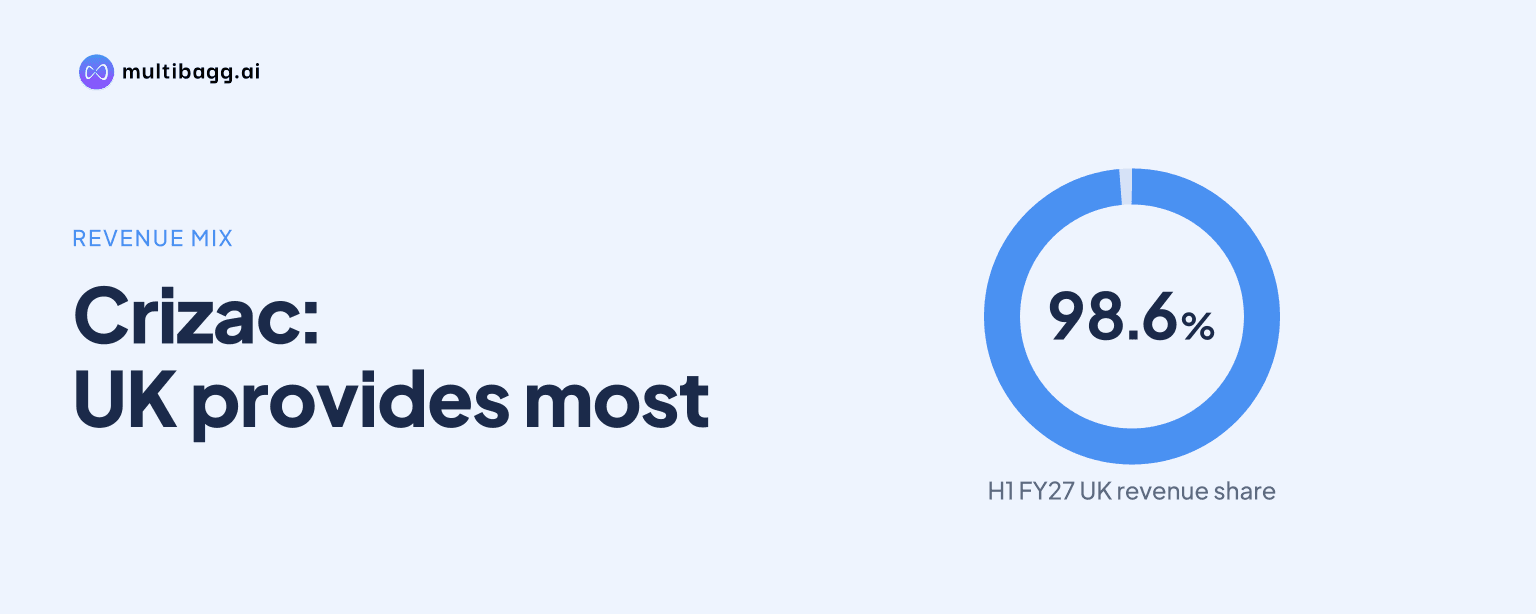
Crizac derived 98.6% of first-half (H1) FY27 revenue from the UK, despite listing 15 destination countries and more than 90 source countries. The UK represented 90.5% of applications, while operating income was Rs 303.9 crore in H1 FY27, showing that reported income remained more concentrated than application activity.
Know Crizac inside out
Results, valuation, peers and who's buying, in one view.
How concentrated was Crizac's H1 FY27 revenue?
Crizac's H1 FY27 revenue was concentrated in the UK, which supplied 98.6% of revenue against 90.5% of applications. The 8.1-percentage-point difference shows that the UK had a larger share of reported revenue than of application volume. Ireland, New Zealand and the UAE were the only other destinations separately identified in the revenue mix.
Crizac reported operating income of Rs 303.9 crore in H1 FY27, down 18.3% from Rs 371.8 crore in H1 FY26. Operating earnings before interest, tax, depreciation and amortisation, or Op EBITDA, declined 24.9% to Rs 93 crore, and the Op EBITDA margin moved to 30.6% from 33.3%. The presentation does not assign the decline to a country, but the UK revenue share means that destination remains central to the reported outcome.
Crizac recognises revenue upon confirmation of student enrolment, typically 45 to 90 days after course commencement. Its model pays remuneration after a successful enrolment and shares part of that revenue with the onboarding counselling partner, meaning the H1 FY27 country mix reflects confirmed enrolments rather than applications alone.
How extensive is Crizac's network beyond the UK?
Crizac listed 15 destination countries and operational presence in 15 countries, but its H1 FY27 revenue disclosure showed limited separately reported non-UK income. The destination list includes Canada, the USA, Australia, New Zealand, Ireland, Singapore, the UAE, Germany, France, Malta, the Netherlands, Spain, Turkey and Malaysia alongside the UK.
Crizac identified Ireland at 0.6% of H1 FY27 revenue, New Zealand at 0.3% and the UAE at 0.2%, with all other destinations combined at 0.3%. The presentation therefore does not provide country-level revenue for Canada, Australia or the USA, even though the USA accounted for 1.2% of applications and appears among the 15 destinations.
Student origin was less concentrated than destination revenue in H1 FY27: India represented 55.3%, Asia excluding India 25.5%, Africa 18.7% and other regions 0.4%. In the six months ended September 2026, Crizac also reported 150 revenue-generating global higher-education institutions, 4,942 active counselling partners and more than 200,000 applications processed. These measures indicate network activity, but do not quantify revenue earned in each non-UK destination.
Got a follow-up? Ask IRIS
How has Crizac performed in the UK visa market?
Crizac increased its calculated share of UK sponsored study visas between FY24 and FY26 as total visas declined. UK sponsored study visas granted to main applicants, excluding dependants, fell from 446,029 in FY24 to 391,572 in FY26, while Crizac students increased from 15,441 to 23,576. Crizac's share consequently rose from 3.5% to 6.0%.
Crizac also gained share among Indian students seeking UK visas. Indian visas granted declined from 116,215 in FY24 to 90,425 in FY26, while Crizac students rose from 10,506 to 12,526. Its share in this segment increased from 9.0% to 13.9% over the period.
Among students outside India, UK visas decreased from 329,814 in FY24 to 301,147 in FY26, while Crizac students increased from 4,935 to 11,050. Crizac's share of this ex-India segment rose from 1.5% to 3.7%. The figures document expansion within the UK market, but do not alter the 98.6% UK share of H1 FY27 revenue.
What disclosed factors could alter Crizac's geographic mix?
Crizac has a platform that can process applications across its 15 stated destinations, but the presentation sets no numerical target or timetable for reducing UK revenue concentration. Its proprietary technology platform connects more than 18,500 global counselling partners and institutions, while the active counselling-partner count was 4,942 in the six months ended September 2026.
Crizac reported 92,108 unique applicants, 6,499 enrolments and a 12.8% student enrolment rate measured on a rolling 12-month basis. Its process uses artificial-intelligence-powered machine-learning automation to process university applications, while counselling partners guide course selection and prepare applications. Revenue outside the UK would depend on applications proceeding to confirmed enrolments in destinations that currently account for only 1.4% of disclosed H1 FY27 revenue.
Partner concentration is also disclosed alongside geographic concentration. Crizac's top 10 university partners generated Rs 204.9 crore, or 67.4% of H1 FY27 revenue, and revenue per university partner was Rs 2.03 crore. The top 10 counselling partners accounted for 17.9% of cost of services, so shifts in destination mix may also depend on the distribution of institutional and counselling-partner activity.
Conclusion
Crizac's H1 FY27 disclosure combines a broad operating footprint with a narrowly concentrated revenue base. Its 15 destinations, more than 90 source countries and 150 revenue-generating institutions contrast with the UK's 98.6% revenue contribution, while its UK visa share rose from 3.5% in FY24 to 6.0% in FY26 despite lower total visa issuance.
The next measure to watch is whether revenue outside the UK moves beyond the 1.4% represented by Ireland, New Zealand, the UAE and the combined Others category in H1 FY27. Crizac has disclosed no diversification target or timetable, so future country-level application, enrolment and revenue disclosures will determine whether its 15-destination network changes the reported mix.