










Crizac non-UK applications reach 9.5%, revenue remains 1.4%
Key highlights
- Crizac said non-UK destinations accounted for 9.5% of H1 FY ’27 applications, up from 4.7% in H1 FY ’26.
- Non-UK destinations contributed only 1.4% of Crizac revenue in H1 FY ’27.
- Crizac expects New Zealand’s February intake to begin contributing to revenue in Q4 FY ’27.
- Management expects 30% of Crizac revenue to come from non-UK destinations by FY ’30.
powered by IRIS
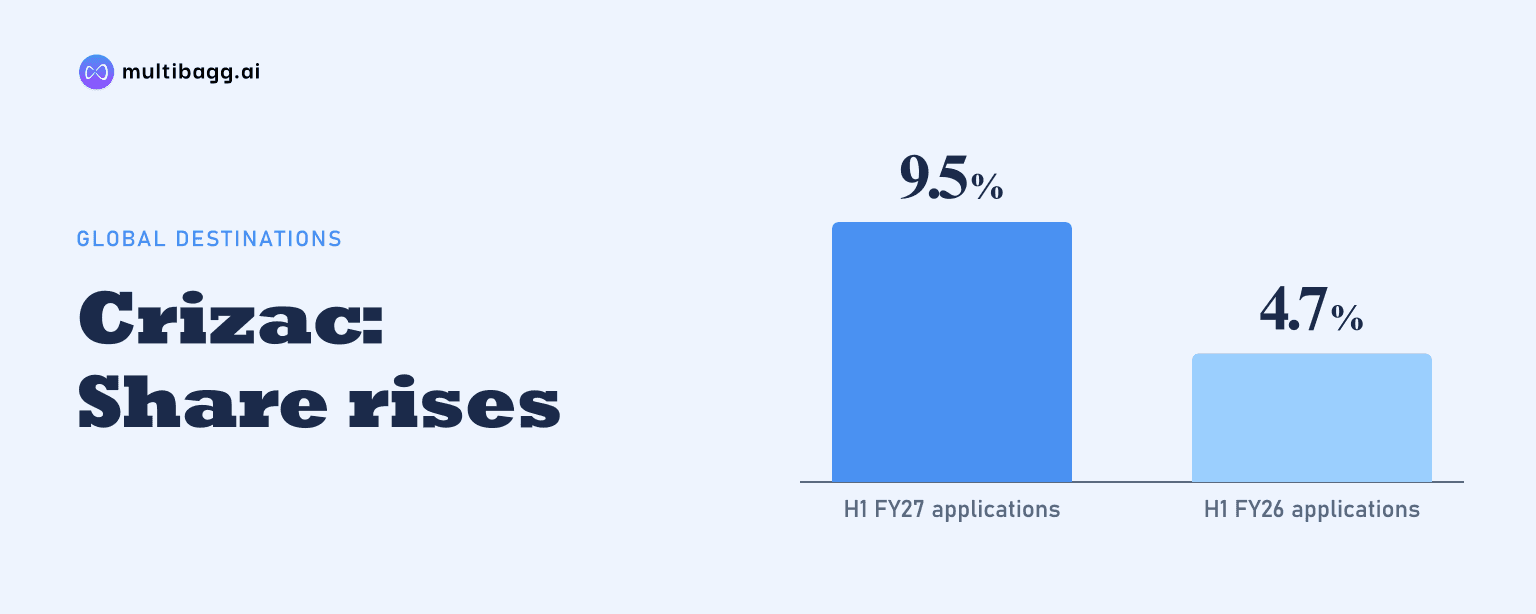
Crizac Limited said destinations outside the United Kingdom (UK) accounted for approximately 9.5% of applications in the first half (H1) of fiscal year (FY) ’27, up from 4.7% in H1 FY ’26, but generated only 1.4% of revenue. The figures show applications diversifying faster than enrolment-based revenue recognition.
Know Crizac inside out
Results, valuation, peers and who's buying, in one view.
Why is Crizac’s non-UK revenue still only 1.4%?
Crizac’s non-UK revenue is only 1.4% because it recognises revenue after a university confirms student enrolment, usually 45 to 90 days after a course begins. Management said applications are the first step in the process, so new-destination application growth does not immediately become reported revenue.
The gap also reflects the maturity of Crizac’s destination network. Management said the company entered Australia and New Zealand in 2017-18 but initially had only a handful of university contracts in those markets. It described New Zealand, Ireland and other non-UK destinations as small-volume markets so far, despite Crizac working with more than 600 institutions across 15 destination markets.
Management described the difference between the 9.5% application share and 1.4% revenue share as headroom rather than a shortfall. That is management’s view, not a reported conversion outcome: the call did not disclose non-UK enrolments, revenue by destination or conversion rates for applications outside the UK.
How is Crizac building its New Zealand business?
Crizac is building New Zealand enrolments through its Medway Education acquisition, which management said gave it representation across that destination and increased New Zealand application flow multifold. Management said inorganic acquisitions are the principal route to securing a majority of university contracts in newer markets.
The company expects timing to matter because New Zealand’s main intake is in February. Management said those enrolments should begin contributing to fourth-quarter (Q4) FY ’27 revenue, consistent with the 45-to-90-day interval between course commencement and university confirmation of enrolment.
Crizac did not disclose Medway’s purchase price, revenue, number of university contracts or the number of New Zealand applications received. It is therefore not possible from the call to establish how much of the 9.5% non-UK application mix came from New Zealand rather than Ireland, Australia, the Netherlands or other European destinations.
What does the application increase mean for UK dependence?
Crizac’s rising non-UK application share indicates reduced UK reliance at the application stage, but not yet in recognised revenue. Management said the UK remained its largest and most welcoming destination at the time of the November 2, 2026 call, while its market-research forecast envisaged 30% of revenue coming from outside the UK by FY ’30.
Management said diversification should come from higher student volumes in other destinations rather than lower UK student numbers. It identified expansion in the Netherlands, Europe and New Zealand, while naming Australia, Canada and the United States (US) as potential markets for further growth. It also cited Africa-to-India and Malaysia-to-China corridors as possible ways to broaden source and destination exposure.
The 1.4% revenue contribution illustrates that the plan has yet to change current earnings exposure materially. Crizac reported operating income of Rs 102.7 crore in the second quarter (Q2) of FY ’27, down 36.7% year on year, while H1 operating income was Rs 303.9 crore, down 18.3%. Management attributed the Q2 decline mainly to travel disruption, flight cancellations and currency movements that caused students, particularly postgraduates, to defer study plans.
Got a follow-up? Ask IRIS
Can non-UK markets scale quickly enough to affect results?
Crizac said non-UK markets cannot be expected to scale on a fixed timetable because visa access and destination-country policy influence student demand. Management declined to give a date for non-UK revenue to reach 10%, instead setting out its FY ’30 expectation that non-UK destinations would provide 30% of revenue.
The US illustrates the policy constraint. Crizac said it acquired Raj Consultants to support its US presence but cited limited visa-appointment availability as a barrier to student applications. Management said contracts and relationships were already in place, but that destination policy was preventing material growth in student numbers.
The company’s Q2 experience also demonstrated the timing gap between applications and revenue. An analyst said applications had fallen about 3% year on year in the quarter while operating income declined 36.7%; management said the difference was mainly due to student deferrals rather than changes in revenue per enrolled student. Crizac guided for Q3 FY ’27 revenue growth of 10% to 12% over Q3 FY ’26, based on students with admissions and visas in place.
What resources support Crizac’s diversification plan?
Crizac said its platform processes more than 2 lakh applications from 92 countries and is supported by more than 18,500 counselling partners, including 4,942 active partners in H1 FY ’27. Its rolling 12-month student-enrolment rate was 12.8%, although management did not provide a corresponding conversion rate for non-UK destinations.
Management linked geographic expansion to technology and acquisitions. Crizac said it is developing EduMentor, an artificial intelligence-led student-university matching and mentorship platform, and is actively assessing acquisition opportunities. The company said its acquisition criteria include potential synergies, operating jurisdictions, founders, revenue and earnings before interest, tax, depreciation and amortisation.
Crizac had free cash of Rs 595.8 crore as of September 30, 2026, compared with Rs 469.3 crore in March 2026, and described itself as net debt-free. Management said its inorganic pipeline was active but also said it would proceed cautiously amid geopolitical uncertainty, without identifying a transaction or timetable.
Conclusion
Crizac’s H1 FY ’27 disclosure shows a material shift in incoming applications, with non-UK destinations reaching 9.5% of the total from 4.7% a year earlier. However, the 1.4% revenue contribution confirms that diversification has not yet materially reduced earnings exposure to the UK because applications must progress through admissions, visas, course starts and confirmed enrolments.
The next disclosed test is Q4 FY ’27, when management expects the February New Zealand intake to start contributing revenue after the Medway Education acquisition. Management’s Q3 FY ’27 revenue-growth guidance of 10% to 12% and its FY ’30 expectation for a 30% non-UK revenue share provide the next benchmarks for progress.