










Crizac Limited keeps FY27 target after Q2 income fell 36.7%
Key highlights
- Crizac reported Q2 FY27 operating income of Rs 102.7 crore, down 36.7% year on year.
- Crizac expects Q3 FY27 revenue growth of 10% to 12% over Q3 FY26.
- H1 FY27 PAT was Rs 84 crore, down 10.7% year on year.
- Crizac reported free cash of Rs 595.8 crore at September 30, 2026.
powered by IRIS
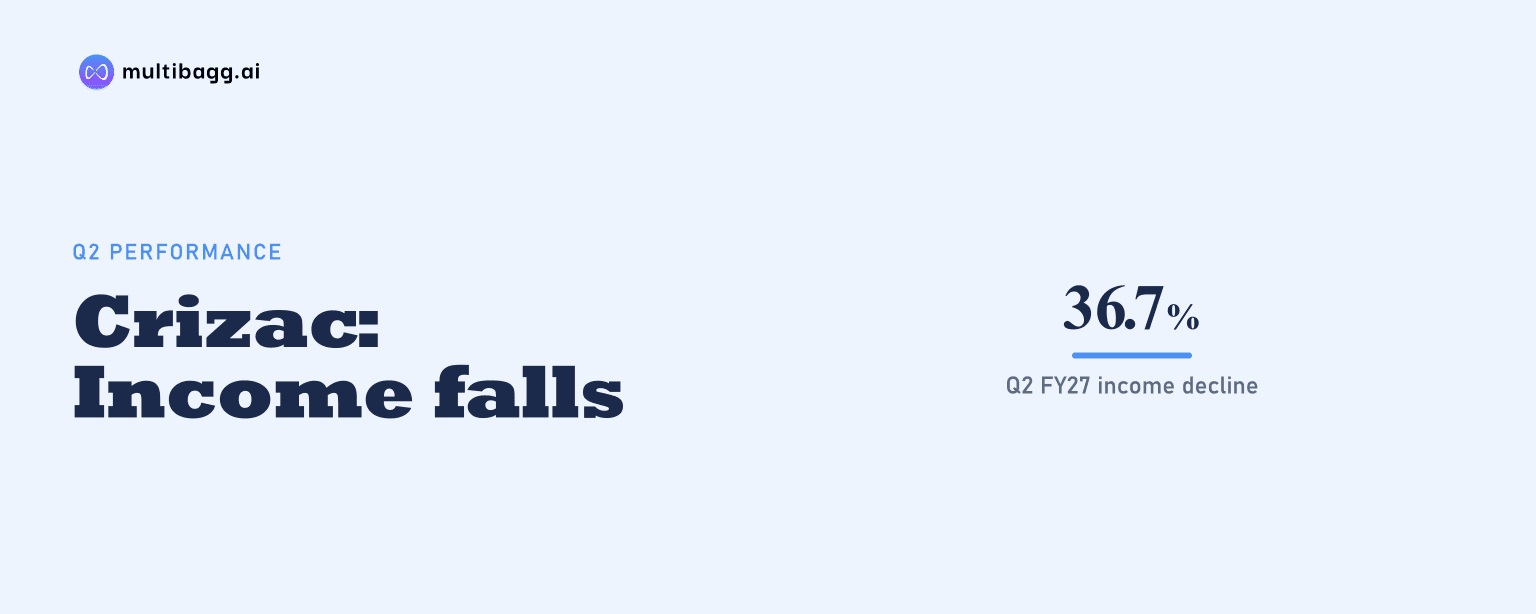
Crizac retained its FY27 revenue and profit outlook after Q2 FY27 operating income fell 36.7% year on year to Rs 102.7 crore, as management said admissions and visas secured for Q3 support revenue growth of 10% to 12% over Q3 FY26.
Know Crizac inside out
Results, valuation, peers and who's buying, in one view.
Why did Crizac's Q2 FY27 operating income fall?
Crizac said Q2 FY27 operating income fell because the West Asia conflict between February and June disrupted international travel and caused flight cancellations, while currency movements in a key source market increased the cost of overseas education. Management said the uncertainty caused prospective students, predominantly postgraduate applicants, to postpone study plans.
Operating earnings before interest, tax, depreciation and amortisation, or EBITDA, were Rs 33 crore in Q2 FY27, down 44% from Rs 59 crore in Q2 FY26. Profit after tax, or PAT, was Rs 36.9 crore, down 23.7% year on year; management attributed the smaller decline in PAT than EBITDA to Rs 8.5 crore of other income, lower depreciation and a lower tax charge.
For H1 FY27, operating income was Rs 303.9 crore, down 18.3% year on year, while PAT fell 10.7% to Rs 84 crore. The steeper Q2 decline reflects management's explanation that revenue reported in Q2 largely came from applications processed in Q1 or earlier, when the disruption was most acute.
Why does Crizac expect Q3 FY27 revenue to grow?
Crizac expects Q3 FY27 revenue to grow 10% to 12% over Q3 FY26 because management said most students supporting that revenue had secured admission and visa approvals. Some students had already started their travel or university courses when management made the November 2, 2026 statement.
The forecast relies on Crizac's revenue-recognition timing. The company records revenue only after a university confirms enrolment, which management said typically occurs 45 to 90 days after a course starts. Therefore, application work completed during Q2 is expected to be reflected in Q3, whereas Q2 revenue was largely tied to earlier applications.
Management also said a large share of applications expected to support Q4 revenue had already been received and was being processed. It expects H2 FY27 to be significantly stronger than H1 FY27 and ahead of H2 FY26, although it qualified that outlook by referring to the possibility of an unforeseen external event.
Can Crizac deliver FY27 revenue and profit in line with FY26?
Crizac maintained that FY27 revenue and profit should be in line with FY26, despite the H1 FY27 operating-income decline of 18.3% and the 10.7% decline in H1 PAT. Management based that view on the Q3 student pipeline and applications already being processed for Q4.
Q2 EBITDA margin was 32%, compared with 36.3% in Q2 FY26, as the cost base reflected team expansion, technology investment and broader operations. The margin nevertheless improved 233 basis points from 29.8% in Q1 FY27, which management said was supported by a lower cost of service.
H1 FY27 operating EBITDA was Rs 93 crore, down 24.9%, at a margin of 30.6%. Net cash flow from operating activities was Rs 126.9 crore, equal to 136% of H1 operating EBITDA, although the chief financial officer said favourable working-capital timing contributed to that conversion and was expected to normalise during the year.
Crizac reported free cash of Rs 595.8 crore at September 30, 2026, compared with Rs 469.3 crore in March 2026, and said it remained net debt-free. The board declared an interim dividend of Rs 4 per equity share, amounting to Rs 70 crore, while management expects total FY27 dividends, including a final dividend, of Rs 8 to Rs 10 per share.
Got a follow-up? Ask IRIS
What supports Crizac's market-share and diversification plans?
Crizac said its UK student volumes rose 53% between FY24 and FY26 while UK-sponsored study visas fell 20%, increasing its global share from 3.5% to 6%. Among Indian students, management said Crizac's share rose from 9% to 13.9% even as visas granted to Indian students declined 22% over the same period.
The company worked with more than 600 institutions, and each of its top 30 university relationships had extended beyond five years. Its counselling network exceeded 18,500 partners, including 4,942 active partners during H1 FY27, while its platform processed more than 2 lakh applications from 92 countries with a rolling 12-month enrolment rate of 12.8%.
Diversification beyond the UK is appearing first in applications rather than revenue. Non-UK destinations accounted for about 9.5% of H1 FY27 applications, more than double 4.7% in H1 FY26, but represented only 1.4% of revenue at the time of the call. Management said conversion in newer destinations generally improves as the business develops.
What does the UK graduate-visa proposal mean for Crizac?
Crizac views the UK government's October 28 budget proposal as constructive for its largest market because it proposed a two-year graduate visa for graduates of high-compliance universities with strong labour-market outcomes. Management said an 18-month period would otherwise apply to students from January 2027, although the government had not identified qualifying universities.
The policy's commercial effect remains unresolved because visa and immigration rules can change, and Crizac said diversification would take time to affect financial results. The chairman noted that UK net migration declined from 891,000 in 2022 to 171,000 in 2025, while characterising the policy intent as reducing net migration rather than ending international education.
Crizac said universities are becoming more selective in their recruitment partnerships as compliance requirements rise. Management linked this trend to the company's FY24-to-FY26 share gains, but did not provide a numerical revenue or profit forecast from the proposed graduate-visa changes.
Conclusion
Crizac's Q2 FY27 operating-income decline to Rs 102.7 crore reflected travel disruption, currency movements and deferred student plans, while the 44% EBITDA decline exceeded the 23.7% reduction in PAT. Management's unchanged FY27 outlook depends on the lag between applications, university enrolment confirmation and recorded revenue, alongside the Q3 and Q4 intake pipeline.
The next reported test is whether Q3 FY27 revenue grows by the guided 10% to 12% over Q3 FY26 and whether Q4 applications convert as management expects. Investors can also watch for UK government details on eligible universities for the proposed two-year graduate visa from January 2027, and whether non-UK destinations lift their contribution above 1.4% of revenue.