










DEE expands Anjar to 30,000 MTPA and adds seamless pipe
Key highlights
- DEE increased Anjar capacity excluding heavy fabrication from 6,000 MTPA to 30,000 MTPA by September 2025.
- DEE established a 7,000-MTPA seamless-pipe plant at Anjar for high-wall-thickness pipes.
- DEE reports 93,500 MTPA of piping capacity and 22,800 MTPA of heavy-fabrication capacity.
- DEE reported an order book of Rs 2,586 crore with visibility through FY27 and beyond.
powered by IRIS
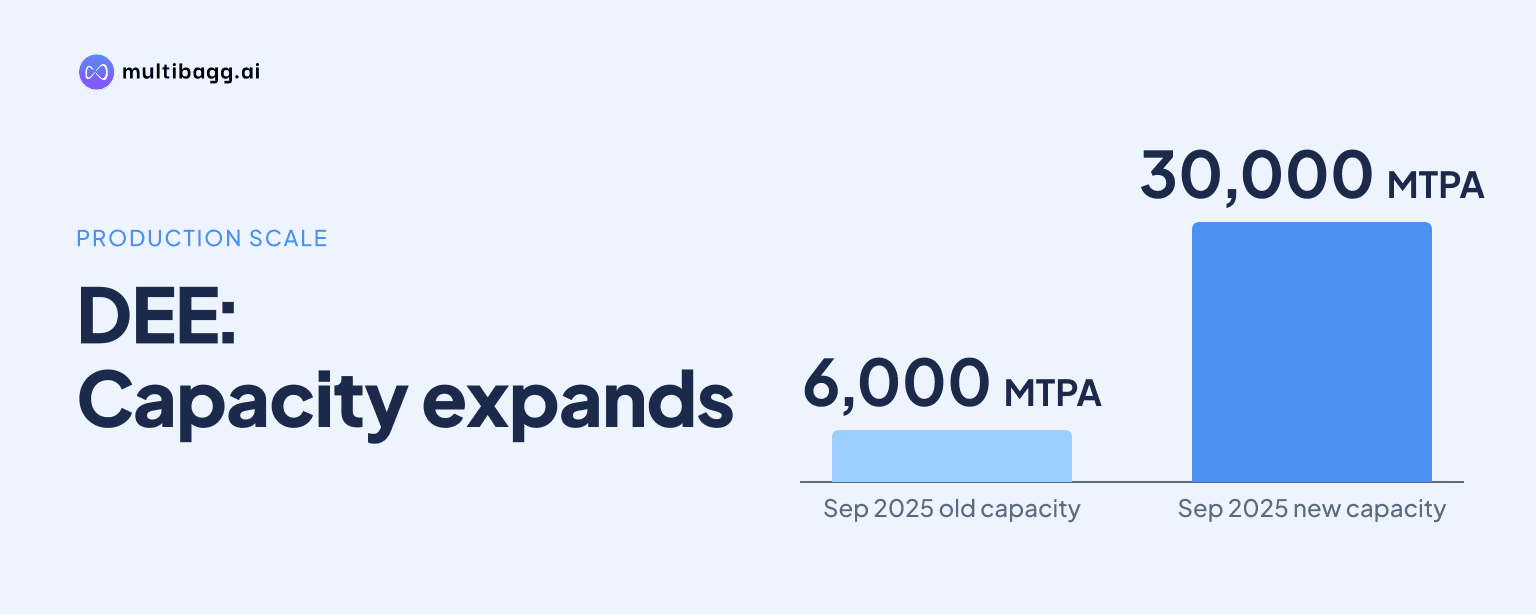
DEE increased Anjar’s production capacity excluding heavy fabrication from 6,000 MTPA to 30,000 MTPA by September 2025 and established a 7,000-MTPA seamless-pipe plant. The expansion combines Oil & Gas-focused pipe fabrication, in-house production of high-wall-thickness pipes, automation and proximity to Kandla and Mundra Ports.
Know DEE Development Engineers inside out
Results, valuation, peers and who's buying, in one view.
How much capacity has DEE added at Anjar?
DEE increased Anjar’s production capacity excluding heavy fabrication by 24,000 MTPA, taking it from 6,000 MTPA to 30,000 MTPA by September 2025. MTPA means metric tonnes per annum. DEE separately identifies the 30,000-MTPA Anjar pipe-fabrication unit, while listing heavy-fabrication capacity of 22,800 MTPA at the same broader manufacturing base.
DEE says the 30,000-MTPA pipe-fabrication facility is dedicated to the Oil & Gas sector. The stated operating purpose is to free Palwal capacity for the Power sector. Palwal has combined capacity of 36,000 MTPA across 9,000 MTPA of high-pressure piping and induction bends, 3,000 MTPA of industrial fittings, and 24,000 MTPA of piping spools and systems.
This creates a disclosed division of work between the two locations: Anjar for Oil & Gas fabrication and Palwal for Power-sector work. DEE does not provide utilisation rates, output volumes or revenue by plant, so the presentation does not quantify how much work has shifted between Anjar and Palwal.
What does the 7,000-MTPA seamless-pipe plant change?
DEE established a 7,000-MTPA seamless-pipe plant at Anjar for high-wall-thickness pipes, which it says are currently 100% import-dependent in India. The facility is a backward-integration measure, placing production of a pipe input within DEE’s manufacturing network rather than relying only on imports and external vendors.
Management identifies cost optimisation, supply security, reduced external-vendor dependence, shorter lead times and tighter quality-process monitoring as objectives for the seamless-pipe plant. These are intended operating benefits, not reported financial outcomes: the presentation gives no commissioning date, project cost, utilisation level, production volume, selling price or margin contribution for the 7,000-MTPA unit.
The seamless-pipe plant operates alongside the 30,000-MTPA pipe-fabrication unit at Anjar. DEE also lists a nuclear-piping plant at the site, without a stated capacity, as well as a 3,000-MTPA support-and-structure fabrication unit and 22,800 MTPA of heavy fabrication. The disclosed configuration shows that the Anjar base has pipe, fabrication and infrastructure-related activities.
How does the Anjar facility support manufacturing execution?
DEE says the 30,000-MTPA Anjar pipe-fabrication unit uses a U-shaped plant design to improve material handling and reduce time and cost. It also cites advanced automation and technology intended to reduce dependence on manual labour, improve productivity and optimise expenses, without disclosing automation expenditure or measured labour savings.
The unit is located near Kandla and Mundra Ports, which DEE says enables quicker import and export turnaround and lowers inland transport costs and transit time. That logistics mechanism supports a business that serves more than 27 countries, including Canada, the United States, Italy and Japan, although the presentation does not quantify freight savings or port-to-plant distances.
DEE’s broader process-piping capabilities include robotic welding, high-frequency induction bending, computer numerical control, or CNC, bevelling, and digital radiography used in non-destructive examination. Its product range includes high-pressure piping systems, piping spools, industrial pipe fittings, induction pipe bends and pressure vessels. The presentation positions the Anjar layout and automation as execution tools for this manufacturing portfolio.
Got a follow-up? Ask IRIS
How does Anjar fit into DEE’s wider manufacturing network?
DEE reports installed piping-division capacity of 93,500 MTPA across seven facilities in India and Thailand, plus 22,800 MTPA in the heavy-fabrication division. The disclosed piping total includes 36,000 MTPA at Palwal, 30,000 MTPA of pipe fabrication at Anjar, 7,000 MTPA of seamless-pipe capacity at Anjar, 6,000 MTPA at Numaligarh and 14,500 MTPA in Bangkok.
The 93,500-MTPA total distinguishes piping capacity from the 22,800-MTPA heavy-fabrication division. DEE says heavy fabrication supports renewable-energy wind towers and critical industrial infrastructure, including chimney stacks from 30 metres to 140 metres. The heavy-fabrication operation is handled by wholly owned subsidiary DEE Fabricom India Private Limited at Anjar.
Which markets and financial indicators accompany the expansion?
DEE says the 30,000-MTPA Anjar facility is dedicated to Oil & Gas, while its wider process-piping business serves Power, including Nuclear, and Chemical customers. Its H1 FY27 industry coverage includes refinery and petrochemical, liquefied natural gas, hydrogen, chemicals and fertilizers, thermal power, carbon capture, semiconductors, and oil and gas exploration.
DEE reported an order book of Rs 2,586 crore, which it says provides revenue visibility through FY27 and beyond. This figure is an order-book measure rather than an Anjar output forecast. The presentation does not disclose the portion allocated to Oil & Gas, the Anjar plant or the seamless-pipe facility.
Core-business revenue was Rs 558.5 crore in H1 FY27, compared with Rs 469 crore in H1 FY26, a year-on-year increase of 19.2%. Operating earnings before interest, tax, depreciation and amortisation, or EBITDA, rose to Rs 110.4 crore from Rs 84 crore, while operating EBITDA margin increased by 177 basis points to 19.8%. DEE does not attribute these H1 FY27 changes specifically to Anjar’s expanded capacity or seamless-pipe production.
Conclusion
DEE’s Anjar expansion changes its disclosed manufacturing setup through 30,000 MTPA of pipe-fabrication capacity, up from 6,000 MTPA excluding heavy fabrication by September 2025, and a 7,000-MTPA seamless-pipe plant. The site combines Oil & Gas-focused fabrication, a U-shaped production layout, automation and port access with in-house production of high-wall-thickness pipe.
The next measure to watch is the execution of DEE’s stated plan to dedicate Anjar to Oil & Gas and release Palwal capacity for the Power sector. Management has cited an Rs 2,586 crore order book extending through FY27 and beyond, but has not disclosed Anjar utilisation, seamless-pipe output or financial returns from the new capacity.