










DEE targets ₹2,500 crore revenue and 19-20% margin by FY30
Key highlights
- DEE targets FY30E revenue of ₹2,500 crore, compared with ₹1,142 crore reported in FY26.
- Management guides to a 19-20% operating EBITDA margin by FY30, versus 16.6% in FY26.
- DEE reports a ₹2,586 crore executable order book and ₹2,000 crore of FY27 order visibility.
- H1 FY27 operating EBITDA margin increased to 18.5% from 16.2% in H1 FY26.
powered by IRIS
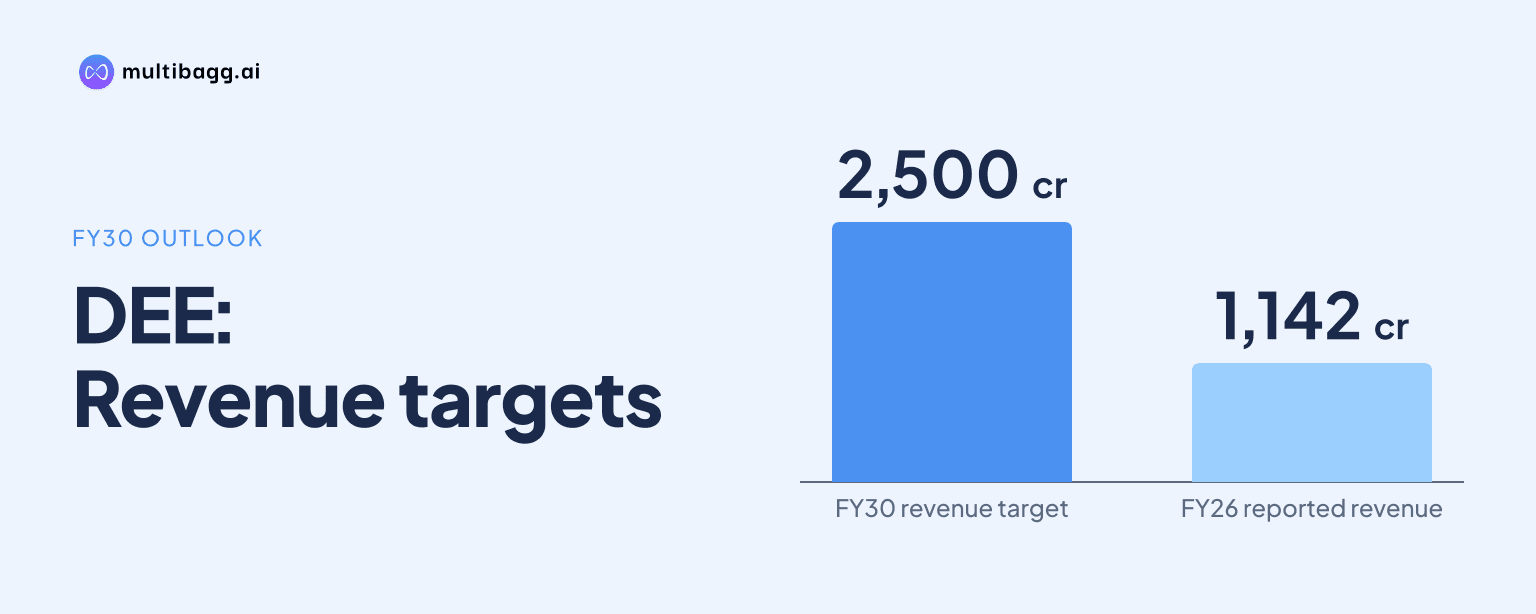
DEE targets ₹2,500 crore of revenue in FY30E and a 19-20% operating EBITDA margin, compared with ₹1,142 crore of revenue and a 16.6% margin in FY26. The roadmap implies about 22% revenue compound annual growth from FY26 to FY30E, with management citing a ₹2,586 crore executable order book, higher capacity utilisation and integrated facilities as support.
Know DEE Development Engineers inside out
Results, valuation, peers and who's buying, in one view.
What is DEE’s FY30 revenue and margin target?
DEE’s management targets ₹2,500 crore of revenue in FY30E, a 19-20% operating EBITDA margin and profit after tax of 9-10% of revenue. FY denotes fiscal year, E denotes management’s estimate and operating EBITDA is operating earnings before interest, tax, depreciation and amortisation. The FY30E revenue target is ₹1,358 crore above the ₹1,142 crore reported in FY26, while the margin range is 2.4 to 3.4 percentage points above FY26’s 16.6% operating EBITDA margin.
The roadmap identifies revenue compound annual growth rate, or CAGR, of about 22% from FY26 to FY30E. Its FY27E target of ₹1,500 crore is ₹358 crore higher than FY26 revenue, and the FY28E figure of ₹1,800 crore is another ₹300 crore higher than FY27E. The presentation does not disclose a separate FY29E revenue figure.
Management also guides to operating EBITDA CAGR of about 26% and profit after tax CAGR of about 30% between FY26 and FY30. Profit after tax, or PAT, was ₹77.2 crore in FY26 and represented a 6.8% margin, versus the FY30 target of 9-10% of revenue. These are management targets rather than reported FY30 results.
How does DEE plan to expand margins by FY30?
DEE plans to expand margins through a power-sector mix shift, operating leverage, backward integration through its pipe mill, plant proximity to ports, automation and biomass pellets. Management connects these levers with higher utilisation of integrated facilities and better absorption of fixed costs in its stated investor flywheel.
The roadmap targets asset turns of about 3.5 times by FY30, from less than 2 times currently. Asset turns measure revenue generated relative to the asset base. The stated increase is paired with planned maintenance capital expenditure of ₹20-30 crore, indicating that management expects utilisation and integration to be central to the revenue build-out rather than disclosing a large expansion-capital-spending programme.
The biomass platform is also listed as a margin lever. DEE says its biomass pellet capacity recently became operational and that the pellet initiative is expected to offset current cash burn, stabilise segment profitability and restore historical margin levels. The presentation says additional pellet capacity is proposed to be housed under an Infrastructure Investment Trust, or InVIT, but gives no timing, investment amount or projected financial contribution.
DEE’s two biomass power plants have 14 megawatts of combined operating capacity, comprising 8 megawatts at Abohar and 6 megawatts at Muktsar. The Muktsar tariff was revised to ₹5.22 per kilowatt-hour from ₹3.50 per kilowatt-hour, with retrospective recovery of about ₹5.14 crore in FY26; an appeal before the Appellate Tribunal for Electricity remains ongoing, according to the presentation.
Got a follow-up? Ask IRIS
What order visibility supports DEE’s FY30 roadmap?
DEE reports a ₹2,586 crore executable order book, ₹2,000 crore of FY27 order visibility and a 40% bid success rate. The stated FY27 visibility is ₹500 crore above the ₹1,500 crore FY27E revenue target, although the presentation does not specify conversion timing, cancellation terms or revenue-recognition schedules for individual orders.
Management identifies domestic thermal expansion, domestic refining expansion and exports as core order-book drivers. The presentation shows domestic thermal capacity rising from 220 gigawatts to 300 gigawatts, an 80-gigawatt addition by FY32. It also shows domestic refining capacity increasing from 258 million metric tonnes per annum, or MMTPA, to 310 MMTPA by 2030.
Nuclear, data centres and semiconductors are described as medium-term or emerging opportunities, not as quantified DEE revenue commitments. The nuclear reference is capacity increasing from about 8 gigawatts to 100 gigawatts by FY47. For data centres, the presentation estimates piping of about ₹25 crore per 25 megawatts, while providing no DEE order value or pipeline conversion estimate for that segment.
DEE’s listed served industries in H1 FY27 include refinery and petrochemical, thermal power, liquefied natural gas, hydrogen, carbon capture and semiconductors. This sector spread sits alongside the FY30 growth plan, but the presentation does not disclose revenue by end market or the proportion of the ₹2,586 crore executable order book attached to each industry.
How do DEE’s latest results compare with the FY30 plan?
DEE reported ₹587.4 crore of revenue from operations in H1 FY27, up 19.0% from ₹493.8 crore in H1 FY26. First-half operating EBITDA rose 35.9% to ₹108.6 crore from ₹79.9 crore, raising operating EBITDA margin by 2.3 percentage points to 18.5% from 16.2%. The H1 FY27 margin was 0.5 percentage points below the lower end of management’s 19-20% FY30 range.
In Q2 FY27, revenue was ₹293.0 crore, 8.5% above ₹270.0 crore in Q2 FY26 but 0.5% below ₹294.5 crore in Q1 FY27. Quarterly operating EBITDA rose to ₹58.9 crore from ₹44.1 crore a year earlier and ₹49.7 crore in the preceding quarter. The Q2 FY27 operating EBITDA margin reached 20.1%, compared with 16.3% in Q2 FY26 and 16.9% in Q1 FY27.
PAT in Q2 FY27 was ₹23.5 crore, up 31.8% year on year from ₹17.8 crore and 45.8% sequentially from ₹16.1 crore. The Q2 PAT margin was 8.0%, compared with 6.6% a year earlier and 5.5% in Q1 FY27. In H1 FY27, PAT increased 27.8% to ₹39.5 crore from ₹30.9 crore, while the margin increased to 6.7% from 6.3%.
Interest expense was ₹32.5 crore in H1 FY27, 28.9% higher than ₹25.2 crore in H1 FY26, while depreciation and amortisation increased 19.2% to ₹30.9 crore. These items reduced reported profit after operating EBITDA: H1 FY27 operating EBITDA was ₹108.6 crore and PAT was ₹39.5 crore. The presentation’s roadmap includes debt reduction as an operating-efficiency objective but does not provide a debt target or schedule.
Conclusion
DEE’s FY30 plan combines growth from ₹1,142 crore of FY26 revenue to ₹2,500 crore with operating-margin expansion from 16.6% to 19-20%. The reported H1 FY27 operating EBITDA margin of 18.5%, the ₹2,586 crore executable order book and the proposed increase in asset turns from less than 2 times to about 3.5 times are the presentation’s principal numerical links between current performance and the roadmap.
The next disclosed operating checkpoints are FY27E revenue of ₹1,500 crore and ₹2,000 crore of FY27 order visibility. Management’s plan also calls for ₹20-30 crore of maintenance capital expenditure, debt reduction and higher utilisation of integrated facilities, while the timing and financial role of the proposed InVIT for additional pellet capacity remain unresolved in the presentation.