










DEE Uses New Pellet Capacity to Offset Biomass Cash Burn
Key highlights
- DEE operates 14 MW of biomass capacity, split between 8 MW at Abohar and 6 MW at Muktsar.
- Muktsar’s tariff rose to Rs 5.22 per kWh from Rs 3.50 per kWh, producing about Rs 5.14 crore of FY26 retrospective recovery.
- DEE says recently operational pellet capacity is intended to offset current biomass cash burn with minimal incremental capital expenditure.
- DEE reports more than 191,067 tons of carbon dioxide emissions reduced through its biomass platform.
powered by IRIS
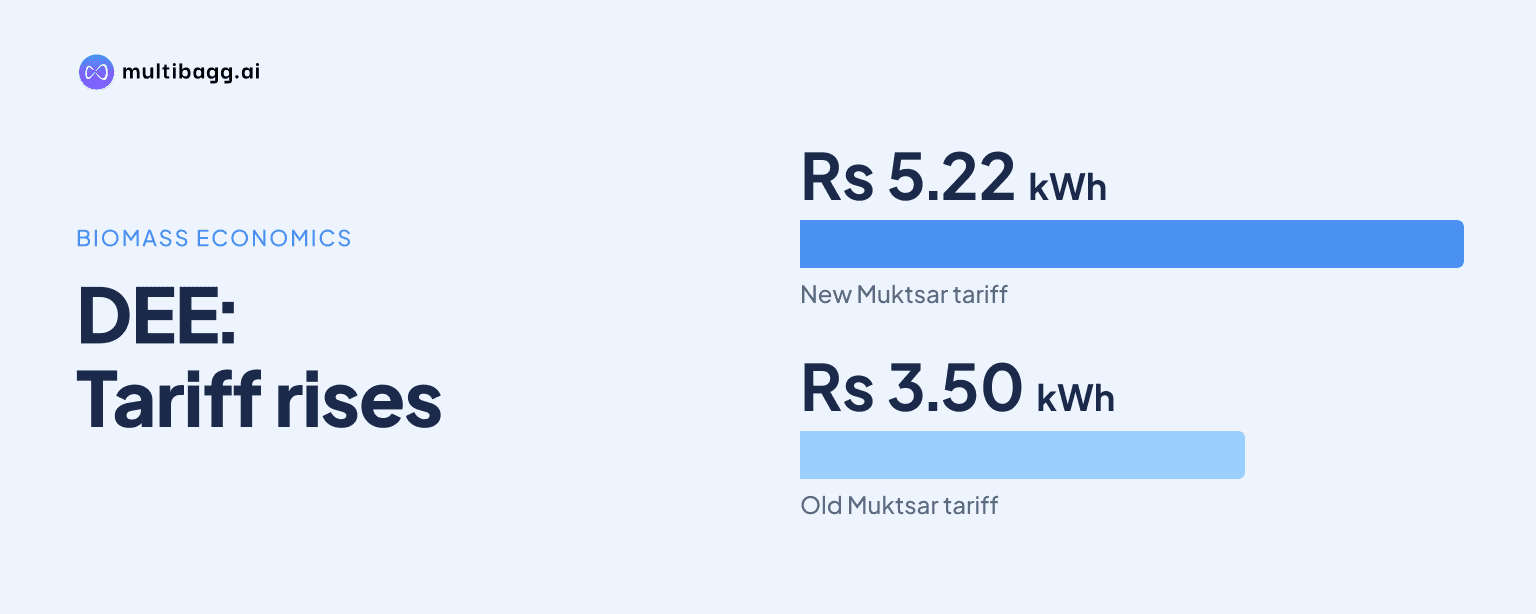
DEE is using recently operational biomass pellet capacity to offset cash burn in its non-core power-generation segment after Muktsar’s tariff rose to Rs 5.22 per kilowatt-hour from Rs 3.50, generating about Rs 5.14 crore of retrospective recovery in FY26.
Know DEE Development Engineers inside out
Results, valuation, peers and who's buying, in one view.
Why is DEE changing its biomass business model?
DEE is adding biomass pellet manufacturing because management says recently operational pellet capacity can address near-term losses and offset cash burn in the non-core power-generation segment. The presentation describes a pivot from power-only biomass operations to pellet manufacturing with minimal incremental capital expenditure.
Management characterises pellet manufacturing as a higher-margin activity and says the initiative is intended to stabilise segment profitability and restore historical margin levels. The presentation does not disclose the pellet plant’s production capacity, commissioning date, revenue contribution or the historical margin level management expects to restore, so its financial scale cannot be quantified from the disclosed material.
The shift follows tariff-related pressure in the biomass business rather than an exit from power generation. DEE retains 14 megawatts of operational capacity across Abohar, with 8 megawatts, and Muktsar, with 6 megawatts; both plants are described as fully contracted under long-term power purchase agreements, or PPAs, with Punjab State Power Corporation Limited, or PSPCL.
The pellet project also changes the proposed capital structure of the segment. Management says additional pellet capacity is proposed to be housed under an infrastructure investment trust, or InVIT, for efficient capital deployment, but does not state whether the InVIT has been formed, which assets it would hold, its funding or a timetable.
How much did DEE's Muktsar tariff change?
DEE says the Malwa Power Muktsar tariff was revised to Rs 5.22 per kilowatt-hour from Rs 3.50 per kilowatt-hour, an increase of Rs 1.72 per kilowatt-hour. The tariff revision generated approximately Rs 5.14 crore of retrospective recovery in FY26, according to the presentation.
The Rs 5.437 per kilowatt-hour FY27 tariff includes annual escalation, DEE says. An appeal before the Appellate Tribunal for Electricity, or APTEL, remains ongoing for further tariff optimisation, so the disclosed tariff outcome may not be the final regulatory position.
The tariff improvement should be read with management’s statement that near-term losses from tariff revisions are being addressed through the pellet-manufacturing model. DEE does not disclose Muktsar’s generation volume, biomass-fuel cost, segment operating loss or the duration of cash burn, preventing a direct calculation of the revision’s effect on profitability.
Got a follow-up? Ask IRIS
What supports DEE's biomass operations?
DEE’s Abohar biomass plant has 8 megawatts of aggregate capacity across 205,681.48 square metres and is contracted under a 30-year PPA signed on March 4, 2011 with PSPCL. The presentation also says the agreement commenced on February 5, 2009 and permits grid interconnection and parallel operation with PSPCL and Punjab State Transmission Corporation Limited systems.
DEE’s Muktsar biomass plant has 6 megawatts of aggregate capacity across 141,829.67 square metres. It is fully contracted under a 20-year PPA signed on February 19, 2004 by DEE’s wholly owned subsidiary, MPPL, with the Punjab State Electricity Board.
The two plants combine contracted electricity operations with the new pellet activity rather than relying only on merchant power sales. Abohar represents 8 megawatts of the disclosed 14-megawatt portfolio, while Muktsar represents 6 megawatts and is the plant to which the Malwa Power tariff revision relates.
DEE reported a power-generation revenue figure of 13 in Q2 FY27, compared with 11 in Q2 FY26, although the presentation does not identify the unit or currency. The reported figure increased year on year, but it does not establish segment profitability or the pellet plant’s contribution because DEE provides no revenue split.
What does pellet manufacturing mean for DEE's plan?
DEE’s pellet-manufacturing initiative is intended by management to integrate the biomass platform beyond its 14-megawatt power plants while requiring minimal incremental capital expenditure. Management says the pellet capacity recently became operational, but provides no tonnage, utilisation rate, customer contracts, selling price or operating-cost data.
DEE links the biomass platform to sustainability, stating that it has reduced more than 191,067 tons of carbon dioxide emissions. The presentation does not define the measurement period or methodology, or disclose the share attributable to pellet manufacturing versus the Abohar and Muktsar power plants.
Within DEE’s FY30 roadmap, management identifies biomass pellets as one of its margin-expansion levers. The roadmap targets Rs 2,500 crore of revenue and an operating earnings before interest, tax, depreciation and amortisation, or EBITDA, margin of 19% to 20% by FY30, compared with FY26 revenue of Rs 1,142 crore; these are wider-business targets rather than separate biomass forecasts.
Management also identifies planned maintenance capital expenditure of Rs 20 crore to Rs 30 crore and a move in asset turns from below 2 times to about 3.5 times by FY30. The presentation does not allocate these targets between piping systems, the pellet operation and the proposed InVIT, so they are not pellet-specific commitments.
Conclusion
DEE’s disclosed turnaround mechanism combines the higher Muktsar tariff, approximately Rs 5.14 crore of retrospective FY26 recovery and operational pellet capacity that management expects to offset non-core cash burn. The biomass platform now combines 14 megawatts of contracted power capacity with pellet manufacturing, although pellet output, revenue and profitability remain undisclosed.
The next points to watch are the ongoing APTEL appeal, execution of the proposed InVIT structure for additional pellet capacity and management disclosure of pellet volumes or financial contribution. DEE’s FY30 plan includes Rs 2,500 crore of revenue and a 19% to 20% operating EBITDA margin target, but it gives no separate timetable or profitability target for the biomass pellet business.