










Deepak Fertilisers says ammonium nitrate ban ended in October
Key highlights
- Deepak Fertilisers said the ammonium nitrate export ban was completely removed in October.
- Deepak Fertilisers began international market-development work in November.
- Gopalpur adds about 380,000 tonnes of TAN capacity versus annual TAN sales of 550,000 to 560,000 tonnes.
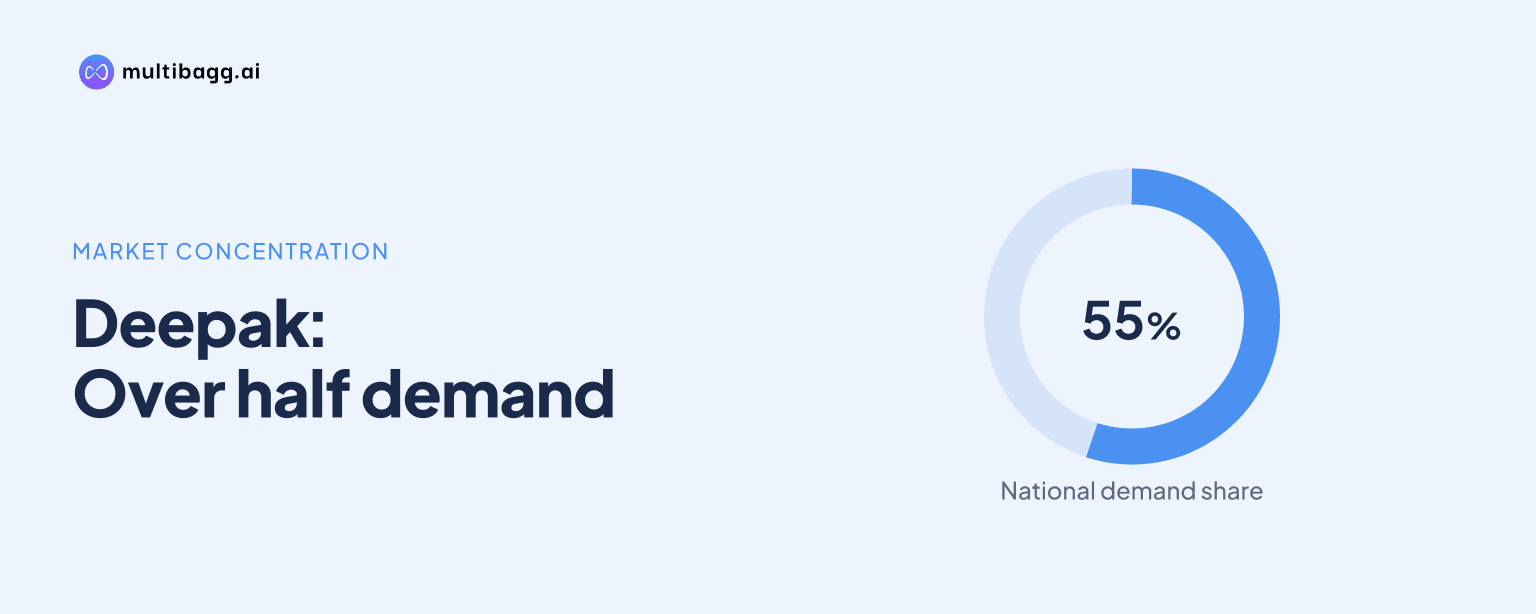
- Management said eastern India and Singrauli account for 55% of national explosives and ammonium nitrate demand.
powered by IRIS
Deepak Fertilisers said the Government of India completely removed the ammonium nitrate export ban in October, allowing it to restart international market-development work from November as its Gopalpur technical ammonium nitrate, or TAN, project prepares to contribute during Q4 FY27.
Know Deepak Fertilisers & Petrochemicals Corp inside out
Results, valuation, peers and who's buying, in one view.
When did Deepak Fertilisers say the ammonium nitrate export ban ended?
Deepak Fertilisers said the export ban was removed completely in October “this year.” Tarun Sinha made the statement in response to an analyst’s question on whether the restriction remained in force, alongside discussion of mining demand around the Gopalpur project.
The company did not disclose export orders, shipment volumes, revenue, destination markets or pricing after the policy change. Management instead said that returning to international markets requires time and effort because a supplier that has been absent must re-establish market relationships.
How is Deepak Fertilisers restarting international sales?
Deepak Fertilisers began business-development and market-development work for international markets in November, according to management. This means the stated immediate response to the October removal was customer and market development, rather than a forecast of export volumes in Q4 FY27.
Management did not provide an export-price outlook. In its domestic market comments, it said demand and prices generally firm in the second half after the monsoon period, while its DMSL business prices composite offerings according to the value generated for customers.
The export option comes alongside a domestic TAN strategy. Deepak Fertilisers said Gopalpur in Odisha is intended to supply mining customers in eastern states and nearby central regions, including Madhya Pradesh and Chhattisgarh, which management said have historically relied on ammonium nitrate imports.
How much TAN capacity is Deepak Fertilisers adding?
Deepak Fertilisers is adding about 380,000 tonnes of TAN capacity, against current annual TAN sales of roughly 550,000 to 560,000 tonnes. Management described the addition as 60% to 70% of existing capacity and said new volumes should become a growth driver after commercialisation from Q4 FY27 onward.
The Gopalpur TAN project is part of a wider two-project expansion that also includes Dahej. Management said Dahej will add almost 300,000 tonnes of nitric acid capacity, while current annual nitric acid sales are about 240,000 to 250,000 tonnes, implying sales capacity would more than double after the project begins operating.
Management said the new projects will contribute to Q4 FY27 revenue and profit, though not for the full quarter. Trial runs were still under way phase by phase across multiple units, including weak nitric acid, or WNA, and concentrated nitric acid, or CNA, at Dahej, as well as WNA and TAN at Gopalpur.
Got a follow-up? Ask IRIS
When will Deepak Fertilisers’ new plants reach target utilisation?
Deepak Fertilisers expects the new facilities to reach about 75% utilisation within a couple of weeks of commercial production, but said this level would apply for only part of Q4 FY27. Management subsequently said utilisation should move to 85% soon afterward and exceed 95% in the following year.
These are management expectations, not reported operating results. The company did not disclose commercial-production dates for each WNA, CNA or TAN unit, nor did it separate expected utilisation between domestic sales and possible export shipments.
The capacity ramp-up is intended to support established domestic customers rather than create an entirely new customer base. Management said the mining customers targeted by Gopalpur are already served from the Taloja plant, while Gopalpur should allow supply closer to their operating locations.
How important is the Gopalpur region to Deepak Fertilisers?
Deepak Fertilisers said eastern India and the adjoining Singrauli region of Madhya Pradesh account for 55% of national explosives and ammonium nitrate demand, compared with 45% for the rest of India. Management said Gopalpur was located to address demand in this region and reduce customers’ dependence on imported ammonium nitrate.
On the mining customer mix, Tarun Sinha said activity currently tilts toward the public sector. He said mine developers and operators, or MDOs, are likely to increase their mineral-production share over the next five to 10 years as they receive more mining leases.
Management also disclosed the financial framework for the Dahej and Gopalpur projects. It said the two projects have a combined cost of Rs 4,600 crore, with term loans expected to fund about 55% to 60%, and estimated annual depreciation of around Rs 180 crore to Rs 200 crore based on 25-year capitalisation.
What could affect Deepak Fertilisers’ near-term contribution?
Deepak Fertilisers did not say that exports would make a material contribution during the current quarter. Its disclosed plan is to rebuild international markets from November, while trial runs continue and Q4 FY27 project income is expected for only part of the quarter.
The timing and scale of contribution will also depend on the planned operating ramp-up. Management expects about 75% utilisation shortly after commercial production, then 85% soon afterward and more than 95% in the following year, but it did not give unit-by-unit commissioning dates.
Management did not provide medium-term segment revenue or earnings before interest, tax, depreciation and amortisation, or EBITDA, guidance. When asked whether an operating margin of about 22%, following about 26% in Q1 and 22% in Q2, was sustainable into FY28, it declined to endorse a specific percentage and referred instead to a range.
Conclusion
The October removal of the ammonium nitrate export ban gives Deepak Fertilisers a potential additional outlet for TAN, but management’s disclosed action is currently market rebuilding rather than a quantified export programme. The nearer operational change is the addition of about 380,000 tonnes of TAN capacity at Gopalpur alongside nearly 300,000 tonnes of nitric acid capacity at Dahej.
The next point to watch is phase-wise trial completion and commercial production at Dahej and Gopalpur in Q4 FY27. Management expects partial-quarter revenue and profit contribution, about 75% utilisation shortly after start-up, 85% soon afterward and more than 95% in the following year.