










Deepak Fertilisers Plans Maintenance Capex Beyond CCPL Projects
Key highlights
- Deepak Fertilisers expects normal maintenance capex next year beyond CCPL, with no other major growth projects currently visible.
- Dahej and Gopalpur were approximately 98% complete and are expected to start operations in Q4 FY27.
- Deepak Fertilisers incurred approximately Rs 774 crore of capital expenditure in the first half.
- Net debt was Rs 4,743 crore and the net debt-to-EBITDA ratio was around 1.5 times.
powered by IRIS
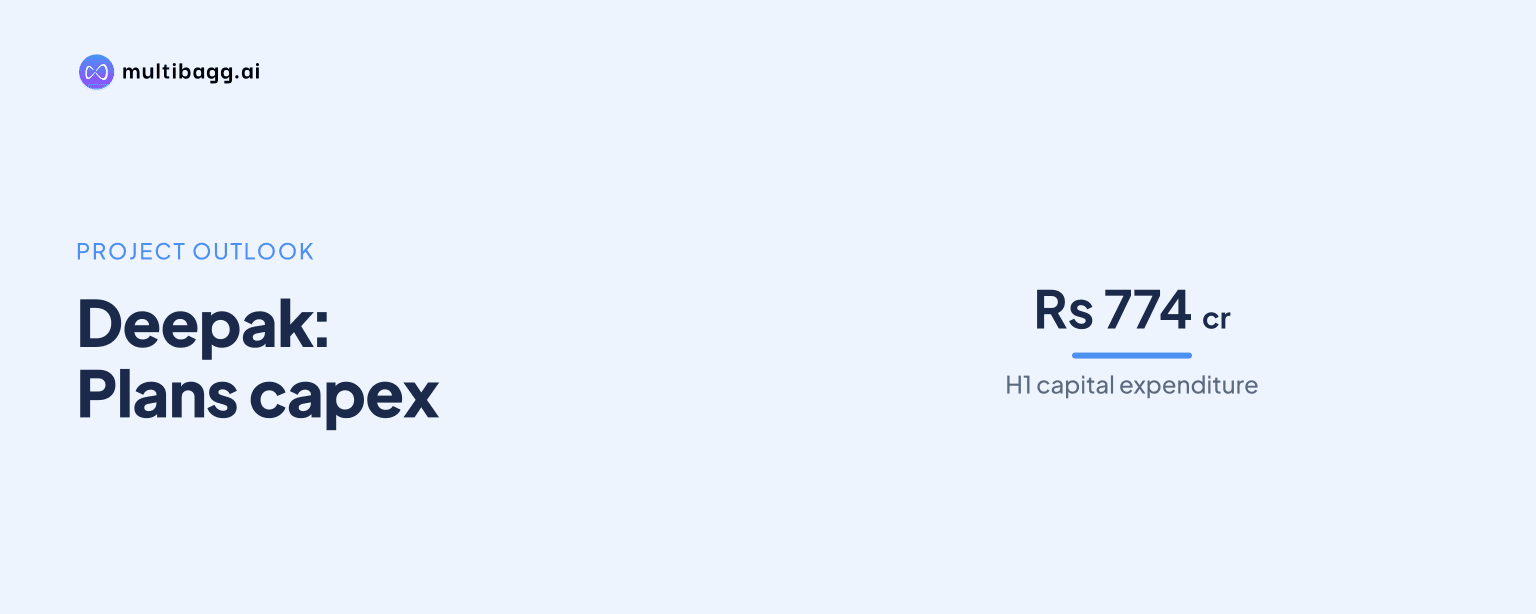
Deepak Fertilisers said it expects normal maintenance capital expenditure for at least next year beyond CCPL, with no other major growth projects currently visible. The shift follows approximately Rs 774 crore of first-half capital expenditure and comes as the Dahej nitric acid and Gopalpur TAN projects were about 98% complete, with operations expected in Q4 FY27.
Know Deepak Fertilisers & Petrochemicals Corp inside out
Results, valuation, peers and who's buying, in one view.
What capex will Deepak Fertilisers undertake after CCPL?
Deepak Fertilisers expects normal maintenance capital expenditure, rather than another major growth commitment, for at least next year after CCPL. Management said CCPL is an already announced project that remains under execution and should be completed over the next few quarters, but it did not disclose the project's cost, scope or specific completion date.
Management said no major growth projects with capital expenditure are currently visible beyond CCPL. It added that it would return with details when it decides on a subsequent growth-capex phase, meaning the call did not establish a longer-term capital-spending target or a ceiling for maintenance expenditure.
The stated plan follows a heavy project-execution period. Deepak Fertilisers incurred approximately Rs 774 crore of capital expenditure in the first half while progressing Dahej and Gopalpur, and management said both projects remain within their approved capital-expenditure budgets.
Which projects are nearing completion at Deepak Fertilisers?
Deepak Fertilisers said the Dahej nitric acid project and Gopalpur TAN project were each approximately 98% complete and expected to commence operations in Q4 FY27. Management described both as being in the final stage of completion and said their commissioning would add to fourth-quarter revenue and profit, although not for the full quarter.
Dahej is set to add almost 3 lakh tonnes of nitric acid capacity annually against Deepak Fertilisers' existing annual nitric acid sales of around 2.4 lakh to 2.5 lakh tonnes. Management said the addition would more than double nitric acid sales after commercialisation, making it the principal disclosed source of future volume growth in that business.
Gopalpur is set to add around 3.8 lakh tonnes of TAN capacity annually, compared with current TAN sales of roughly 5.5 lakh to 5.6 lakh tonnes. Management characterised that addition as 60% to 70% extra capacity and said the plant is intended to serve mining customers in eastern states and adjoining central regions including Madhya Pradesh and Chhattisgarh.
How quickly could Deepak Fertilisers ramp up Gopalpur?
Deepak Fertilisers plans to take Gopalpur to around 75% utilisation within a couple of weeks from the start of production. Management said the project was more or less on track, with most activities completed and only a few final balance activities remaining before commercial production in Q4 FY27.
The company did not provide a full-year FY28 utilisation target, a revenue estimate for Gopalpur or contracted customer volumes. Management said it was in close touch with customers and positioned the Odisha facility as a way to improve supply to mining regions that historically had no ammonium nitrate plant.
The Gopalpur ramp-up will occur as management expects seasonal demand to firm in the second half. It said the higher-demand period generally supports mining-product demand, while mineral producers may seek to catch up on output after lower production in the first half.
Deepak Fertilisers did not disclose TAN pricing or make a quantified forecast for price improvement. It said only that prices tend to be firmer in the second half than in the monsoon period, while the company prices its DMSL products based on the value of composite offerings.
Got a follow-up? Ask IRIS
What does the capex shift mean for Deepak Fertilisers' finances?
Deepak Fertilisers reported net debt of Rs 4,743 crore at the first-half stage and a net debt-to-EBITDA ratio of around 1.5 times. EBITDA means earnings before interest, tax, depreciation and amortisation. Management said this financial position gave it flexibility to complete ongoing projects while maintaining balance-sheet discipline.
The move toward maintenance spending does not mean all project expenditure ends immediately. Dahej and Gopalpur were 98% complete but still awaiting Q4 FY27 commissioning, while CCPL is expected to continue for the next few quarters. Management did not specify whether maintenance spending would be funded from operating cash flow, borrowings or another source.
Management also said internal discussions on a possible demerger or initial public offering were continuing. It gave no concrete decision, structure or timeline, stating only that it would inform investors after those discussions were concluded.
What operating performance supports Deepak Fertilisers' monetisation plan?
Deepak Fertilisers reported Q2 consolidated revenue of Rs 3,334 crore, up 11% year on year, while EBITDA rose 62% to Rs 750 crore. EBITDA margin increased to 22.5% from 15.5% a year earlier, and profit after tax rose 84% to Rs 394 crore.
For the first half, revenue increased 16% year on year to Rs 6,590 crore, EBITDA rose 63% to Rs 1,595 crore and profit after tax increased 93% to Rs 884 crore. Management attributed the improvement to long-term liquefied natural gas sourcing, higher in-house ammonia integration, product mix and downstream value-added products.
Segment conditions varied during the period. Nitric acid volume increased 14% year on year despite softer pricing, while IPA volume was 17,000 tonnes despite a temporary RGP supply constraint. In mining chemicals, business-to-consumer revenue represented about 16% of segment revenue, compared with 14% a year earlier.
Crop nutrition faced uneven rainfall, phosphoric-acid availability constraints, raw-material inflation and elevated channel inventory during Kharif. Management said the excess inventory was entirely in crop nutrition and expected liquidation to begin during the Rabi season, while Croptek and specialty fertilisers accounted for about 28% of quarterly crop-nutrition revenue.
Conclusion
Deepak Fertilisers has indicated that its immediate capital-allocation priority is completing and monetising projects already under construction rather than committing to another large expansion cycle. The first-half spend of approximately Rs 774 crore, the 98% completion of Dahej and Gopalpur, and the maintenance-capex plan beyond CCPL together mark the disclosed transition point.
The next scheduled event is the Q4 FY27 commissioning of Dahej and Gopalpur, including Gopalpur's planned move to around 75% utilisation within weeks of starting production. Investors will also be watching for management's eventual decision on the next growth-capex phase and its unresolved internal discussions on a demerger or initial public offering.