










Deepak Fertilisers Expects 75% Gopalpur Utilisation Within Weeks
Key highlights
- Deepak Fertilisers expects Gopalpur TAN to reach 75% utilisation within a couple of weeks of Q4 FY27 commercial production.
- Management targets 85% utilisation immediately after the initial ramp-up and more than 95% in the following year.
- Gopalpur is expected to add about 380,000 tons of TAN capacity against current sales or capacity of around 550,000 to 560,000 tons.
- Management said eastern India and Singrauli account for 55% of India’s explosives and ammonium nitrate demand.
powered by IRIS
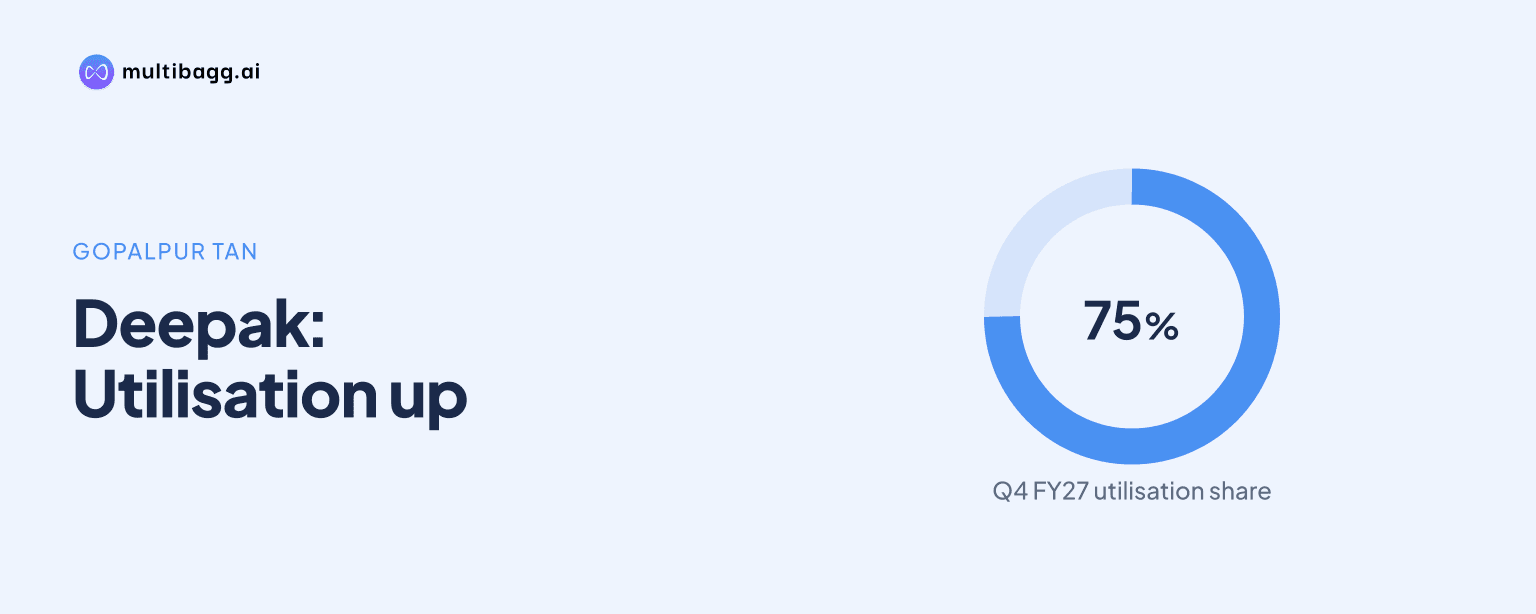
Deepak Fertilisers expects its Gopalpur TAN plant, an ammonium nitrate facility, to reach 75% utilisation within a couple of weeks of first commercial production in Q4 FY27, or the fourth quarter of financial year 2027. Management then plans to reach 85% utilisation immediately afterward and exceed 95% in the following year.
Know Deepak Fertilisers & Petrochemicals Corp inside out
Results, valuation, peers and who's buying, in one view.
When will Gopalpur TAN begin commercial production?
Deepak Fertilisers expects Gopalpur TAN to begin first commercial production in Q4 FY27, with a contribution to fourth-quarter revenue and profit rather than a full-quarter contribution. Management said the Odisha project was more or less on track, with most activities completed and only a few balance activities remaining.
The Q4 FY27 expectation follows an earlier Q3 commissioning expectation raised by an analyst during the call. Management did not give a specific commercial-production date within Q4, but said Gopalpur TAN and the Dahej nitric acid project were each about 98% complete during the first half.
Trial runs were still under way at the time of the call. Management described phase-wise testing across multiple units, including weak nitric acid and concentrated nitric acid at the projects, plus weak nitric acid and TAN units at Gopalpur, making the Q4 FY27 start an expectation rather than a reported commissioning outcome.
How fast does Gopalpur TAN plan to reach 75% utilisation?
Deepak Fertilisers plans to take Gopalpur TAN to 75% utilisation within a couple of weeks from the start of commercial production. Management clarified that 75% is not an average for all of Q4 FY27, because the plant is expected to begin operating only partway through the quarter.
Management’s subsequent ramp-up plan is to reach 85% utilisation immediately after the initial phase and more than 95% in the year after that. These are management targets for a new facility, not reported utilisation levels, and management said the company had planned for a quick ramp-up at its new plants.
The capacity addition makes the utilisation path material to volume growth. Gopalpur is expected to add about 380,000 tons of TAN capacity, against current TAN sales or capacity of around 550,000 to 560,000 tons, which management described as a 60% to 70% increase.
Got a follow-up? Ask IRIS
Why does management expect Gopalpur TAN demand to absorb new output?
Deepak Fertilisers expects Gopalpur TAN to serve mining customers in eastern India and adjoining central regions that have historically depended on imported ammonium nitrate. Management said the eastern states and the Singrauli region of Madhya Pradesh account for 55% of India’s explosives and ammonium nitrate demand, compared with 45% for the rest of India.
The plant is intended to supply existing customers closer to their operations, rather than depend only on new customer acquisition. Management said these customers are already supplied from the Taloja plant, while the Gopalpur location can reduce their dependence on imports and domestic transport from other regions.
Management also said mining growth in the eastern states and Singrauli is likely to be higher than in the rest of India. It acknowledged that new domestic supply can cause initial market turbulence, but said the market should settle; it did not provide a TAN price forecast or disclose contracted customer volumes.
Management said prices generally firm in the second half compared with the monsoon period as demand rises cyclically. It cited mining companies seeking to catch up on mineral production after the first half, while maintaining that its pricing is based on the value of composite offerings rather than disclosing specific TAN price levels.
How will Gopalpur and Dahej change the project programme?
Deepak Fertilisers expects Gopalpur TAN and Dahej nitric acid to drive the next phase of volume growth from Q4 FY27 and into FY28. The Dahej project is expected to add almost 300,000 tons of nitric acid, compared with current annual nitric acid sales of around 240,000 to 250,000 tons, more than doubling the existing sales base.
The company said the two projects have a combined cost of about Rs 4,600 crore and remain within their approved capital-expenditure budgets. Management expects around 55% to 60% of project costs to be funded by term loans, meaning the related interest impact will become visible as the facilities are commissioned.
Management estimated annual depreciation of around Rs 180 crore to Rs 200 crore for the two plants, based on a 25-year capitalisation period. It also said direct costs of the new plants are capitalised during construction, while some indirect corporate costs can rise as additional project resources are used.
The first quarter of reported contribution will therefore combine a partial-quarter production period with ramp-up costs and financing effects. Management said the projects will add to Q4 FY27 revenue and profit, but stated that they will not contribute for the full quarter because commercial production will start during it.
Conclusion
Deepak Fertilisers has set a defined monetisation plan for Gopalpur TAN: Q4 FY27 commercial production, 75% utilisation within weeks, 85% immediately afterward and more than 95% in the following year. The plan coincides with about 380,000 tons of additional TAN capacity and almost 300,000 tons of added nitric acid capacity at Dahej.
The next disclosed test is the Q4 FY27 start of commercial production and the resulting partial-quarter revenue and profit contribution. Management’s phase-wise trials, the pace toward 75% utilisation, customer absorption in the 55% eastern and Singrauli demand region, and the effect of term-loan funding and Rs 180 crore to Rs 200 crore of annual depreciation will determine how the ramp is reflected in reported results.