










Delhivery calls automation existential amid labour volatility in India
Key highlights
- Delhivery handled 325 million Express shipments in Q2FY27, up 32% year on year.
- Delhivery reported Rs 3,066 crore of Q2FY27 revenue from services, up 20% year on year.
- Delhivery reported Q2FY27 adjusted EBITDA of Rs 123 crore, equal to 4% of revenue.
- Delhivery held Rs 4,676 crore of cash on its Q2FY27 balance sheet.
powered by IRIS
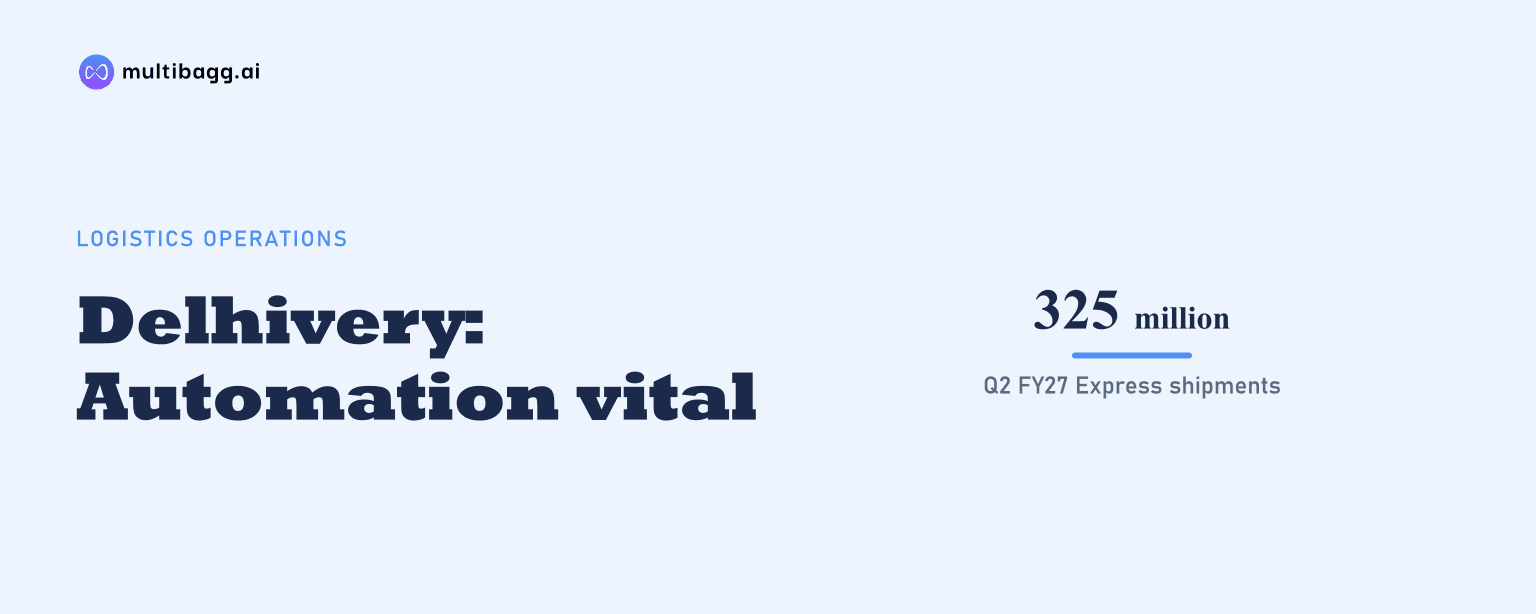
Delhivery says automation has become an existential investment in Q2FY27 because labour availability, workforce regulation and climate-related productivity risks are changing the economics of manual operations; the company handled 325 million Express shipments, up 32% year on year, as management expanded work on robotics and artificial intelligence.
Know Delhivery inside out
Results, valuation, peers and who's buying, in one view.
Why does Delhivery call automation existential?
Delhivery calls automation existential because management sees the Indian labour environment as increasingly volatile and difficult to manage at network scale. Chief Executive Officer Sahil Barua cited labour availability, large seasonal fluctuations in workforce availability, changing minimum wages and changing compliance requirements as the main reasons for the view.
Delhivery also includes climate-related effects in its assessment. Barua said climate affects labour availability and workforce productivity, and management believes Indian labour, adjusted for productivity, is becoming increasingly uncompetitive. That is management’s assessment rather than a disclosed company-wide labour-cost measure, but it explains why the company is comparing manual throughput with automation economics.
The issue is material to Delhivery’s operating scale. Express shipments reached 325 million in Q2FY27, up 32% year on year, while part-truckload, or PTL, freight volume was 545,000 metric tonnes, up 14.2%. Labour shortages or lower productivity can affect sorting, facility movements and mid-mile operations across both parcel and freight networks.
What robotics is Delhivery deploying?
Delhivery is self-developing autonomously guided vehicles for movements within facilities and piloting other robotic systems in mid-mile operations. Management did not disclose the number of vehicles, pilot locations, capital expenditure or deployment timetable, leaving the current scale of the programme undisclosed.
Delhivery said the cost curve for automation has improved enough to make newer robotic systems deployable where they may not have been viable three or four years ago. Management linked that view partly to its experience as a 40% shareholder in Falcon Autotech, although the call did not disclose Falcon’s revenue, valuation or any separate Delhivery investment amount.
Management expects the newer systems’ payback periods to at least match those of earlier tractor-trailer and automated-sorter investments. Barua said those earlier investments, including sorter capacity bought around 12 years ago, had initially faced market scepticism. The expected payback on current robotics is a forward-looking management view, not a reported return or a numerical target.
How is Delhivery using AI in operations?
Delhivery says four quarters of artificial-intelligence investment are now producing material service and cost outcomes. The programme initially focused on the software development life cycle and technology-team productivity, but current applications include claims reduction, automated sales-bid generation and Delhivery Maps.
Delhivery Maps has improved over the last two quarters and is saving the company about USD 1 million a year compared with using Google application programming interfaces, or APIs, according to management. The call did not disclose total technology spending or separate savings from Maps, claims processing and sales tools.
Artificial intelligence is also intended to improve working capital through operating processes rather than accounting treatment. Chief Financial Officer Vivek Pabari said automation can enable faster billing, more accurate billing and faster claims resolution, which can improve collections and compress the working-capital cycle.
Unbilled receivables are separate from that potential benefit, Delhivery said. Pabari explained that unbilled revenue is an accounting construct: partial revenue is accrued when a shipment has not completed its network life cycle. Therefore, management does not expect AI to take unbilled receivables to zero, even if it improves the collections process.
Got a follow-up? Ask IRIS
How does Delhivery’s financial performance frame automation?
Delhivery reported Rs 3,066 crore of revenue from services in Q2FY27, its first quarter above Rs 3,000 crore, up 20% year on year. Adjusted earnings before interest, tax, depreciation and amortisation, or EBITDA, were Rs 123 crore, equal to 4% of revenue, while profit after tax was Rs 41 crore.
The period comparison shows that Express expanded faster than PTL freight in Q2FY27. Express shipment volume rose 32% year on year, compared with 14.2% growth in PTL freight tonnage, while revenue from services increased 20%. Delhivery did not attribute either volume growth rate or revenue growth specifically to automation.
Delhivery also reported Rs 4,676 crore of cash on its balance sheet in Q2FY27. That cash position provides context for continued investment in engineering and technology, but management did not allocate a specific amount to robotics, AI or Falcon Autotech.
What evidence should investors watch from Delhivery’s automation programme?
The key evidence to watch is whether Delhivery moves from pilots to measurable deployment in facilities and mid-mile operations. Management has disclosed autonomously guided vehicles and other robotic experiments, but has not disclosed facility coverage, units installed, capital committed or an FY27 deployment target.
A second measure is whether AI produces observable collections and service improvements. Delhivery has identified faster billing, billing accuracy and claims resolution as mechanisms for reducing the working-capital cycle, but it did not provide a baseline for collection days, a target for receivables or a monetary AI savings target beyond the USD 1 million annual Maps saving.
Management’s comparison with prior tractor trailers and sorter systems sets the relevant benchmark. Delhivery expects new robotics paybacks to match those earlier investments, while reporting Q2FY27 adjusted EBITDA of Rs 123 crore. Future disclosures on service quality, labour productivity, capacity and costs would show whether that expectation is translating into reported operating outcomes.
Conclusion
Delhivery’s automation strategy is a response to labour availability, regulation and climate-related productivity risks rather than a discretionary efficiency project, according to management. The company is applying physical robotics to in-facility and mid-mile work while using AI for claims, sales bids, mapping, billing and collections processes across a network that carried 325 million Express shipments in Q2FY27.
The next issue is the unresolved gap between pilots and disclosed operating returns. Management expects new robotic systems to deliver paybacks at least comparable with earlier tractor-trailer and sorter investments, but has given no numerical target or rollout schedule. Investors should watch for quantified deployment, collection-cycle changes and reported service or cost outcomes in subsequent updates.