










Delhivery sees Rs 90,000-100,000 crore PTL opportunity
Key highlights
- Delhivery estimates the PTL addressable market at a minimum of Rs 90,000-100,000 crore.
- Delhivery said the six largest organised PTL players together account for nearly Rs 12,000 crore.
- Management said less than 30% of PTL yield improvement came from inflation-linked commercial revisions.
- Delhivery said the Express market could grow 15-20% in volume terms over the short to medium term.
powered by IRIS
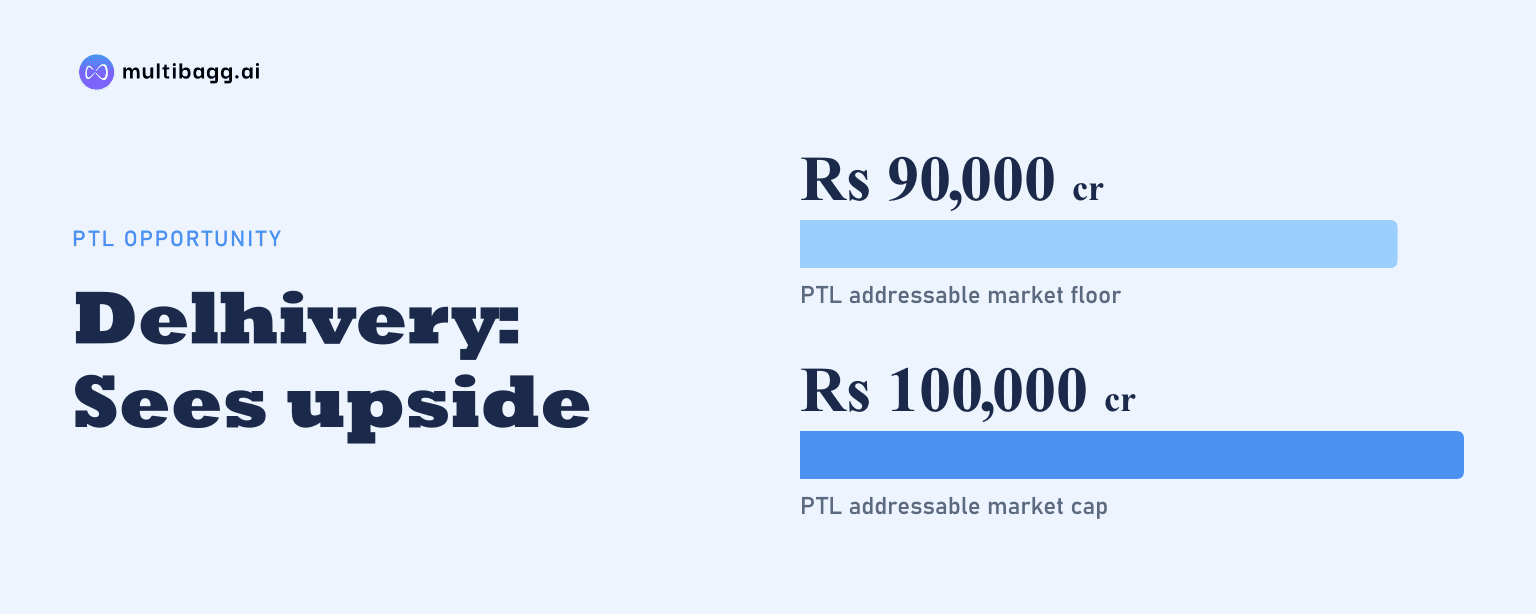
Delhivery estimates India’s part-truckload market at a minimum of Rs 90,000-100,000 crore, more than five times the Rs 15,000-20,000 crore range raised by an analyst, because it includes unorganised freight, migration to faster services and potential movement from full-truckload shipments.
Know Delhivery inside out
Results, valuation, peers and who's buying, in one view.
Why does Delhivery put the PTL market at Rs 90,000-100,000 crore?
Delhivery says the total addressable market, or TAM, for part-truckload, or PTL, freight is at least Rs 90,000-100,000 crore. Management described this as a conservative minimum estimate based on what it knows so far and said the opportunity could be larger. PTL refers to shipments that do not require an entire truck.
The estimate differs sharply from the Rs 15,000-20,000 crore range cited by an analyst for the Express business-to-business, or B2B, market. Delhivery said the six largest organised PTL operators alone account for nearly Rs 12,000 crore on a back-of-the-envelope basis, before considering numerous smaller providers and freight handled outside organised networks.
Delhivery’s market-size assessment is management’s estimate, not revenue guidance or an independently detailed calculation disclosed on the call. The company did not provide a split of the Rs 90,000-100,000 crore opportunity between organised and unorganised freight, customer categories or regions.
How does unorganised freight expand Delhivery’s PTL opportunity?
Delhivery says a very large unorganised PTL segment expands the opportunity beyond the revenue currently reported by organised operators. Management said some markets remain completely unserved by organised providers, leaving freight demand to be handled by fragmented operators or outside national logistics networks.
Management gave the example of a large shipper located south of Mangalore that may not be served by an organised player. Such locations have historically been classified in the logistics industry as ODA, or out-of-delivery area. Delhivery used this coverage gap to explain why it does not view the market as limited to the revenue of today’s largest organised companies.
The unorganised-market argument also addressed an analyst’s question about the longevity of 20% PTL growth. Delhivery said conversion of freight from fragmented providers gives it a growth source beyond the expansion of existing organised PTL volumes. It did not quantify the current value of freight in those underserved markets or state a timetable for converting it.
This opportunity depends on network coverage rather than simply on overall freight demand. Delhivery said it will continue investing in differentiated capacity, technology and engineering, while management argued that network quality becomes more important as logistics operators handle larger shipment volumes.
Why does Delhivery expect demand to move to faster PTL services?
Delhivery says demand can shift from slower general PTL services to faster PTL as operators add infrastructure, trucks and broader network reach. Management identified this migration as a second industry tailwind after the conversion of unorganised freight, alongside improved road quality that supports faster movement.
The company said there is not a very significant cost difference between Economy PTL and Express PTL. Delhivery said its network can provide an economy product on express routes, which management called “express rails.” According to management, this can raise the value of the service and support some improvement in yield.
That service proposition was linked to Delhivery’s pricing comments elsewhere in the call. Management said less than 30% of the increase in PTL yield came from commercial revisions linked to cost inflation, with the majority coming from yield improvement. The company did not disclose PTL revenue, shipment volumes or a separate quarterly PTL yield figure.
The faster-service opportunity therefore rests on service levels and coverage, rather than on a quantified conversion forecast. Delhivery did not disclose how much of its Rs 90,000-100,000 crore TAM currently uses slow PTL, nor did it set a target date for customers to move to faster offerings.
Got a follow-up? Ask IRIS
Can full-truckload freight shift to Delhivery’s PTL network?
Delhivery says some full-truckload, or FTL, freight can shift to PTL as customers seek faster transportation and lower inventory holdings. Management said businesses can choose between carrying larger inventories and paying a higher transport premium for part-load freight that enables them to hold less stock.
Management said lower inventory can improve working capital for businesses using its services. Under this framework, FTL-to-PTL migration is not just a change in freight demand; it is a supply-chain decision balancing transportation cost against the capital tied up in inventory. Delhivery did not quantify the potential conversion volume, price premium or customer working-capital benefit.
The three growth mechanisms are distinct. Unorganised-market conversion brings freight into organised networks, slow-to-fast PTL migration changes the service level used for part-load freight, and FTL-to-PTL migration changes the shipment format. Delhivery said these factors could make growth exceed regular gross domestic product, or GDP, growth.
Management also said the broader Express market could grow at 15-20% in volume terms over the short to medium term. Delhivery said it expects to grow at least at that pace, if not faster, as it gains share, although it did not present that range as a separate PTL revenue forecast.
What does Delhivery say about future market share?
Delhivery says it expects to continue gaining share through its network, technology and engineering investments. Management said logistics is easy to enter but hard to scale, and argued that the quality of the underlying network increasingly determines an operator’s ability to handle more volume.
Management said Delhivery has operated its network for 15 years and has built an integrated network with technical and engineering expertise. It also said the company moved from about 3% market share to being, in management’s description, the dominant third-party shipper in India over the past 10 years.
Delhivery did not state a PTL market-share target for FY29 or another date. Management said its share could rise whether the industry consolidates through acquisitions or through competitors losing share, and cautioned that individual quarters can move up and down.
The company’s case for continued share gains is therefore based on capabilities rather than a disclosed numerical target. Delhivery said it will keep investing in capacity and capabilities, but did not provide PTL-specific capital expenditure, coverage expansion or margin targets on the call.
Conclusion
Delhivery’s central claim is that PTL is a materially larger opportunity than the Rs 15,000-20,000 crore industry range raised on the call. Its minimum Rs 90,000-100,000 crore estimate includes unorganised freight, faster PTL adoption and possible FTL-to-PTL switching, while the nearly Rs 12,000 crore revenue of six large organised players provides management’s starting comparison.
The next point to watch is evidence that Delhivery’s continuing investment in network capacity, technology and engineering converts underserved freight and raises share. Management’s stated 15-20% short- to medium-term Express volume-growth view provides a benchmark for future commentary, while the pace of PTL conversion remains unresolved.