










Delhivery sees Express growth above its FY27 guidance band
Key highlights
- Delhivery handled 325 million Express Parcel shipments in Q2FY27, about 32% more than a year earlier.
- Delhivery said Express Parcel growth was beyond its original 20-30% FY27 guidance band as of October 2026.
- Delhivery’s revenue from services reached Rs 3,066 crore in Q2FY27, up 20% year on year.
- Delhivery reported Rs 123 crore of adjusted EBITDA and Rs 41 crore of profit after tax in Q2FY27.
powered by IRIS
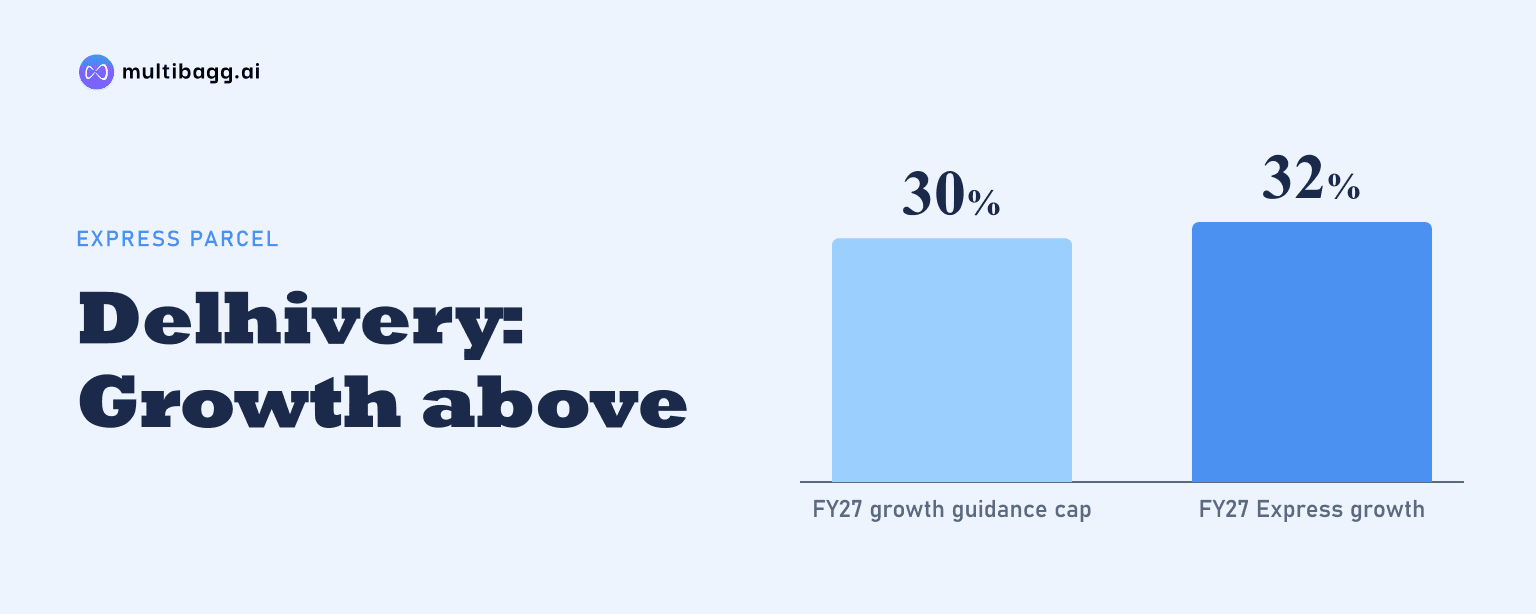
Delhivery Limited said on October 30, 2026, that Express Parcel growth was running beyond the upper end of its original 20-30% FY27 guidance band, after Q2FY27 shipments reached a record 325 million, up about 32% year on year. Management retained its formal range despite a stronger October and volatile macro conditions.
Know Delhivery inside out
Results, valuation, peers and who's buying, in one view.
Has Delhivery formally raised its FY27 Express Parcel guidance?
Delhivery has not formally raised its 20-30% FY27 Express Parcel growth guidance, although management said it was operating beyond the range’s upper end as of October 2026. Chief Executive Officer Sahil Barua said Q2FY27 volume growth exceeded 30% year on year and October had also been a good month, putting the company ahead of its expectations at that point.
Management’s stated downside case is now reaching the upper end of the original range. Barua said Delhivery did not see a reason to revise its estimate, but added that it should “easily” be at the upper end at worst. This is a more positive assessment of the likely FY27 outcome, rather than a new published numerical target.
The outlook follows a contrast between the first two quarters of FY27. Management described Q1FY27 as challenging because of macro volatility, while Q2FY27 went more or less to plan. Delhivery said volumes broadly held up despite that environment, but Barua cited the US midterm elections scheduled for the Tuesday after the October 30 call as a reason to remain cautious about external conditions.
How fast did Delhivery’s Express Parcel business grow in Q2FY27?
Delhivery’s Express Parcel business handled 325 million shipments in Q2FY27, about 32% more than a year earlier and above the original FY27 guidance range’s 30% ceiling. The September-quarter volume was a record for the company, but the transcript did not disclose an October shipment figure or a revised full-year volume forecast.
The Express result grew faster than Delhivery’s part-truckload, or PTL, freight operation. PTL moved 545,000 metric tonnes in Q2FY27, up 14.2% year on year, compared with the 32% increase in Express shipments. The two measures are not directly comparable because Express is measured in shipments and PTL in freight tonnes, but both businesses reported year-on-year growth.
Revenue from services rose 20% year on year to Rs 3,066 crore in Q2FY27, slower than the 32% Express shipment increase. Delhivery did not disclose Express revenue, revenue per shipment or the mix of customers and services behind this difference. The call therefore supports a comparison between volume and total service-revenue growth, but not a conclusion on Express pricing or yield.
What did record volumes mean for Delhivery’s Q2FY27 results?
Delhivery reported record quarterly volumes, revenue and overall business profitability in Q2FY27, with revenue from services crossing Rs 3,000 crore for the first time at Rs 3,066 crore. Adjusted earnings before interest, tax, depreciation and amortisation, or adjusted EBITDA, was Rs 123 crore, equal to 4% of revenue, and profit after tax was Rs 41 crore.
The company ended Q2FY27 with Rs 4,676 crore of cash on its balance sheet. Management said efforts over several quarters to manage capital intensity and improve net working capital were beginning to contribute, alongside investments in newer businesses and in engineering and technology. It did not identify the contribution of Express Parcel specifically to the Rs 123 crore of adjusted EBITDA.
Management said artificial intelligence, or AI, work over the preceding four quarters was starting to improve service and cost outcomes. Barua cited lower claims, automatically generated sales bids and Delhivery Maps, while Chief Financial Officer Vivek Pabari said automation could support faster and more accurate billing, claims resolution and collections.
Pabari said these measures may further compress Delhivery’s working-capital cycle, but would not eliminate unbilled receivables. He described unbilled receivables as an accounting construct: partial revenue is accrued while a shipment has not completed its lifecycle in the network. The distinction means improved billing can aid collections without removing revenue accrued on incomplete shipments.
Got a follow-up? Ask IRIS
Which initiatives could add to Delhivery’s growth beyond FY27?
Delhivery is expanding same-day and next-day delivery, fulfilment, local transport and international shipping, but management did not quantify how much these businesses contributed to the 325 million Q2FY27 Express Parcel shipments. Barua said the same-day and next-day operation, including integrated fulfilment for vertical brands, could look like a Rs 300 crore to Rs 500 crore business if it were separately reported.
The same-day and next-day operation runs on Delhivery’s wider Express network, which is why management does not separately disclose it. The company has fulfilment centres across the top 15 major cities and said it would continue to expand its footprint and client base. That plan gives the service a defined operational expansion path, although no FY27 volume target was disclosed.
Delhivery Local, the in-city commercial vehicle rental service within Delhivery Direct, had crossed Rs 200 crore of annual recurring revenue, or ARR, by October 30 and was operating in eight cities. Management’s earlier goal was Rs 240 crore to Rs 250 crore of ARR by the end of FY27; Barua said the business could instead reach a Rs 270 crore to Rs 280 crore run rate.
Management also said Delhivery Local could reach contribution-margin break-even as early as Q4FY27, compared with its prior expectation of early to mid-FY28. Separately, the international Saver business was nearing Rs 140 crore of ARR, grew 55% quarter on quarter from Q1FY27 to Q2FY27, and reached service-level EBITDA break-even, according to Barua.
What could affect Delhivery’s ability to sustain Express growth?
Delhivery’s ability to sustain growth above its FY27 guidance band depends partly on macro conditions that management continued to call volatile on October 30, 2026. The company’s reported evidence was 32% year-on-year Express shipment growth in Q2FY27 and a stronger October, but it did not disclose a full-year shipment forecast beyond its existing 20-30% range.
Automation is central to management’s execution plan because it identified labour availability, seasonal workforce changes, wage revisions, compliance requirements and climate effects as operating challenges. Delhivery owns 40% of Falcon Autotech and is piloting self-developed autonomously guided vehicles for in-facility movements, along with other robotic systems in its mid-mile operations.
Barua said automation paybacks should at least match those from earlier investments in tractor trailers and sorter systems, though he did not disclose the capital outlay or expected payback period. Management’s reasoning was that automation prices are declining and Delhivery has experience with these systems. This remains a management expectation rather than a reported financial outcome.
Conclusion
Delhivery’s Q2FY27 performance supports management’s view that Express Parcel growth is running beyond its original 20-30% FY27 guidance band. Record Express shipments of 325 million, up about 32% year on year, coincided with Rs 3,066 crore of service revenue, Rs 123 crore of adjusted EBITDA and Rs 41 crore of profit after tax.
The next disclosed milestones are the remaining FY27 Express shipment trend, the possibility of Delhivery Local reaching contribution-margin break-even in Q4FY27, and management’s planned end-of-FY27 update on financial services. Delhivery also plans to keep expanding fulfilment centres and deploying automation, while management has yet to issue a revised formal Express Parcel growth target.