










Delhivery says faster delivery needs no new fixed infrastructure
Key highlights
- Delhivery said SDD and NDD expansion needs no specific new fulfilment-centre or transportation infrastructure.
- Delhivery previously operated about 20-30 dark stores across three to four cities before integrating rapid delivery into its fulfilment network.
- Management expects aggregate transportation margins to expand by 130-150 basis points between FY26 and FY27.
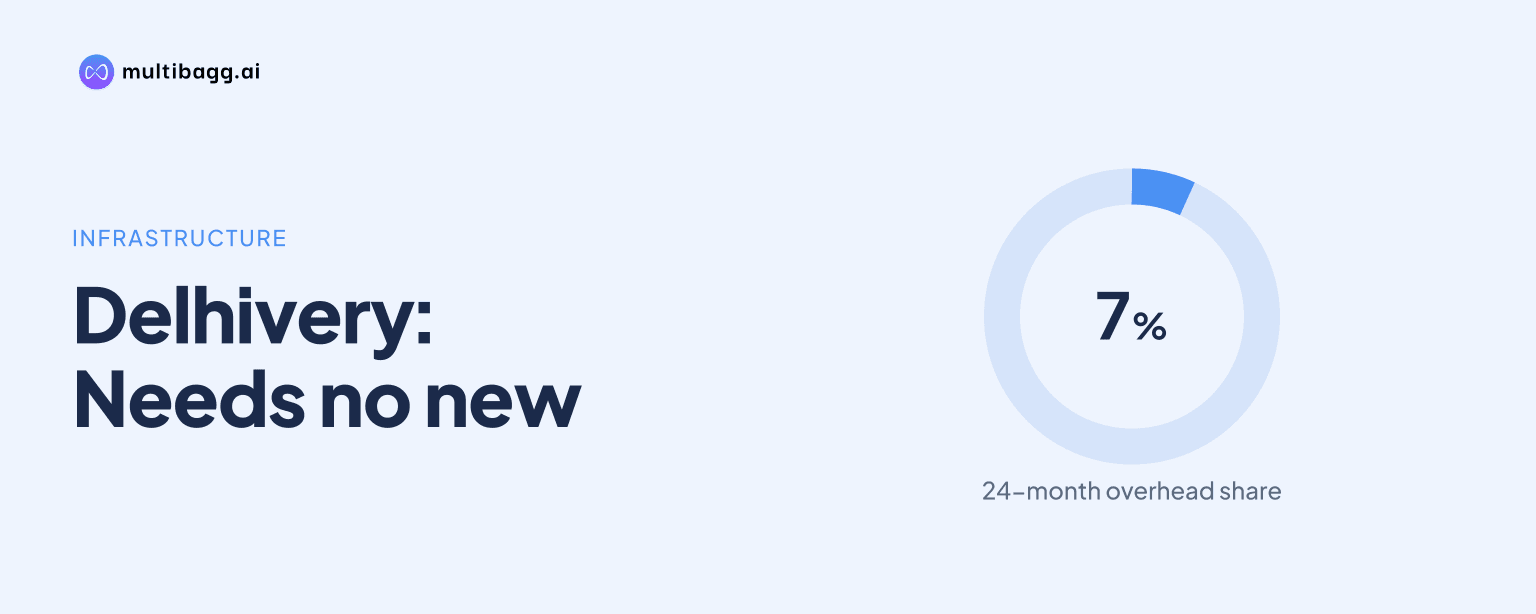
- Delhivery said corporate overheads as a share of revenue should begin declining from Q4, with 7% potentially achievable within about 24 months.
powered by IRIS
Delhivery said on its earnings call that expanding same-day delivery and next-day delivery will require no specific new fulfilment-centre or transportation infrastructure, after its rapid-delivery model had reached about 20-30 dark stores across three to four cities. Management said line-haul routing changes and higher Part Truckload, or PTL, density can make more locations viable.
Know Delhivery inside out
Results, valuation, peers and who's buying, in one view.
How will Delhivery expand same-day and next-day delivery?
Delhivery said it will expand same-day delivery, or SDD, and next-day delivery, or NDD, mainly by changing line-haul routing rather than building new fixed assets. Management said the operational work is to route more shipments into eligible locations at faster speeds. Where volume reaches an optimal threshold, the addition may be an already efficient vehicle within the existing fleet rather than a new fulfilment centre or a separate transport network.
Delhivery described the expansion as variable rather than fixed-cost growth. Faster coverage requires a minimum viable shipment volume in each location, but management said that threshold can be met through the combined network rather than Express volumes alone. The company said there would be no fundamental increase in fixed cost from extending the SDD and NDD network.
PTL growth is central to that approach because its loads can add network density in locations that might otherwise lack sufficient Express volume. Management said Delhivery was once primarily an Express-led network carrying PTL, but in some situations has become a PTL-led network carrying Express. That shift can widen Express service availability without a fundamental increase in infrastructure.
The model differs from one that needs a dedicated facility footprint in every new fast-delivery market. Management said that as PTL volumes grow, even distant locations can become viable for Express rapid delivery. Delhivery did not disclose the current number of SDD or NDD locations, or a target for future geographic coverage, on the call.
Why did Delhivery move rapid delivery away from dark stores?
Delhivery said it has not stopped rapid delivery, but has folded the service into its broader fulfilment network. The company initially provided the service through dark stores and, at its peak, reached about 20-30 dark stores across three to four cities. Management concluded that its larger fulfilment network could serve the same customer need for fast delivery in the same city.
Management said separate inventory pools for a two-hour order, an eight-hour order, a next-day order and an intercity order would add costs for brands. Its alternative is to use one wider inventory pool for several delivery promises. Delhivery said its e-commerce fulfilment operation is already significant within its Supply Chain Services, or SCS, business.
The change means the SDD and NDD plan is not presented as a return to building a separate dark-store estate. Instead, Delhivery said it can use fulfilment capacity already in place and make transport-network decisions that speed deliveries. Management said the rapid-delivery service continues even though the fulfilment architecture has changed.
This arrangement depends on volume density rather than a separately owned inventory pool for each delivery speed. Delhivery said PTL growth can support the network in locations where Express traffic alone would not justify faster delivery. Management did not provide a separate revenue, margin or shipment-volume figure for rapid delivery, SDD or NDD.
Got a follow-up? Ask IRIS
What does PTL growth mean for Delhivery's delivery economics?
Delhivery expects PTL volume growth and PTL margin expansion to improve overall network efficiency between FY26 and FY27. Management estimated that aggregate transportation margins could expand by 130-150 basis points, even under a conservative view. One basis point is one-hundredth of a percentage point, and management said higher PTL density creates a knock-on benefit for Express.
For Express, management said a margin of about 17% in FY27 was a reasonable expectation, compared with almost 17% in the prior year. It said a major change in fuel prices could affect that outcome, while stating that it did not foresee a reason for margins not to persist. Delhivery did not give a standalone profitability target for SDD or NDD.
Pricing also affects the shared-network model. Delhivery said cost-related price revisions started around the middle to end of Q1 and largely came through in Q2 across Express and PTL. In PTL, management said a smaller portion of yield change came from inflation-related revisions, while contractual revisions and value-added service pricing accounted for more of the movement.
Management said yields expanded from Q1 to Q2, which it described as historically unusual. Q3 normally has higher heavy-goods volumes, but management said there was no structural change expected in Q3 yields versus Q2 and that the outcome depended on November and December. The company’s case is that density and routing, rather than a new fixed asset base, can support faster-service economics.
What does this strategy imply for Delhivery's growth and cost plans?
Delhivery said e-commerce volume growth of roughly 15-20% remained a reasonable guide despite a higher comparison base. Management also said 16-20% sounded reasonable when discussing October, when its volumes were slightly ahead of its internal expectation. It distinguished volume performance from gross merchandise value, or GMV, commentary around electronics-led retail sales.
Management attributed its outlook to market-share gains and investments in more productive facilities, staff and vehicles, alongside technology-led service improvements. It said volatile operating conditions tend to favour Delhivery, which is management’s assessment rather than a quantified market forecast. The company did not disclose how much future volume growth would come specifically from SDD or NDD.
The absence of a separate fixed-infrastructure build for faster delivery is relevant to Delhivery’s overhead plan. Management said corporate overheads as a percentage of revenue should begin declining from Q4 and beyond. It said reaching 7% should not take longer than about 24 months, although the timing depends on how much it chooses to grow certain businesses.
Delhivery said it invested more in technology during the year, including additional capacity and capabilities within teams. Management said that spending responded to a new technology it regarded as consequential, while maintaining that it had a firm handle on reducing corporate overhead intensity. The routing-based SDD and NDD plan is intended to add reach without creating a matching layer of fulfilment centres or transport assets.
Conclusion
Delhivery’s rapid-delivery strategy is to use its existing fulfilment and transportation network more intensively rather than recreate a dark-store model. The operating mechanism is PTL density, which management says can make more locations viable for Express-based SDD and NDD while contributing to estimated aggregate transportation-margin expansion of 130-150 basis points between FY26 and FY27.
The next disclosures to watch are whether corporate overheads begin declining from Q4, whether PTL volume growth continues to improve network density, and whether management reports broader SDD and NDD coverage. Management said the 7% corporate-overhead ratio should be achievable within about 24 months, subject to its decisions on business expansion.