










Delhivery newer businesses exceed Rs 450 crore run rate
Key highlights
- Delhivery’s Local, Direct and international businesses exceeded a combined Rs 450 crore annual revenue run rate in Q2FY27.
- Delhivery Local had crossed Rs 200 crore ARR and could reach contribution-margin breakeven as early as Q4FY27.
- Saver international was close to Rs 140 crore ARR, grew 55% quarter on quarter and reached service-EBITDA breakeven.
- Delhivery reported Q2FY27 revenue from services of Rs 3,066 crore, up 20% year on year.
powered by IRIS
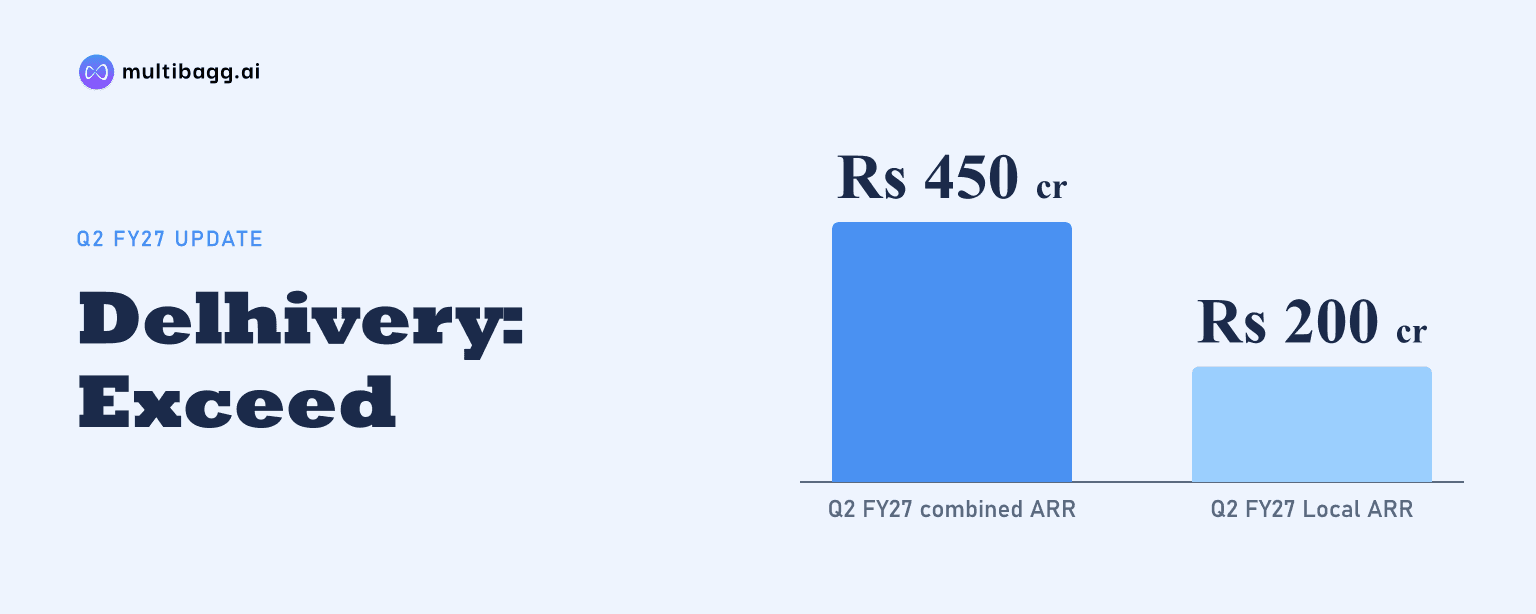
Delhivery Limited’s Local, Direct and international businesses exceeded a combined Rs 450 crore annual revenue run rate in Q2FY27, based on Local surpassing Rs 200 crore, consumer Direct nearing Rs 100 crore and Saver international approaching Rs 140 crore, alongside a separately material intercity Direct operation. Local and Saver also advanced toward profitability faster than management initially expected.
Know Delhivery inside out
Results, valuation, peers and who's buying, in one view.
What revenue run rate have Delhivery’s newer businesses reached?
Delhivery’s newer Local, Direct and international operations have exceeded a combined Rs 450 crore annual revenue run rate in Q2FY27. The disclosed components were Delhivery Local at more than Rs 200 crore, Delhivery Direct for consumers at close to Rs 100 crore and Saver international at close to Rs 140 crore, while management also described intercity Direct as a material business.
Annual revenue run rate, or ARR, represents the revenue pace at a point in time expressed over a full year. The company did not disclose one consolidated ARR figure or a quarterly revenue split for these operations. However, Local had already crossed Rs 200 crore, while the consumer Direct and Saver figures were described as close to their stated levels, and intercity Direct adds to the combined total.
The businesses are distinct from Delhivery’s established Express and part-truckload network. Local is an in-city, on-demand commercial vehicle rental service, while Direct serves non-e-commerce express-parcel customers through consumer and small-business channels. Saver is the company’s economy international shipping product.
How fast is Delhivery Local moving toward profitability?
Delhivery Local could reach contribution-margin breakeven as early as Q4FY27, versus management’s prior expectation of early to mid-FY28. Contribution margin measures revenue after directly attributable operating costs, and management said Local was ahead of its original contribution-margin expectations in eight cities as of the October 30, 2026 earnings call.
Management’s original aim was for Local to exit FY27 at an ARR of Rs 240 crore to Rs 250 crore. With the business already above Rs 200 crore, management said it could potentially reach a Rs 270 crore to Rs 280 crore run rate if current progress continued. This is a management expectation rather than reported revenue guidance.
Local’s expansion addresses commercial in-city shipping using light commercial vehicles, or LCVs. Management said the addressable market for this activity was large and noted that other operators already serve the segment, but it gave no market-share figure, customer count or separate quarterly revenue for Local.
How are Delhivery Direct and Saver international developing?
Delhivery Direct for consumers was operating at close to a Rs 100 crore run rate after about 15 months of focused effort, while Saver international was close to Rs 140 crore ARR in Q2FY27. Consumers access Direct through the Delhivery Direct application, while small and medium enterprises, or SMEs, use the Delhivery One application.
The Direct offering has two elements: Local for in-city commercial vehicle rental and an intercity service for non-e-commerce express-parcel shippers. Management said the intercity business was slowly becoming material, but it did not provide a separate ARR, shipment volume or profitability figure for that operation.
Saver recorded the fastest disclosed recent growth among the newer services, rising 55% quarter on quarter between Q1FY27 and Q2FY27. It also broke even at service earnings before interest, tax, depreciation and amortisation, or EBITDA, level, making it the only one of the three businesses with a specifically disclosed profitability milestone in the call.
Got a follow-up? Ask IRIS
How do the newer businesses compare with Delhivery’s core operations?
Delhivery’s newer businesses are smaller than the core network, which generated Rs 3,066 crore of revenue from services in Q2FY27, up 20% year on year. Adjusted EBITDA was Rs 123 crore, equal to 4% of revenue, and profit after tax was Rs 41 crore for the quarter.
Express handled 325 million shipments in Q2FY27, a 32% year-on-year increase, while part-truckload, or PTL, freight volume reached 545,000 metric tonnes, up 14.2%. These core volumes provide the network context for the newer businesses, although the call did not say that Local, Direct or Saver use the same assets or cost base in every case.
Same-day and next-day delivery is another adjacent activity with a larger scale than the individually disclosed newer operations. Management said that, if separated, its transportation and integrated fulfilment services for vertical brands would probably appear as a Rs 300 crore to Rs 500 crore business, but it does not report that activity separately because it runs on the wider Express network.
What plans could expand Delhivery’s newer revenue streams?
Delhivery plans to keep expanding fulfilment centres and its customer base for same-day and next-day delivery, with several centres already operating across the top 15 major cities. Management said this integrated fulfilment model combines delivery with services provided to vertical brands, rather than being only a transportation product.
For international shipping, management estimated that economy and express services together could become a Rs 900 crore to Rs 1,000 crore revenue opportunity over the next three to four years. That range is management’s estimate of the opportunity, not a current run rate or a formal company forecast.
Financial services remain at a much earlier stage than Saver, Local and Direct. Management said monetisation had begun but was very early, following regulatory preparation during FY27, and it expects to be in a better position to comment by the end of FY27. The intended model includes partner-led loans for fleet owners attaching vehicles to Delhivery’s network, followed by financing for electric vehicles and LCVs, as well as products such as insurance.
Conclusion
Delhivery’s Q2FY27 disclosures indicate that its newer Local, Direct and international activities have moved beyond small experiments, with a combined revenue run rate above Rs 450 crore. Local had surpassed Rs 200 crore ARR and could reach contribution-margin breakeven in Q4FY27, while Saver approached Rs 140 crore ARR, grew 55% quarter on quarter and reached service-EBITDA breakeven.
The next measures to watch are whether Local approaches management’s potential Rs 270 crore to Rs 280 crore run rate, whether Saver sustains its growth after Q2FY27, and what revenue or profitability data emerge for intercity Direct. Management has also said it will provide a clearer update on financial services by the end of FY27, while its Rs 900 crore to Rs 1,000 crore international opportunity estimate covers the next three to four years.