










Delhivery targets 130-150 basis-point transport-margin gain in FY27
Key highlights
- Delhivery estimates aggregate transportation-margin expansion of 130-150 basis points between FY26 and FY27.
- Delhivery expects Express margin to finish FY27 at about 17%, versus almost 17% in FY26.
- Delhivery said yields rose from Q1 to Q2 after price revisions and changes in customer and service mix.
- Delhivery said its rapid-delivery pilot reached roughly 20-30 dark stores across three or four cities at peak before integration into fulfilment centres.
powered by IRIS
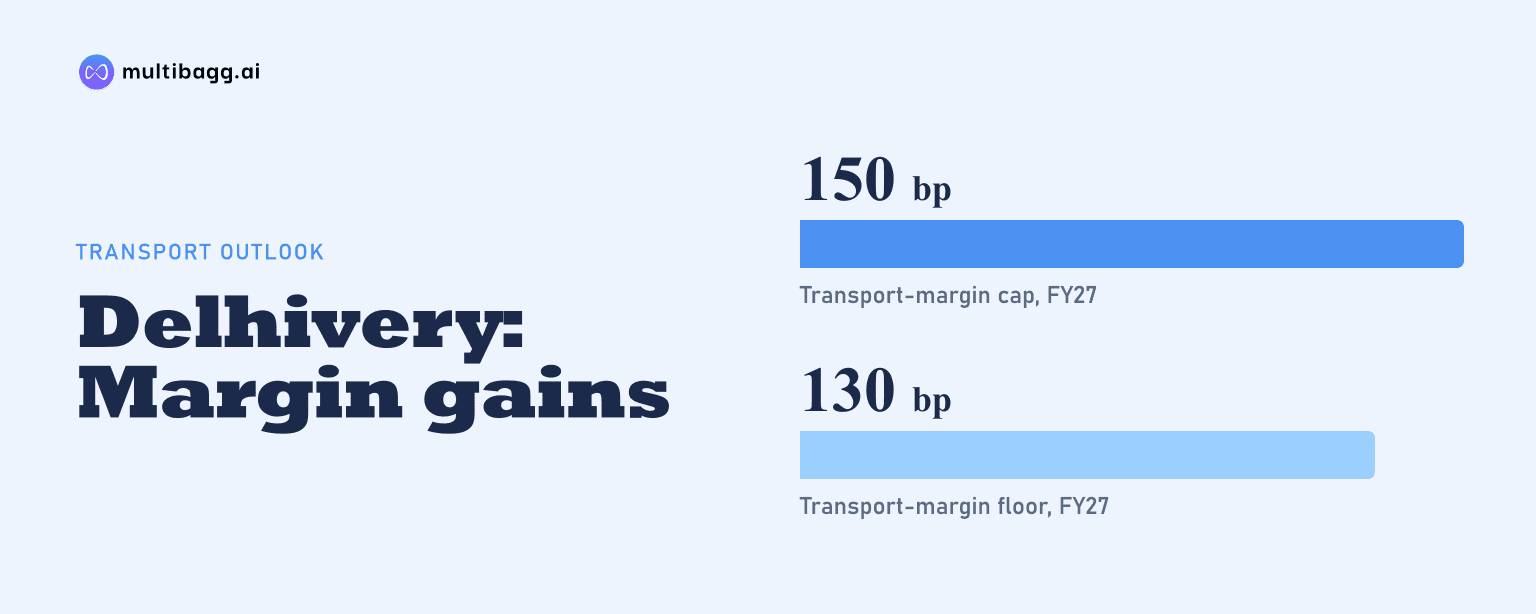
Delhivery expects aggregate transportation margins to expand by 130-150 basis points between FY26 and FY27, supported by higher part-truckload margins, rising PTL volumes and productivity measures. Management said the estimate follows a fuel-inflation-affected Q1, while Express margin is expected to remain around 17% in FY27.
Know Delhivery inside out
Results, valuation, peers and who's buying, in one view.
What transportation-margin expansion does Delhivery expect in FY27?
Delhivery estimates that aggregate transportation margins should expand by 130-150 basis points between FY26 and FY27, even on a conservative view. Management made the estimate after describing a volatile year in which fuel inflation disrupted Q1, but said the transportation network should not suffer a margin degradation from the prior year.
The outlook covers the combined transportation network rather than a single service. Management said absolute network margins were expected to remain broadly constant versus last year before the benefits of PTL, or part-truckload, improvement are considered. The 130-150-basis-point estimate therefore depends on gains in PTL and network efficiency rather than a separately disclosed margin target for every transport service.
Delhivery’s management also said a range of productivity work remains underway, including initiatives to unitise loads. Early results from those experiments were described as solid in the later part of Q2 and early Q3. The company did not quantify savings from unitisation, so the 130-150-basis-point estimate remains management’s aggregate target rather than a calculation disclosed by segment.
How will PTL and Express affect Delhivery’s FY27 margins?
Delhivery expects PTL margins to improve year on year while Express margins remain at least at FY26 levels, combining to support the FY27 transportation-margin target. Management specifically said PTL margins should expand from FY26 to FY27 and that PTL volumes should also grow over the same period.
The mechanism is network density. As PTL volumes rise, management said the efficiency of the overall network increases, creating a knock-on benefit for Express. Delhivery described this as a change from an earlier network model that was Express-denominated and carried PTL to one in which PTL can, in certain situations, be the larger network flow carrying Express.
For Express, management said FY27 margins should end at about 17%, compared with almost 17% in FY26. The company’s previously stated service EBITDA range for Express is 16-18%; EBITDA means earnings before interest, tax, depreciation and amortisation. Management said Q3 is the key quarterly period for Express profitability because seasonal volumes can materially affect the full-year result.
What could prevent Delhivery from meeting its FY27 margin target?
Delhivery said a catastrophic change in fuel prices could disrupt the expectation that Express margins persist near 17% in FY27. Management did not foresee such an event at the time of the call, but stressed that the year had been volatile and declined to present the outcome as certain.
Fuel costs had already contributed to a rocky Q1, prompting price revisions beginning around the middle to latter part of the quarter. Management said many of those revisions took effect in Q2 in both Express and PTL. It added that PTL yield changes were not driven only by inflation-related repricing, as contractual revisions and changes in prices for value-added services also contributed.
The Q3 seasonal mix remains another variable. Delhivery said Q3 normally carries more heavy shipments, which can support yields, but said November and December performance still had to play out. Management did not identify a structural shift in Q3 yields relative to Q2, meaning it did not base the FY27 margin estimate on an assumed seasonal acceleration in pricing.
Got a follow-up? Ask IRIS
Are Delhivery’s transportation yields improving?
Delhivery said yields expanded from Q1 to Q2, an outcome management described as historically unusual because yields have not regularly risen as much in that period. The improvement followed price revisions in response to inflation, fuel costs and, in some cases, changes to the labour code.
PTL yield improvement has several inputs rather than a single list-price increase. Management said a smaller part of the overall PTL yield change came from inflation- and cost-driven revisions, while contractual price changes and altered pricing for some value-added services accounted for a larger part. The company said price revisions are an ongoing process rather than one that concludes in a particular quarter.
Express pricing follows a different stated objective. Delhivery said it aims to charge for the value of its service while ensuring Express customers receive the lowest possible shipping cost that remains profitable for the company. Management did not provide a Q3 or Q4 yield forecast because mix and shipment density can affect the result alongside pricing changes.
How can Delhivery expand fast delivery without new infrastructure?
Delhivery said it can expand same-day delivery, or SDD, and next-day delivery, or NDD, geographic reach mainly by changing line-haul routing rather than by building new fulfilment centres or transportation infrastructure. Where volumes reach an optimal threshold, it may add an already efficient vehicle to existing routes.
The company said minimum viable volume is required to make a location eligible for SDD or NDD. Growing PTL volumes can help distant locations reach that threshold for Express, according to management. This is why the planned expansion of faster delivery coverage does not, in management’s description, require a fundamental increase in fixed costs.
Delhivery also said it has retained its rapid-delivery service but changed its operating format. It had operated through roughly 20-30 dark stores across three or four cities at peak, then folded the service into a larger fulfilment network. Management said the integrated model can serve two-hour, four-hour, eight-hour, 12-hour, next-day and intercity demand without separate inventory pools for each delivery speed.
Conclusion
Delhivery’s FY27 margin outlook depends on a combined effect: PTL margins and volumes are expected to rise, network density is intended to benefit Express, and load-unitisation initiatives are expected to improve productivity. That combination underpins management’s estimate of 130-150 basis points of aggregate transportation-margin expansion, while Express is expected to remain around its FY26 level of almost 17%.
The next measure to watch is Q3, which management identified as the key period for Express profitability because of seasonal heavy-volume mix. Delhivery will also need PTL volume growth and productivity initiatives to continue, while fuel-price conditions and yield performance through November and December remain unresolved variables in management’s outlook.