










Devson Catalyst targets Q1 FY28 plant start, 50% utilisation
Key highlights
- Devson Catalyst targets Q1 FY28 operations for its 5,088-metric-tonne-a-year automated facility.
- The expansion would raise Devson Catalyst's installed capacity by about 82% to 11,293 metric tonnes a year.
- Devson Catalyst targets 50% utilisation of the new facility during FY28.
- H1 FY27 EBITDA rose 9.84% to Rs 10.25 crore, while export contribution fell to 6.72% from 42.95%.
powered by IRIS
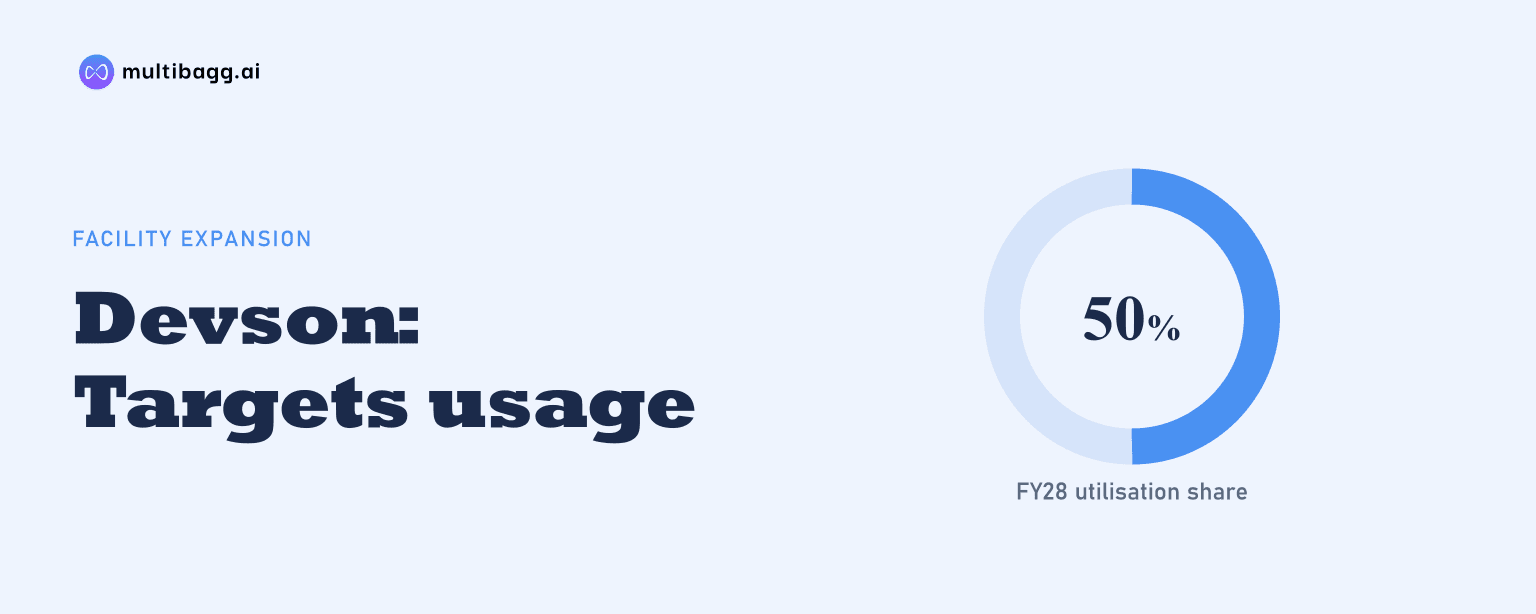
Devson Catalyst Limited targets Q1 FY28 operations for a 5,088-metric-tonne-a-year automated plant and 50% utilisation of that new capacity during FY28. The planned unit would increase total installed capacity by about 82% to 11,293 metric tonnes a year from 6,205 metric tonnes, management said on November 3, 2026.
Know Devson Catalyst inside out
Results, valuation, peers and who's buying, in one view.
When will Devson Catalyst's new plant begin operations?
Devson Catalyst expects the new facility to enter operational mode in the first quarter of FY28. On the H1 FY27 earnings call on November 3, 2026, management said planning had been completed, orders for pre-engineered building, or PEB, structures had been placed, and labour orders had been completed.
Management said the steel erection work was expected to take about three months after material dispatch following Diwali. It was also in discussions with machinery suppliers, expected to close those arrangements within 15 days, and anticipated machinery delivery within three to four months. The Q1 FY28 start is therefore a management target contingent on construction, machinery delivery and installation.
Devson Catalyst said its July 2026 initial public offering, or IPO, raised Rs 39.39 crore and would support the new manufacturing facility. It separately allocated Rs 12 crore of IPO proceeds to long-term working-capital requirements, of which Rs 4.14 crore had been used by September 30, 2026.
How much capacity will Devson Catalyst add through the project?
Devson Catalyst plans to add 5,088 metric tonnes a year of capacity at the new facility, increasing total installed capacity to 11,293 metric tonnes a year from 6,205 metric tonnes a year at its Wadhwan, Gujarat site. The addition equals approximately 82% of the existing capacity base.
Management referred to the new unit as having capacity of around 5,000 metric tonnes during the question-and-answer session, while the formal business update specified 5,088 metric tonnes a year. The 5,088-tonne figure is the disclosed planned addition used in the company's approximately 82% expansion calculation.
Devson Catalyst said the new site will be automated and span 4,000 square metres, compared with 7,000 square metres for the existing facility. Management attributed the smaller footprint to automation and process machinery, and said the new site was designed from the first stage for catalyst manufacturing.
What utilisation does Devson Catalyst target in FY28?
Devson Catalyst targets 50% utilisation of the new facility during the full FY28 financial year. Management gave the target for the 5,088-metric-tonne addition, rather than providing a consolidated utilisation target for both the existing and new plants.
At 50% utilisation, the new unit would account for 2,544 metric tonnes of output over FY28, based on its stated annual capacity. Devson Catalyst did not disclose quarterly ramp-up milestones, a revenue target from the facility, or an expected production split among catalysts, adsorbents and ceramic balls.
Management said the plant could reach saturation earlier if products under development are commercialised successfully. It did not identify the products or specify expected volumes, although it said cage trials and physical-property testing for a PE catalyst were complete and chemical results were awaited.
Got a follow-up? Ask IRIS
What factors will determine Devson Catalyst's capacity ramp-up?
Devson Catalyst said product mix, portfolio expansion and market development will determine how the extra capacity translates into revenue. Management did not endorse a combined-plant revenue estimate because catalyst pricing differs by customer, application and the metal content used in each product.
The company reported revenue from operations of Rs 31.69 crore in H1 FY27, up 1.14% from Rs 31.36 crore in H1 FY26. Earnings before interest, tax, depreciation and amortisation, or EBITDA, rose 9.84% to Rs 10.25 crore, while EBITDA margin increased 250 basis points to 31.80% from 29.30%.
Profit after tax increased 13.12% to Rs 7.50 crore in H1 FY27 from Rs 6.66 crore a year earlier. Management attributed the profitability improvement to operational efficiency, cost optimisation, product development and enhancement of existing offerings, while net operating cash flow was Rs 6.37 crore for the half year.
Management said catalyst sales increased in H1 FY27 while ceramic-ball sales declined because shipments to the Middle East were disrupted. It described catalysts as higher-value and higher-margin products, but did not disclose revenue by catalyst, adsorbent and ceramic-ball categories.
How could exports and orders affect Devson Catalyst's FY28 ramp-up?
Devson Catalyst said Middle East shipping conditions remain a variable for demand as the new plant starts operations. Export revenue contributed 6.72% of H1 FY27 revenue, down from 42.95% in H1 FY26, while domestic sales represented 93.28% in H1 FY27.
Management said the Strait of Hormuz disruption affected outbound shipments rather than raw-material availability because about 97% of inputs are sourced domestically. It said catalysts and adsorbents primarily use oxide-form minerals, but did not disclose a detailed raw-material list or pricing structure.
Devson Catalyst stated that its order book was approximately Rs 25 crore to Rs 28 crore, including purchase orders and other orders on hand. Management said most one-time orders should be completed in FY27, while contractual orders depend on customers issuing call-off purchase orders for particular quantities.
The company also said it was participating in new tenders but did not quantify the tender pipeline or disclose an export-domestic split for the order book. Management said active export orders remained in hand and that export sales could improve if shipping and logistics conditions stabilise.
Conclusion
Devson Catalyst has set out a defined expansion timetable: a 5,088-metric-tonne-a-year automated unit targeted to start in Q1 FY28, with 50% utilisation in its first full financial year. The project would raise installed capacity to 11,293 metric tonnes a year, while H1 FY27 profitability increased faster than revenue amid a shift toward catalyst sales.
The next items to watch are management's closure of machinery arrangements, construction and installation progress against the Q1 FY28 target, and the pending chemical results for the PE catalyst. Execution of the Rs 25 crore to Rs 28 crore order book and any normalisation in Middle East shipping conditions could also affect the pace at which the new capacity is used.