










Devson export mix fell to 6.72% as freight rose tenfold
Key highlights
- Devson’s export mix declined from 42.95% to 6.72% in the first half of FY27.
- Management said 20-foot container freight to the Middle East increased by roughly sixfold to tenfold.
- Catalyst sales rose to Rs 25.31 crore in H1 FY27 from Rs 13.26 crore in H1 FY26.
- Devson plans to add 5,088 metric tonnes of catalyst-and-adsorbent capacity in the first quarter of FY28.
powered by IRIS
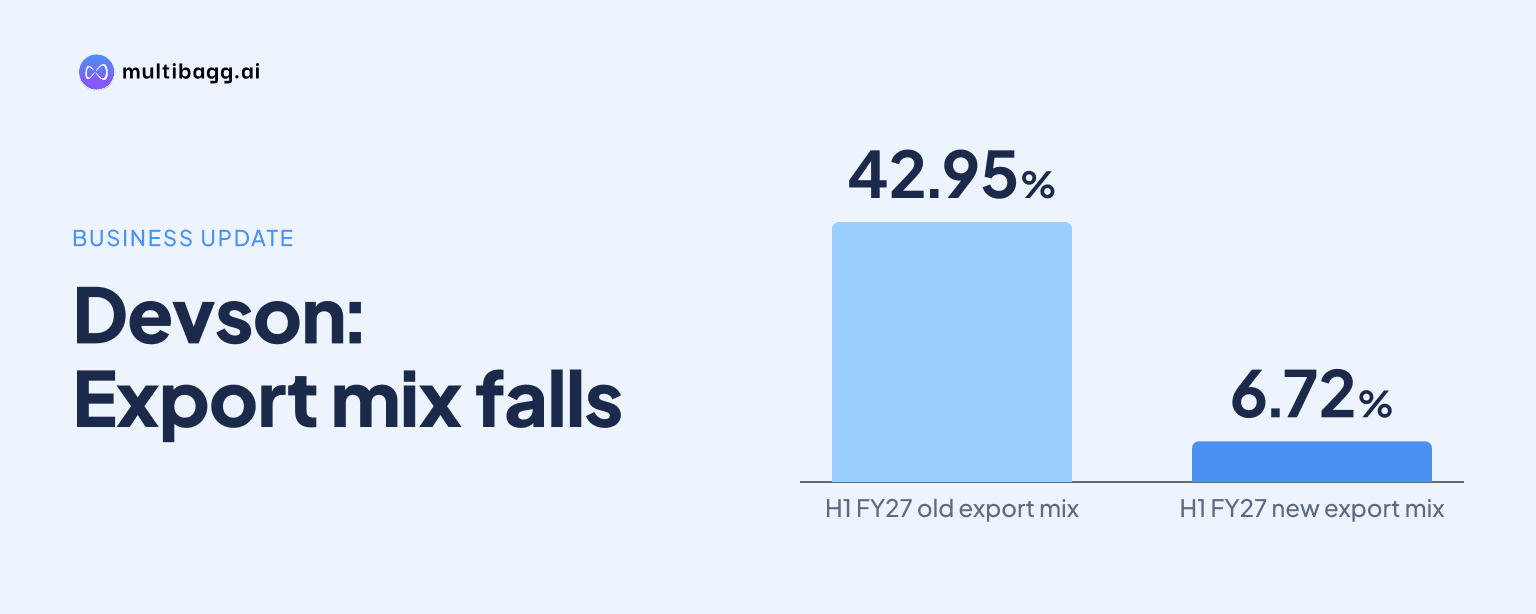
Devson’s export mix fell from 42.95% to 6.72% in the first half of FY27 as Strait of Hormuz disruption raised 20-foot container freight by as much as tenfold, restricting shipments to the Middle East despite continued orders from the region. The disruption changed the sales mix rather than interrupting domestic production.
Know Devson Catalyst inside out
Results, valuation, peers and who's buying, in one view.
Why did Devson's export mix fall to 6.72%?
Devson's export mix fell because vessels were not operating reliably through the Strait of Hormuz and freight costs increased sharply for Middle East deliveries. Management said the freight charge for a 20-foot container had risen from about $600-$800 to $6,000-$8,000, an increase of roughly sixfold to tenfold. The company said it continued to receive demand and orders from the Middle East but faced difficulty dispatching material under those logistics conditions.
The effect was amplified by Devson's prior concentration in the Middle East. Management said about 70% to 80% of its export business in FY26 came from that region, meaning the disruption affected a large part of its overseas sales channel. Management did not provide a timetable for normal shipping conditions and said the political circumstances affecting Hormuz could not be predicted.
The interruption was limited to finished-goods exports rather than raw-material procurement. Management said 97% of Devson's raw materials were indigenous and that domestic orders were being executed without a supply disruption. For catalysts and adsorbents, it identified oxide-form minerals as major inputs and said these were sourced domestically.
How did the disruption change Devson's product sales?
Devson replaced part of the lost Middle East ceramic-ball business with higher catalyst sales in India during H1 FY27. Management said ceramic-ball sales declined because the Middle East had been a major market for that product, while catalyst business increased in India. The resulting shift helped keep first-half revenue almost comparable with the previous year, according to management.
Catalyst sales rose by Rs 12.05 crore, from Rs 13.26 crore in H1 FY26 to Rs 25.31 crore in H1 FY27. That increase exceeded the Rs 9.64 crore decline in ceramic-ball sales and the Rs 1.79 crore reduction in adsorbent sales. Management said the catalyst-led product mix improved realisation and margins, but it did not disclose segment-wise realisation or margin figures.
Devson also said it was operating at 80% to 90% of products and capacity during the period. The H1 FY27 comparison therefore indicates that the flat revenue outcome reflected a change in products and markets, with India-focused catalyst sales offsetting some lost Middle East ceramic-ball shipments, rather than an import-driven manufacturing stoppage.
Got a follow-up? Ask IRIS
Can Devson complete its delayed Middle East orders?
Devson expects most one-time orders on hand to be completed within the current financial year, but contractual call-off orders have uncertain timing. Management explained that a 100-tonne contract may be delivered in smaller lots, including 10 tonnes or 50 tonnes, only when a customer issues a purchase-order call-off. It therefore could not confirm whether all contractual order value would be realised in the current or following financial year.
Management said sales and revenue could increase substantially if Hormuz shipping normalises, because Middle East demand and orders have remained active. It did not issue a numerical revenue forecast tied to a reopening. Management also said Devson could deliver growth above the prior year through product mix and sales in India even if the logistics disruption continued, which was an expectation rather than formal guidance.
Devson is pursuing geographic diversification because the Middle East represented about 70% to 80% of export business in FY26. Management named Russia, Africa and South Korea as markets where Devson had not previously done business, and said it had appointed one business-development head from a multinational company for this expansion. It described US business as limited and cited tariffs as an obstacle in that market.
What is Devson's FY28 capacity plan?
Devson plans to add 5,088 metric tonnes of fungible catalyst-and-adsorbent capacity in the first quarter of FY28. Management also described the project as around 5,000 metric tonnes in an earlier response and said it was targeting 50% utilisation of the new facility by the end of FY28. The new plant will be able to make catalysts or adsorbents rather than being dedicated to one product line.
The proposed facility has an area of 4,000 square metres, compared with 7,000 square metres for the existing plant, but management said automation and process machinery should enable it to target 80% of the existing capacity level. It did not provide a fixed revenue target because revenue will depend on the mix of products manufactured, including newly developed catalysts.
Management said it was developing higher-value, higher-margin catalysts and could use the additional capacity for existing as well as new products. It described the catalyst and adsorbent business as only 2 to 3 years old and said Devson had not reached all potential customers in India. A third facility would be considered if the second plant is filled rapidly or reaches about 70% to 80% utilisation; management said land for that expansion has already been acquired.
Conclusion
Devson's first-half results show that the Strait of Hormuz disruption was principally a logistics and market-concentration problem. Export mix declined to 6.72% from 42.95%, while catalyst sales increased to Rs 25.31 crore from Rs 13.26 crore and partly offset reduced ceramic-ball sales of Rs 3.81 crore versus Rs 13.45 crore a year earlier.
The next points to watch are whether shipping conditions allow Middle East orders to be delivered, whether India-based catalyst sales continue to support the changed mix, and progress on market diversification beyond a region that represented 70% to 80% of FY26 exports. Management's stated operating milestone is the first-quarter FY28 commissioning of 5,088 metric tonnes of added capacity, followed by its 50% utilisation target by the end of FY28.