










Devson Catalyst: H1 catalyst sales nearly double to Rs 25.31 crore
Key highlights
- Devson’s H1 FY27 catalyst revenue rose to Rs 25.31 crore from Rs 13.26 crore in H1 FY26.
- Devson’s H1 FY27 ceramic-ball revenue fell to Rs 3.81 crore from Rs 13.45 crore a year earlier.
- The three disclosed product categories totalled Rs 31.61 crore in H1 FY27, versus Rs 30.99 crore in H1 FY26.
- Devson plans around 5,000 metric tonnes of new capacity in the first quarter of FY28 and targets 50% utilisation by the end of FY28.
powered by IRIS
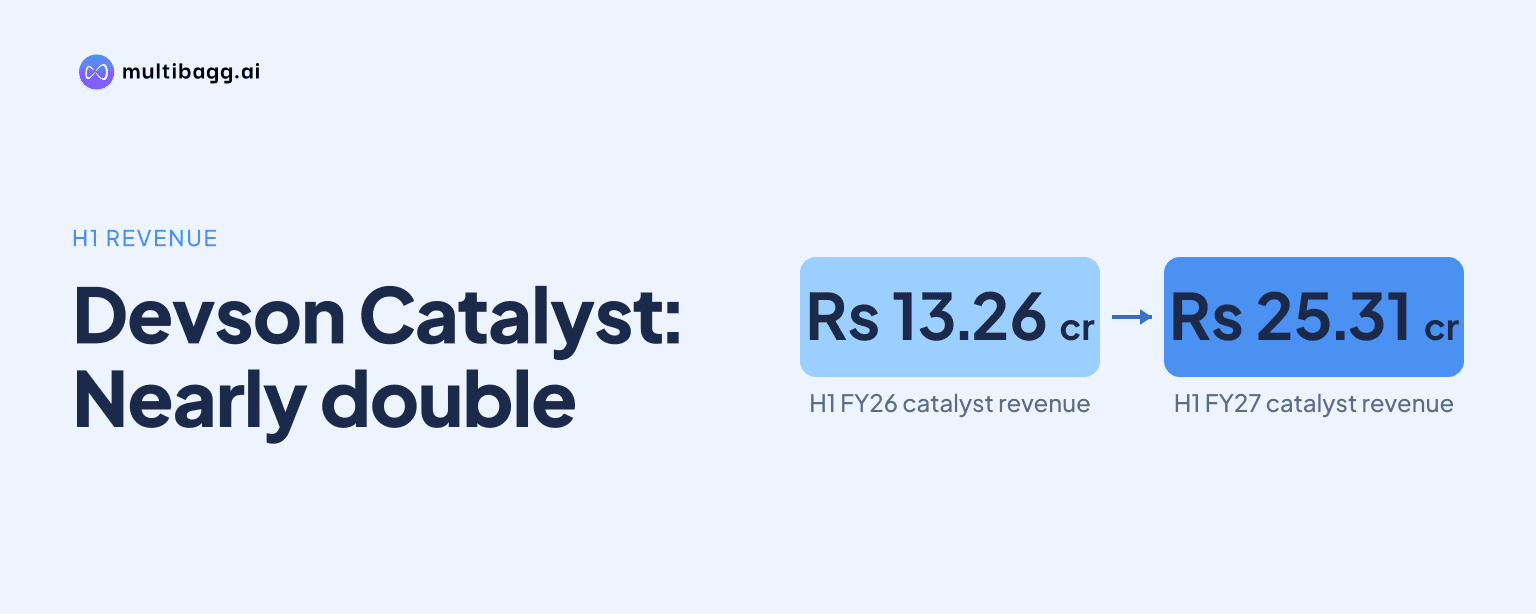
Devson Catalyst nearly doubled H1 FY27 catalyst revenue to Rs 25.31 crore from Rs 13.26 crore a year earlier, offsetting a fall in ceramic-ball sales to Rs 3.81 crore as Middle East shipments were disrupted by the Hormuz situation.
Know Devson Catalyst inside out
Results, valuation, peers and who's buying, in one view.
What drove Devson’s H1 FY27 sales-mix shift?
Devson’s H1 FY27 sales mix shifted toward catalysts because domestic catalyst demand increased while ceramic-ball exports to the Middle East declined. Management said catalyst products carry higher value and higher margins than ceramic balls, and confirmed that the growth in the India catalyst business lifted realisations and margins during the period.
The reported three-product revenue split totals Rs 31.61 crore in H1 FY27, compared with Rs 30.99 crore in H1 FY26. That limited overall increase masks a substantial internal change: catalyst revenue rose by Rs 12.05 crore, while ceramic-ball revenue fell by Rs 9.64 crore and adsorbent revenue declined by Rs 1.79 crore.
On the disclosed numbers, catalysts accounted for about four-fifths of H1 FY27 revenue across the three categories, versus less than half in H1 FY26. This is a calculation from the product figures management gave on the call, rather than a separate company-stated mix percentage. It shows that catalyst growth did more than replace the lost ceramic-ball revenue.
How much did Devson’s catalyst business grow in H1 FY27?
Devson’s catalyst revenue increased to Rs 25.31 crore in H1 FY27 from Rs 13.26 crore in H1 FY26, an increase of Rs 12.05 crore. Management described the current-year figure as double the preceding H1 level, while an investor on the call also identified the move from about Rs 13 crore to about Rs 25 crore.
Management did not provide a single per-kilogram catalyst realisation because pricing differs by catalyst type, application and customer. It said catalyst formulations can vary with the quantity of active metals used, so a standard price for products such as titanium-based or hydro catalysts would not be representative across the portfolio.
Devson said it is seeking to maintain its existing margins and develop catalysts with higher value and higher margins. Its product-development approach is to build adjacent catalysts around an existing catalyst series, with changes to surface treatment or formulation. Management said changes in active-metal content can be as small as 1% or 2% for different processes.
The company also said natural-gas prices had risen two times, but that it passes such pricing through to customers. For catalyst and adsorbent production, management identified oxide-form minerals as the main raw-material group, including aluminium oxide, silica, zinc oxide, titanium and sodium carbonate. It said 97% of raw materials are indigenous, limiting the disclosed supply-chain issue to exports rather than manufacturing inputs.
Why did Devson’s ceramic-ball revenue fall to Rs 3.81 crore?
Devson’s ceramic-ball revenue fell to Rs 3.81 crore in H1 FY27 from Rs 13.45 crore in H1 FY26 because its Middle East business was affected by the Hormuz situation. Management said ceramic-ball sales had been significant in the Middle East and identified disruption to vessel operations as the direct constraint on supplying material into that market.
The decline was not attributed to a shortage of ceramic inputs. Devson said it makes ceramic products from minerals and clays available in Gujarat, near Surendranagar and Thangarh, and in Rajasthan. Management called these natural-source materials readily available, distinguishing input availability from the shipping bottleneck affecting export deliveries.
Freight economics also changed materially for Middle East shipments. Management said a 20-foot container that previously cost about $600 to $800 in freight could cost $6,000 to $8,000 during the disruption, or roughly 10 times the earlier level. It said demand and orders from the Middle East continued, but shipping material remained difficult when vessels were not operational or freight costs increased.
Management said exports declined 42.95% to 6.72%, although the transcript does not specify the denominator or whether the figures refer to revenue growth, revenue share or another measure. It also said that around 70% to 80% of Devson’s export business had come from the Middle East, making the route disruption particularly relevant to ceramic-ball sales.
Got a follow-up? Ask IRIS
Can domestic catalysts and new capacity change Devson’s mix further?
Devson said domestic catalyst sales grew in H1 FY27 and that it has not yet reached all potential Indian customers for catalysts and adsorbents. Management cited three routes for growth: expanding into more Indian customers, widening the product portfolio and entering overseas markets where it had not previously operated.
For exports, management said it plans to pursue Russia, African markets and South Korea, and has appointed one business-development head from a multinational company for this work. It also said United States business had been limited because of tariffs. These initiatives are management plans, not disclosed revenue commitments, and no target revenue by geography was provided.
A new facility with around 5,000 metric tonnes of capacity is planned to be operational in the first quarter of FY28, according to management. The company said the facility will be fungible between catalysts and adsorbents, allowing it to manufacture existing and newly developed products according to demand rather than dedicating the capacity to only one category.
Management said the new site covers 4,000 square metres, compared with 7,000 square metres for the existing plant, but is expected to deliver 80% more capacity because of automation and process machinery. It is targeting utilisation of 50% of the new facility by the end of FY28. The company said it would consider a third facility if the second facility reaches about 70% to 80% utilisation, and stated that land has already been acquired.
What does the H1 product split mean for Devson’s revenue outlook?
Devson’s H1 FY27 figures show a business less dependent on ceramic balls than in H1 FY26, with the Rs 12.05 crore catalyst increase outweighing the combined Rs 11.43 crore reduction in ceramic-ball and adsorbent revenue. Management’s statement that catalysts are higher-value and higher-margin products indicates why the mix shift mattered for profitability, although it did not disclose segment-level margins.
The product mix also reduced the immediate effect of Middle East shipping disruption on H1 revenue. Management said major one-time orders on hand should largely be completed in the current financial year, while contractual orders are released through customer call-off purchase orders and therefore have less certain timing. Its stated order book was around Rs 25 crore to Rs 28 crore, without a disclosed domestic-versus-export split.
Conclusion
Devson’s H1 FY27 revenue composition changed sharply: catalysts reached Rs 25.31 crore, ceramic balls dropped to Rs 3.81 crore and adsorbents fell to Rs 2.49 crore. The resulting Rs 31.61 crore total for the disclosed categories was only Rs 0.62 crore above H1 FY26, but it came from a materially different mix centred on domestic catalysts rather than Middle East ceramic-ball shipments.
The next points to watch are whether Hormuz shipping conditions normalise, whether ceramic-ball exports can resume at workable freight costs, and whether the planned 5,000-metric-tonne facility begins operations in the first quarter of FY28. Management’s target is 50% utilisation of that new capacity by the end of FY28, while its ability to commercialise higher-value catalysts will influence how the added capacity is used.