










Digit AUM reaches Rs 24,371 crore as leverage hits 5.2x
Key highlights
- Digit’s assets under management reached Rs 24,371 crore in H1 2027, up Rs 1,488 crore from FY 2026.
- Digit’s investment leverage rose to 5.2 times in H1 2027 from 5.0 times at FY 2026.
- Digit’s equity allocation increased to 8.6% in H1 2027 from 7.6% at FY 2026.
- Digit reported Rs 875 crore of H1 2027 investment performance, including Rs 832 crore of investment income.
powered by IRIS
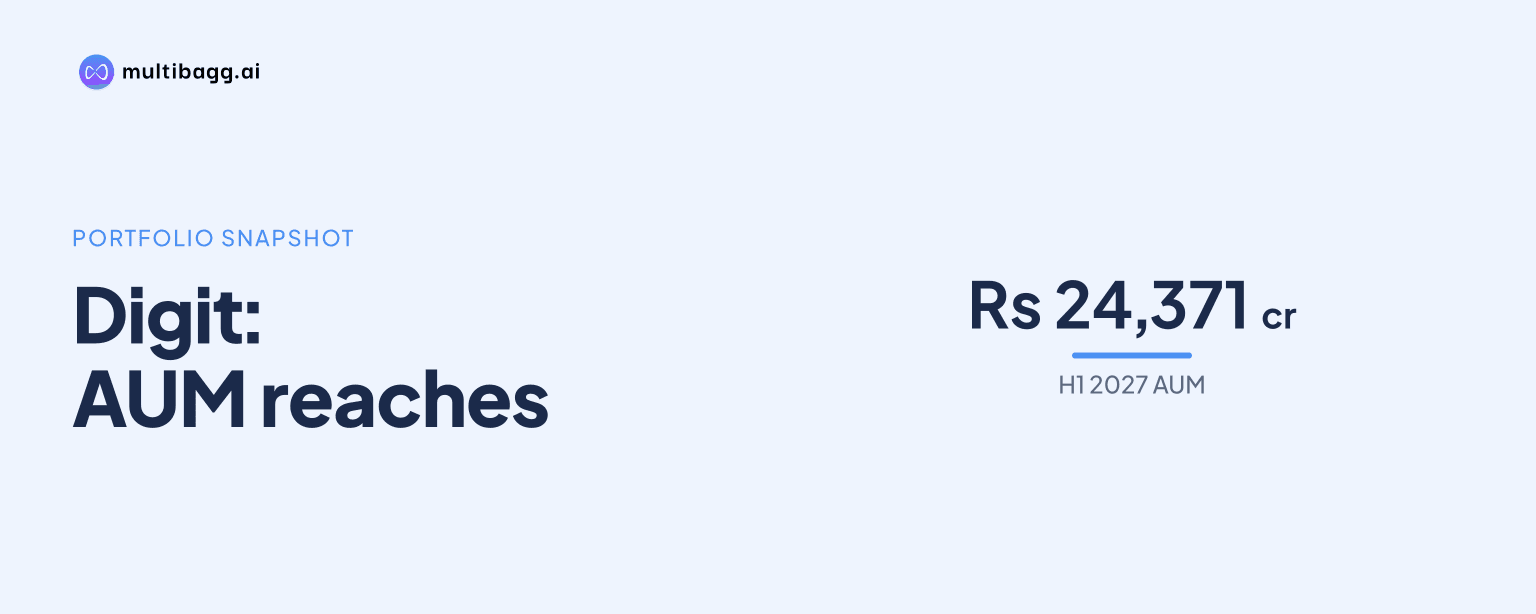
Digit reported Rs 24,371 crore of assets under management in H1 2027, with investment leverage rising to 5.2 times from 5.0 times at FY 2026. The larger investment pool was accompanied by an 8.6% equity allocation, up 1.0 percentage point from FY 2026, and Rs 875 crore of investment performance for the half year.
Know Go Digit General Insurance inside out
Results, valuation, peers and who's buying, in one view.
How did Digit’s assets under management and leverage change?
Digit’s assets under management rose to Rs 24,371 crore in H1 2027 from Rs 22,883 crore at FY 2026 and Rs 21,019 crore in H1 2026. That represents an increase of Rs 1,488 crore from FY 2026 and Rs 3,352 crore from H1 2026. The source reports the amounts in Rs crore.
Digit’s investment leverage increased to 5.2 times in H1 2027, compared with 5.0 times at FY 2026 and 4.9 times in H1 2026. Digit defines investment leverage as assets under management at book value divided by Indian Generally Accepted Accounting Principles, or IGAAP, net worth. The 0.2-times increase from FY 2026 therefore occurred alongside the Rs 1,488 crore rise in book-value assets under management.
The presentation also displays Rs 22,883 crore under the label ESOPs in H1 2027 and Rs 1,486 crore under business surplus, versus Rs 19,455 crore and Rs 3,422 crore respectively at FY 2026. Because these figures are shown in a chart rather than a reconciliation, the presentation does not explain the change in each displayed component. The leverage definition confirms that the reported ratio uses book-value assets rather than a market-value portfolio measure.
How did Digit’s investment allocation change?
Digit increased equity to 8.6% of its investment allocation in H1 2027, from 7.6% at FY 2026 and 6.8% in H1 2026. Real estate investment trusts and infrastructure investment trusts, or REITs and InvITs, rose to 1.0% from 0.7% at FY 2026. Together, equity, REITs and InvITs represented 9.6% in H1 2027, compared with 8.3% at FY 2026.
Digit’s sovereign allocation rose to 36.3% in H1 2027 from 35.7% at FY 2026, while AAA and equivalent exposure increased to 38.1% from 37.1%. Those two categories totalled 74.4%, compared with 72.8% at FY 2026. The comparison shows that the increase in equity-related allocations occurred alongside a higher combined allocation to sovereign and AAA-equivalent instruments.
Digit reduced its allocation to additional tier 1, or AT1, bonds to 9.8% in H1 2027 from 10.5% at FY 2026 and 10.6% in H1 2026. AA+ exposure fell to 5.3% from 7.3%, AA- and equivalent declined to 0.4% from 0.5%, and reverse repurchase, or reverse repo, exposure was 0.4% versus 0.6%. These changes offset part of the rise in equity, REITs, InvITs, sovereign and AAA-equivalent weights.
Got a follow-up? Ask IRIS
Which sectors accounted for Digit’s investment allocation?
Digit’s largest sector allocation was sovereign at 34.7% in H1 2027, up from 33.9% at FY 2026 and 32.6% in H1 2026. Housing and infrastructure was 32.0%, down from 33.5% at FY 2026 and 35.4% in H1 2026. The ranking therefore shifted from housing and infrastructure being the largest category in H1 2026 to sovereign being the largest in H1 2027.
Banking and finance represented 24.7% in H1 2027, slightly below 25.5% at FY 2026. The three largest categories, sovereign, housing and infrastructure, and banking and finance, totalled 91.4% of the allocation, compared with 92.9% at FY 2026. This 1.5-percentage-point reduction coincided with an increase in the others category to 8.1% from 6.8%.
Money-market exposure was 0.4% in H1 2027, compared with 0.3% at FY 2026, while the others category had risen from 6.0% in H1 2026 to 8.1%. The sector classification is separate from the rating-based allocation, which includes categories such as AAA and equivalent, AA+ and AT1 bonds. The two views therefore describe the Rs 24,371 crore pool using different classifications.
What investment income and valuation movements did Digit report?
Digit reported Rs 875 crore of total investment performance in H1 2027, comprising Rs 832 crore of investment income and Rs 43 crore of capital gains. This was Rs 106 crore above the Rs 769 crore reported in H1 2026, when investment income was Rs 734 crore and capital gains were Rs 35 crore. Investment income increased by Rs 98 crore year on year, while capital gains increased by Rs 8 crore.
Digit’s overall yield was unchanged at 3.7% in H1 2027 and H1 2026, and the presentation states that partial-period yields are not annualised. Debt yield increased to 3.8% from 3.7% over the same comparison. In Q2 2027, overall yield was 1.9%, unchanged from Q2 2026, while debt yield rose to 2.0% from 1.9%.
As of September 30, 2026, Digit disclosed an unrealised gain of Rs 148 crore on its equity portfolio, including Rs 46 crore relating to AIF and ATI bonds as labelled in the presentation. It also disclosed an unrealised loss of Rs 164 crore on the other-than-equity portfolio. The disclosed loss exceeded the stated equity-portfolio gain by Rs 16 crore, but the presentation does not provide a holding-level valuation reconciliation.
Conclusion
Digit’s H1 2027 figures show that a Rs 1,488 crore increase in assets under management from FY 2026 coincided with investment leverage reaching 5.2 times. The portfolio mix moved toward equity, REITs, InvITs, sovereign and AAA-equivalent holdings, while AT1 bonds and AA+ exposure declined. Investment performance rose to Rs 875 crore, even as the reported overall H1 yield remained 3.7%.
The next reported portfolio update will show whether the 8.6% equity allocation, 9.8% AT1 bond allocation and 36.3% sovereign allocation change from H1 2027 levels. The presentation provides no allocation target or rebalancing timetable, while the Rs 148 crore unrealised equity gain and Rs 164 crore unrealised loss disclosed as of September 30, 2026 remain the stated valuation matters to track.