










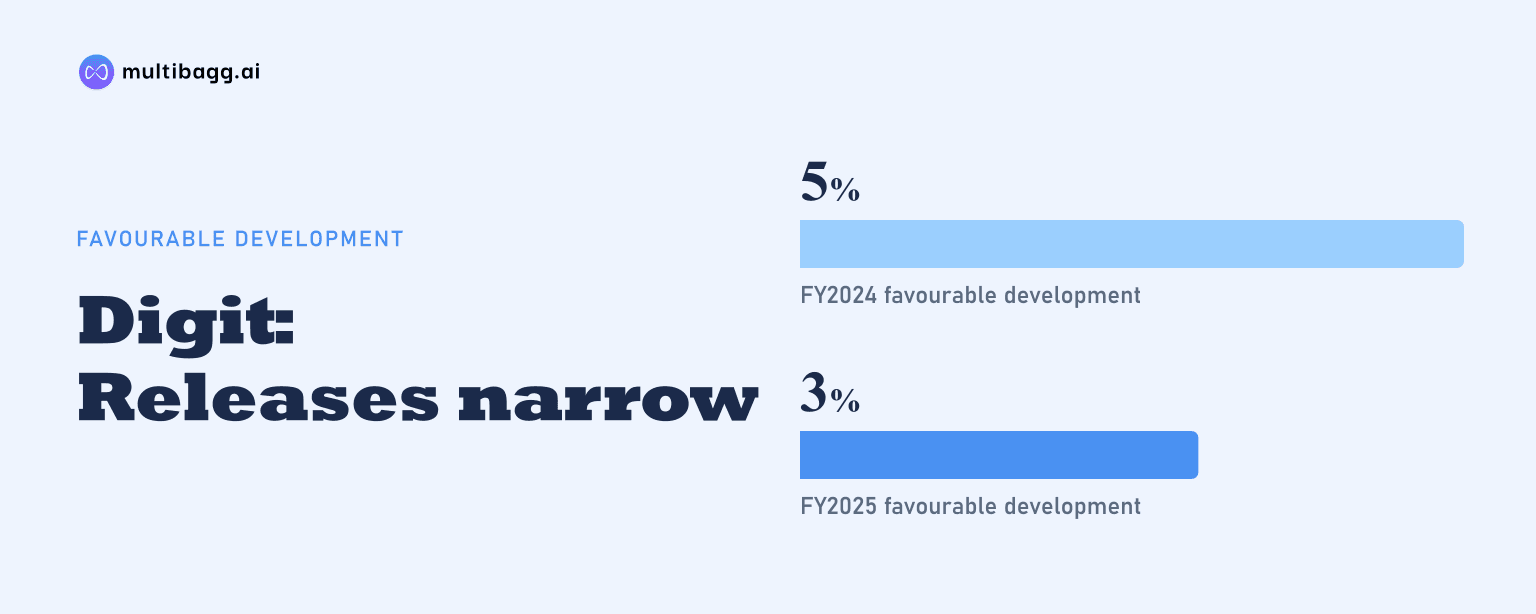
Digit’s whole-account reserve releases narrowed to 3% in FY2025
Key highlights
- Digit’s whole-account favourable development was 31% for FY2020 and FY2021 as at 31 March 2026.
- Digit’s whole-account favourable development declined to 5% for FY2024 and 3% for FY2025.
- Motor TP recorded 41% favourable development for FY2020 and zero movement for FY2025.
- Excluding Motor TP, Digit recorded 6% favourable development for both FY2024 and FY2025.
powered by IRIS
Digit’s whole-account ultimate loss estimate for FY2025 developed favourably by 3% as at 31 March 2026, compared with 31% for both FY2020 and FY2021. The reserving triangles show that earlier underwriting years ultimately cost materially less than first estimated, while releases have been smaller for the latest years with development data.
Know Go Digit General Insurance inside out
Results, valuation, peers and who's buying, in one view.
How have Digit’s whole-account reserve estimates developed?
Digit’s whole-account reserve estimates moved favourably for every underwriting year from FY2018 to FY2025 with disclosed development, meaning the latest ultimate incurred-loss and allocated-expense estimate was below the first-year estimate. The triangle uses an Indian Generally Accepted Accounting Principles, or IGAAP, net basis as at 31 March 2026.
FY2020 and FY2021 each recorded 31% favourable development, the highest percentage outcomes in the whole-account disclosure. FY2020’s estimate fell from Rs 944.4 crore at the end of its first year to Rs 652.8 crore six years later, while FY2021 declined from Rs 1,463.5 crore to Rs 1,012.2 crore five years later.
The largest release by amount was Rs 652.9 crore for FY2022, although its 25% percentage movement was below the 31% recorded for FY2020 and FY2021. FY2026 started with a Rs 6,911.1 crore whole-account estimate, but the disclosure reports no development figure because there was no subsequent year of observation as at 31 March 2026.
Why did Digit’s recent reserve releases narrow?
Digit’s recent reserve releases narrowed because the reported percentage reduction from original estimates fell from 25% for FY2022 to 16% for FY2023, 5% for FY2024 and 3% for FY2025. The source does not state a cause, so the triangles establish the measured change in development rather than an explanation of claims behaviour or reserving policy.
The comparison also covers different development ages. FY2022 had four subsequent years of development by 31 March 2026, whereas FY2025 had one. Still, FY2025’s Rs 222.4 crore release was below FY2024’s Rs 296.8 crore release despite FY2025 having the higher original estimate, Rs 6,454.7 crore versus Rs 5,678.7 crore.
These triangles should not be equated with Digit’s reported claims ratio. The total claims ratio under Indian Accounting Standards, or Ind AS, was 60.9% in H1 FY2027, compared with 53.2% in H1 FY2026, but that metric is gross and discounted while the reserve triangles are IGAAP net estimates.
Got a follow-up? Ask IRIS
How much did Motor TP contribute to earlier releases?
Motor third party, or Motor TP, contributed materially to the larger favourable development in earlier whole-account years. Its favourable development was 41% for FY2020, 38% for FY2021, 32% for FY2022 and 22% for FY2023, exceeding the corresponding whole-account percentages of 31%, 31%, 25% and 16%.
For FY2020, Motor TP’s estimate reduced from Rs 630.3 crore to Rs 371.6 crore, generating a Rs 258.7 crore favourable movement. In FY2021, the Motor TP estimate declined from Rs 1,024.3 crore to Rs 632 crore, producing Rs 392.3 crore of favourable development within the Rs 451.3 crore whole-account release.
Motor TP development was smaller in later years. FY2024 recorded a Rs 122.4 crore, or 5%, favourable movement from an original Rs 2,588.7 crore estimate, while FY2025 reported no favourable or unfavourable development from its Rs 2,678.6 crore original estimate after one year.
What happened to reserve development excluding Motor TP?
Digit’s business excluding Motor TP also showed favourable development in every year with a disclosed movement, but its earlier percentages were lower than those for the whole account. Excluding Motor TP, favourable development was 10% in FY2020, 13% in FY2021, 13% in FY2022 and 8% in FY2023.
The FY2020 estimate excluding Motor TP fell by Rs 32.9 crore, from Rs 314.1 crore to Rs 281.2 crore, while FY2021 declined by Rs 59 crore, from Rs 439.2 crore to Rs 380.2 crore. This comparison shows that the non-Motor TP portfolio also developed below original estimates, while Motor TP accounted for much of the larger whole-account release in those years.
Recent development excluding Motor TP was 6% for both FY2024 and FY2025. The FY2024 estimate reduced by Rs 174.4 crore from Rs 3,090.1 crore, and FY2025 reduced by Rs 222.4 crore from Rs 3,776.1 crore, matching the whole-account FY2025 release because Motor TP recorded zero movement for that year.
What should readers watch in Digit’s next reserve disclosure?
Readers should watch whether FY2024 and FY2025 develop further from their currently reported 5% and 3% whole-account favourable outcomes. They should also watch the first subsequent-year movement for FY2026, whose original whole-account estimate of Rs 6,911.1 crore comprised Rs 2,939.4 crore of Motor TP and Rs 3,971.7 crore excluding Motor TP.
Digit has said it will publish Ind AS reserving triangles, gross and as at 30 September 2026, with its quarterly disclosures. Those data will use a different basis from the IGAAP net triangles at 31 March 2026, but they will provide the next disclosed reserve-development view under the accounting framework used for the 60.9% H1 FY2027 claims ratio.
Conclusion
Digit’s reserving triangles show a history of favourable development, led by 31% whole-account releases for FY2020 and FY2021 and a 41% Motor TP release for FY2020. The measured releases became smaller in the more recent years, with whole-account favourable development of 5% for FY2024 and 3% for FY2025, while the portfolio excluding Motor TP recorded 6% for both years.
The next disclosed test will be Digit’s planned quarterly publication of gross Ind AS reserving triangles as at 30 September 2026. That release should show the first observed movement for the Rs 6,911.1 crore FY2026 whole-account estimate and whether FY2024 and FY2025 continue to develop below their currently reported estimates.