










Digit’s Q2 GDPI fell 1.2% as motor lagged a growing industry
Key highlights
- Digit’s Q2 2027 GDPI declined 1.2% to Rs 2,351 crore, while industry GDPI grew 7.0%.
- Motor GDPI fell 4.1% in Q2 2027 and accounted for 66.9% of Digit’s direct-premium mix.
- Health, travel and PA GDPI grew 19.6% and rose to 21.6% of Q2 2027 GDPI.
- Digit’s Q2 2027 GWP fell 3.6% to Rs 2,571 crore; management said GWP excluding health reinsurance inward business was flat.
powered by IRIS
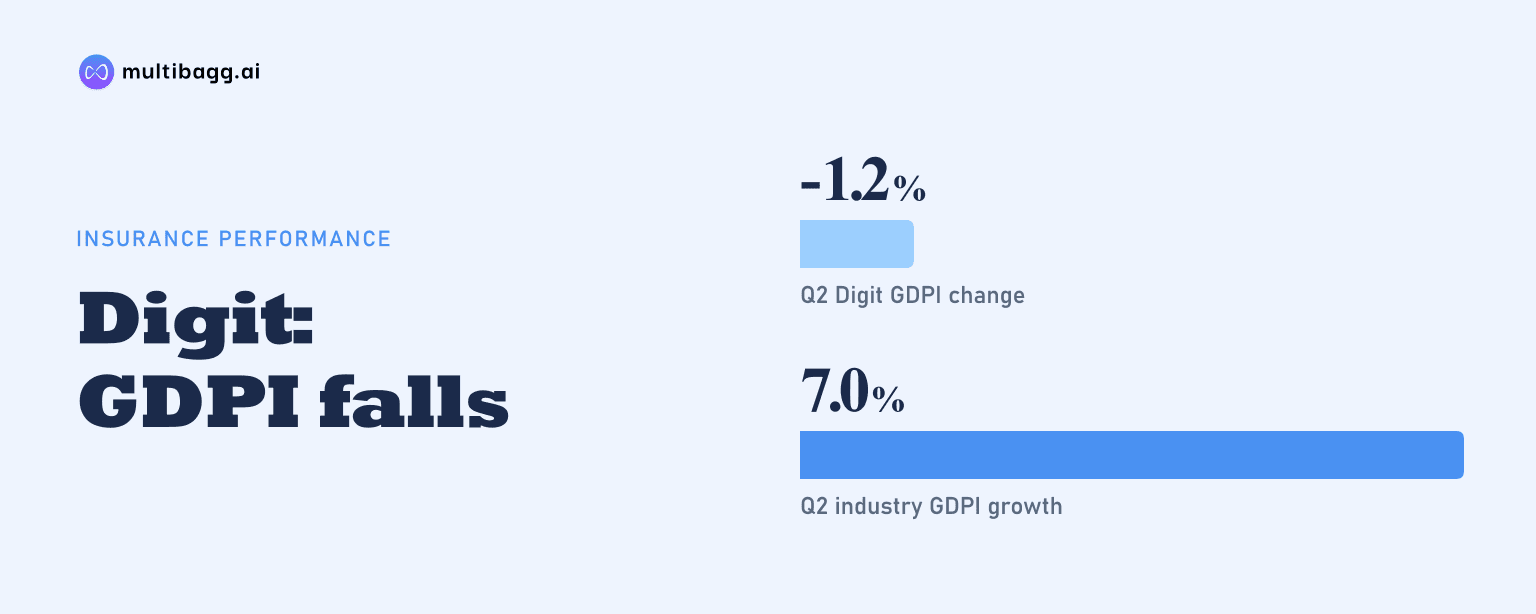
Digit’s gross direct premium income fell 1.2% year on year to Rs 2,351 crore in Q2 2027, as motor GDPI declined 4.1% while total industry GDPI grew 7.0%. Motor accounted for 66.9% of Digit’s premium mix, whereas health, travel and personal accident GDPI grew 19.6% and reached 21.6% of the mix.
Know Go Digit General Insurance inside out
Results, valuation, peers and who's buying, in one view.
Why did Digit’s Q2 gross direct premium income decline?
Digit’s Q2 2027 GDPI fell because its motor portfolio, representing 66.9% of direct premium, declined 4.1% from Q2 2026. Total GDPI was Rs 2,351 crore, compared with Rs 2,379 crore in Q2 2026. This differed from the industry’s 7.0% GDPI growth during Q2 2027, showing that Digit’s contraction occurred while the overall market expanded.
Motor own-damage, or OD, premium declined 7.0% in Q2 2027, while motor third-party, or TP, premium fell 2.4%. Industry GDPI growth was 15.9% in motor OD and 10.1% in motor TP. This reversed the FY 2026 pattern, when Digit’s motor GDPI grew 15.3%, compared with 9.2% industry growth.
The Q2 performance followed a smaller first-half contraction. Digit’s H1 2027 GDPI was Rs 4,798 crore, down 1.8% from Rs 4,887 crore in H1 2026, while industry GDPI rose 8.9%. Motor GDPI decreased 2.0% in H1 2027, with motor OD down 5.1% and motor TP down 0.1%.
How did Digit’s Q2 premium mix change?
Digit’s Q2 2027 direct-premium mix became less motor-heavy because health, travel and personal accident, or PA, increased to 21.6% from 17.8% a year earlier. Motor’s share fell to 66.9% from 69.0% over the same Q2 comparison. The shift reflected 19.6% growth in health, travel and PA alongside the 4.1% decline in motor total.
The same movement was visible in H1 2027. Health, travel and PA increased to 22.7% of Digit’s H1 GDPI from 18.7% in H1 2026, while motor represented 63.5%, compared with 63.6% a year earlier. Health, travel and PA GDPI grew 19.5% in H1 2027, close to the industry’s 20.7% growth rate.
Fire reduced the weight of non-motor business in the quarter, declining 25.8% in Q2 2027 against a 24.4% industry decline. Its share of Digit’s GDPI reduced to 4.6% from 6.1% in Q2 2026. Other products fell 3.6%, less than the industry’s 11.3% contraction, and their mix was 6.9% versus 7.1%.
The mix differed from FY 2026, when motor accounted for 68.7% of GDPI and health, travel and PA represented 17.9%. By Q2 2027, motor OD represented 24.6% of GDPI versus 26.2% in Q2 2026, while motor TP represented 42.3% versus 42.8%. The lower OD share and faster health, travel and PA growth drove the mix change.
Got a follow-up? Ask IRIS
What does Digit’s gross written premium performance show?
Digit’s gross written premium, or GWP, declined faster than direct premium in Q2 2027, falling 3.6% to Rs 2,571 crore from Rs 2,667 crore in Q2 2026. Digit stated that GWP excluding health reinsurance inward business was flat because it chose not to renew that business. Management said the pricing was unattractive.
This distinction is shown by the different quarterly movements in GWP and GDPI. GDPI was down 1.2% to Rs 2,351 crore, while GWP was down 3.6% to Rs 2,571 crore. In H1 2027, GWP fell 6.1% to Rs 5,302 crore from Rs 5,649 crore, compared with the 1.8% H1 decline in GDPI.
Within Q2 GWP, motor fell 4.1%, matching the GDPI motor decline, and represented 61.2% of GWP compared with 61.6% a year earlier. Health, travel and PA GWP grew 7.4% and increased its share to 21.7% from 19.5%. Fire GWP fell 29.9%, while its share reduced to 5.7% from 7.8%.
How did the Q2 premium movement coincide with operating results?
Digit reported Q2 2027 insurance revenue of Rs 2,720 crore, up from Rs 2,675 crore in Q2 2026, even as Q2 GDPI declined. The presentation defines insurance revenue as gross earned premium, a measure different from written or direct premium. Earned-premium recognition can therefore differ from the period’s GDPI movement.
The claims ratio increased to 62.4% in Q2 2027 from 48.2% in Q2 2026 under the methodology prescribed by the Insurance Regulatory and Development Authority of India, or IRDAI. The combined insurance service ratio was 99.8%, compared with 94.9% a year earlier; excluding flood loss, it was 97.4% versus 94.5%.
Profit before tax excluding mark-to-market, or MTM, effects and flood losses was Rs 341 crore in Q2 2027, down from Rs 380 crore in Q2 2026. Flood losses were Rs 63 crore in Q2 2027, compared with Rs 10 crore a year earlier. Profit after tax excluding MTM was Rs 208 crore, compared with Rs 277 crore in Q2 2026.
The balance-sheet indicators reported alongside these results include net worth of Rs 8,137 crore at H1 2027, up from Rs 7,620 crore in H1 2026, and a solvency ratio of 2.40 compared with 2.26. Net retention was 84.3% in Q2 2027 versus 79.1% in Q2 2026, while the expense ratio was 33.5% compared with 31.5%.
Conclusion
Digit’s Q2 2027 premium contraction was concentrated in motor, which remained 66.9% of GDPI but fell 4.1% while industry motor GDPI increased 12.4%. Health, travel and PA grew 19.6% and became 21.6% of GDPI, limiting the total direct-premium decline to 1.2% despite lower fire and motor premiums.
The presentation does not disclose a numerical premium-growth target or a scheduled event. The disclosed matter to watch in subsequent results is the effect of Digit’s decision not to renew health reinsurance inward business, which management said was unattractively priced and which coincided with a 3.6% Q2 GWP decline to Rs 2,571 crore.