










Go Digit Q2 FY27 Profit Falls 29% as Underwriting Tightens
Key highlights
- Go Digit reported Q2 FY27 insurance revenue of ₹2,720 crore for the quarter ended September 30, 2026.
- Profit after tax excluding MTM was ₹208 crore, down 29% year-on-year.
- The Q2 FY27 combined insurance service ratio rose to 99.8%, or 97.4% excluding flood loss.
- Go Digit's solvency ratio was 2.40x, above the 1.50x regulatory requirement.
powered by IRIS
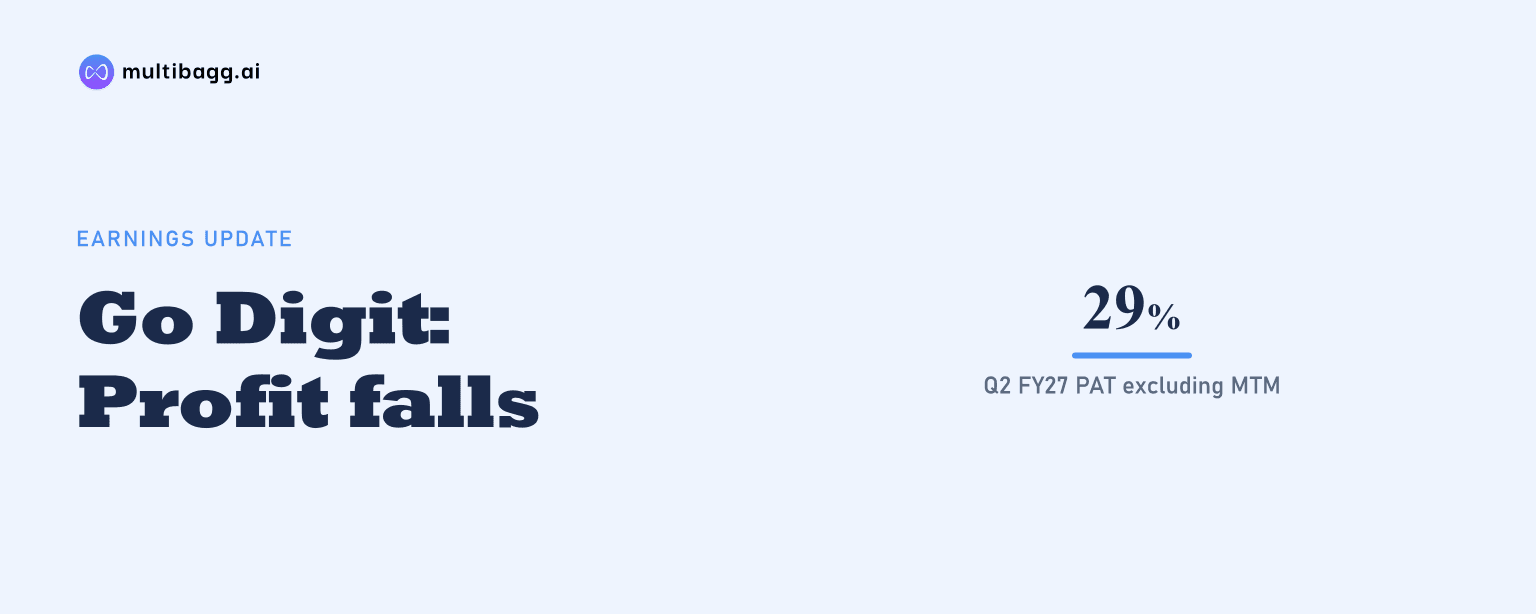
Go Digit General Insurance Limited reported Q2 FY27 insurance revenue of ₹2,720 crore and profit after tax excluding MTM of ₹208 crore, down 29% year-on-year, while its combined insurance service ratio rose to 99.8%. The result matters because the near-100% ratio points to pressure on underwriting profitability despite a 2.40x solvency ratio.
Know Go Digit General Insurance inside out
Results, valuation, peers and who's buying, in one view.
What did Go Digit report for Q2 FY27?
Go Digit reported insurance revenue of ₹2,720 crore for the quarter ended September 30, 2026, alongside profit before tax excluding MTM of ₹278 crore and profit after tax excluding MTM of ₹208 crore. The insurer said its gross direct premium income declined 1.2% year-on-year, while gross written premium fell 3.6%.
The Board approved the unaudited results for the quarter and half-year after considering the Audit Committee's recommendation. It also took on record the Limited Review Report issued by the joint statutory auditors. The financial statements were prepared under Indian Accounting Standards, or Ind AS.
The company separately disclosed insurance revenue of ₹2,720.49 crore, insurance service result of ₹43.04 crore, total investment income of ₹368.40 crore and profit from continuing operations of ₹142.39 crore for the quarter. The reported ₹208 crore profit after tax figure is identified in the company presentation as excluding mark-to-market, or MTM, effects.
Why did underwriting metrics weaken during the quarter?
Go Digit's combined insurance service ratio, or CISR, rose to 99.8% in Q2 FY27, indicating that underwriting income was almost fully absorbed by claims and related insurance service costs. Excluding flood loss, the company reported a CISR of 97.4%.
The total claims ratio was 62.4%, compared with 58.6% in FY26. Within motor insurance, the total claims ratio was 58.4%, while motor own-damage and motor third-party claims ratios were 80.3% and 45.2%, respectively. These data points show that claims experience was an important factor in the quarter's underwriting performance.
Management said gross written premium, excluding health reinsurance and government health business, was flat. It attributed this to the strategic non-renewal of business carrying unattractive pricing. The disclosure frames the slower premium performance as a pricing and portfolio decision rather than a broad expansion in low-return business.
How did the first-half results compare with the quarter?
Go Digit reported H1 FY27 insurance revenue of ₹5,386 crore, profit before tax excluding MTM of ₹597 crore and profit after tax excluding MTM of ₹447 crore. Its H1 combined insurance service ratio was 98.4%, lower than the 99.8% reported for the September quarter.
The difference between the half-year and quarterly CISR indicates that insurance service costs were higher relative to insurance revenue in Q2 than across the full six-month period. The available disclosures do not provide a separate numerical breakdown of every expense or claims category behind this movement.
Assets under management stood at ₹24,371 crore as of September 30, 2026, up 15.9% from a year earlier. Net worth under Ind AS was ₹8,137 crore. These balance-sheet measures provide context to the operating result, as investment assets and capital are important to an insurer's ability to absorb claims volatility and meet policyholder obligations.
Got a follow-up? Ask IRIS
What does the solvency position mean for investors and policyholders?
Go Digit's solvency ratio of 2.40x was above the regulatory requirement of 1.50x as of September 30, 2026. This means the insurer reported capital resources materially above the minimum threshold cited in its results disclosure.
For policyholders, solvency is a core measure of an insurer's financial capacity. For shareholders, it provides a counterbalance to the quarter's weaker profitability, but it does not remove the relevance of the higher combined ratio and lower premium growth. The company disclosed both strong solvency and pressure on insurance service performance in the same set of results.
The results also reflect the importance of pricing discipline in general insurance. Go Digit's decision not to renew unattractively priced business limited premium growth in the period, while potentially avoiding further underwriting pressure from business that did not meet its return criteria.
What should investors assess after the Q2 FY27 results?
Investors should assess whether Go Digit can improve claims experience and restore underwriting margins while retaining its stated pricing discipline. The 99.8% quarterly CISR, 62.4% claims ratio and 29% year-on-year fall in profit after tax excluding MTM are the key reported indicators of current pressure.
The company scheduled its Q2 FY27 earnings call for November 5, 2026 at 5:45 PM IST, following the results disclosure. ICICI Securities was named as the host. Management's discussion may provide further detail on claims experience, motor and commercial insurance operations, flood-related losses, and the implications of non-renewal decisions.
Go Digit had said after Q1 FY27 that it expected the own-damage loss ratio to stabilise in Q2 following corrective action in its car portfolio. The Q2 results provide updated claims-ratio disclosures, but the supplied announcement does not state a forward target for the ratio or a timetable for further improvement.
Conclusion
Go Digit's Q2 FY27 disclosures show an insurer with capital strength but weaker operating profitability. Insurance revenue was ₹2,720 crore, profit after tax excluding MTM was ₹208 crore, and the CISR rose to 99.8%, placing underwriting performance at the centre of investor attention.
The next disclosed event is the November 5 earnings call, where management is expected to discuss the quarterly and half-yearly results. Investors will watch for additional information on motor claims, flood-related costs, the effect of selective non-renewals, and any update on own-damage loss-ratio stabilisation.