










Dixon maps Rs 1,000 crore display investment and revenue goal
Key highlights
- Dixon plans about Rs 1,000 crore of display investment across the current fiscal year and the following two years.
- Dixon expects notebook and automotive display-module production to begin in the current fiscal year’s fourth quarter.
- Dixon plans mobile-display capacity of 20-25 million units, with installation targeted by February 2027.
- Dixon targets Rs 6,000-7,000 crore of display revenue after the business is fully ramped up.
powered by IRIS
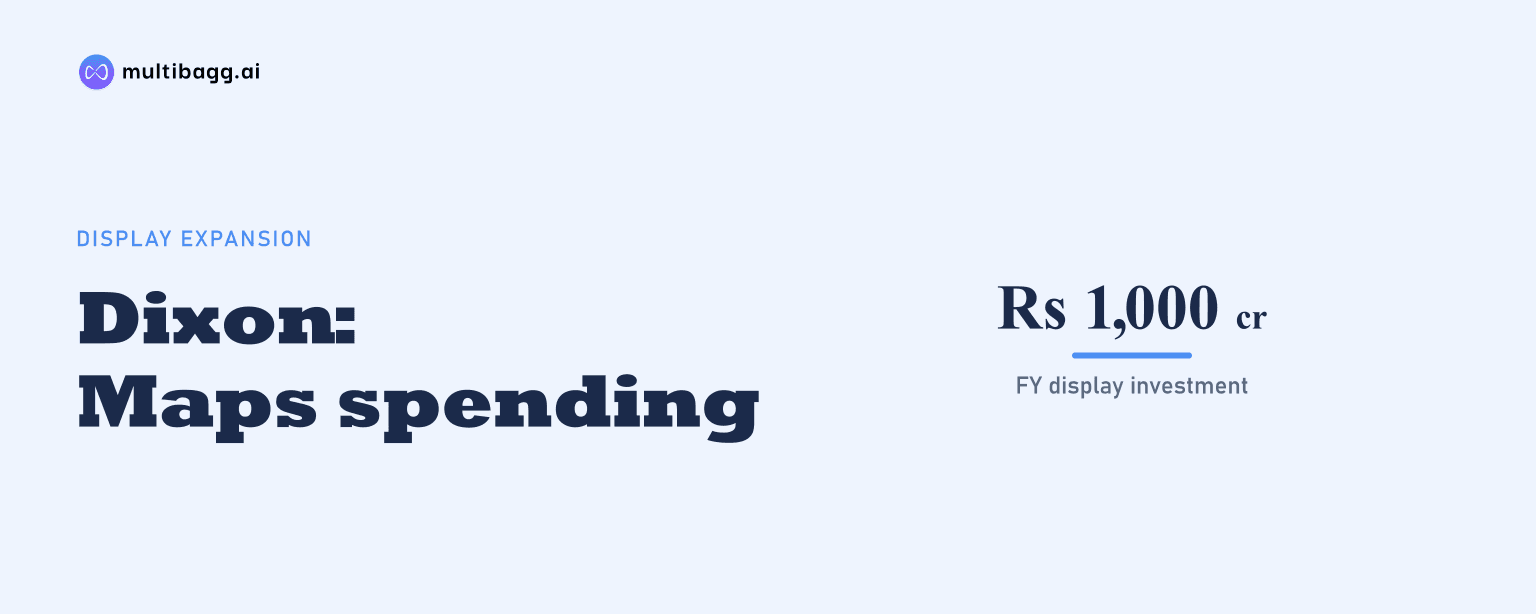
Dixon plans about Rs 1,000 crore of display-manufacturing investment across the current fiscal year and the following two years, with management targeting Rs 6,000-7,000 crore of revenue after full ramp-up. Notebook and automotive display-module lines are due for commercial production in the current fiscal year’s fourth quarter, while mobile-display production is planned for early next financial year.
Know Dixon Technologies (India) inside out
Results, valuation, peers and who's buying, in one view.
How much will Dixon invest in display manufacturing?
Dixon expects to invest about Rs 1,000 crore in display manufacturing over three fiscal years, rather than spending that entire amount next year. Management said the programme includes about Rs 3-3.5 crore in the current fiscal year and another Rs 3.5-4 crore in the next financial year, with the remaining investment expected in the following year.
The disclosed spending ranges indicate Rs 6.5-7.5 crore of investment across the first two years of the programme. Management did not provide a year-by-year allocation for the balance of the Rs 1,000 crore total, but said the investment would be spread between the current year, next year and the year after that as display operations scale.
Dixon placed the display plan within a broader capital-expenditure programme. It said it had incurred about Rs 7 crore of capital expenditure in the first six months, expected about Rs 5 crore more in the second half and therefore expected roughly Rs 1,200 crore for the full year; management indicated a similar Rs 1,200-1,300 crore run rate for the next financial year.
When will Dixon start commercial display-module production?
Dixon expects commercial production of notebook and automotive display modules to begin in the current fiscal year’s fourth quarter. Management said installation of those lines was in process and due to be completed by the end of November, followed by trials in December before commercial output begins in the quarter.
The mobile-display line has a later timetable because management said there had been a delay before equipment was shipped. Dixon expects installation of its initial 20-25 million-unit mobile-display capacity by February 2027, trials in March 2027 and commercial production early in the next financial year.
Management also said automotive and information-technology hardware display lines had been installed, while describing the notebook and automotive line-installation process as nearing completion. The common operational message was that non-mobile lines are closer to production than mobile displays, whose initial capacity is measured at 20-25 million units annually.
The staged rollout is important because it separates the markets served by the project. Notebook and automotive modules are intended to establish output first, while the mobile line is designed for a larger unit scale. Management did not disclose display volumes for notebook or automotive modules, but it set the mobile-line installation target at February 2027.
How large could Dixon’s display business become?
Dixon said its display business could generate Rs 6,000-7,000 crore of revenue once fully ramped over the next couple of years. Management said a large part of this potential would be captive, meaning modules would be used in Dixon’s own manufacturing operations rather than being supplied only to external customers.
For the next financial year, management said it would target at least 25-30% of the Rs 7,000 crore potential. On that stated upper-end potential, this equates to Rs 1,750-2,100 crore, although the calculation is an implication of management’s target rather than reported revenue or formal guidance.
Dixon characterized display modules as a high-teen margin business and said it expected that profile to start contributing in the next financial year. Management also said displays and camera modules together could expand margins by 80-100 basis points over two years; one basis point equals one-hundredth of a percentage point.
Got a follow-up? Ask IRIS
How will Dixon fund the display programme?
Dixon said it is meeting the current year’s display capital expenditure from internal accruals and expects to fund next year’s requirements the same way while generating some free cash flow. Management did not disclose a plan to use temporary debt for the display project, although its funding expectation depends on improving earnings visibility.
Management expects working capital to provide support before March. It said 80-85% of the money blocked in working capital should be released before then, citing strategic memory inventory, seasonal increases in debtors and inventory, customer advances that were subsequently paid, and pending production-linked incentive receipts for information-technology hardware and telecom.
The display project is also part of Dixon’s stated effort to manufacture more components internally. In information-technology hardware, management said current margins were about 2-2.3% and could improve by 80-100 basis points if Dixon localizes 25-30% of the bill of materials through displays, solid-state drives, mechanical components and, later, power supplies.
This strategy differs from Dixon’s other component initiatives in scale and timing. Q Tech has expanded capacity from 80 million to 120 million units and plans to reach 180-190 million units over two years, while the Gemtek telecommunications venture has an initial investment of Rs 50-60 crore. The display project’s Rs 1,000 crore total therefore represents the larger disclosed component investment.
What could change the display project’s financial contribution?
Dixon’s display revenue and margin targets depend on commercial production beginning as scheduled and on captive demand developing alongside external opportunities. Management’s Rs 6,000-7,000 crore potential is a target after full ramp-up, not current revenue, and it said the next financial year should capture at least 25-30% of the Rs 7,000 crore potential.
The pace of localization also matters to the broader economics described by management. Dixon said information-technology hardware receives higher incentives as localization increases under the production-linked incentive framework, while displays, solid-state drives and mechanical components could help it reach a 25-30% localized share of the bill of materials.
Dixon’s current working-capital position is another operating variable. Management linked the first-half cash burn of Rs 280 crore to strategic memory inventory, peak-season working capital and pending incentive receipts, while forecasting that 80-85% of blocked working capital would be released before March.
Conclusion
Dixon’s display plan combines a Rs 1,000 crore three-year investment programme with a management target of Rs 6,000-7,000 crore in revenue after full ramp-up. The project would deepen component manufacturing through notebook, automotive and mobile display modules, with captive consumption expected to account for a large share of the eventual business.
The next disclosed milestones are completion of notebook and automotive line installation by the end of November, trials in December and mobile-line installation by February 2027. Management’s next tests will be starting commercial non-mobile production in the fourth quarter, reaching at least 25-30% of the Rs 7,000 crore potential next financial year and funding the planned investment from internal accruals.