










Dixon Pursues Optical Technology Through Gemtek, Separate Plan
Key highlights
- Dixon plans Gemtek optical-transceiver trials in Q4 FY27 and commercial production in the following financial year.
- Gemtek's first investment is expected to be Rs 50 crore to Rs 60 crore under an approved ECMS application.
- Dixon said advanced packaging is a separate ISM 2.0-eligible initiative rather than part of Gemtek.
- Dixon's telecom and networking segment reported Q2 FY27 revenue of Rs 1,837 crore.
powered by IRIS
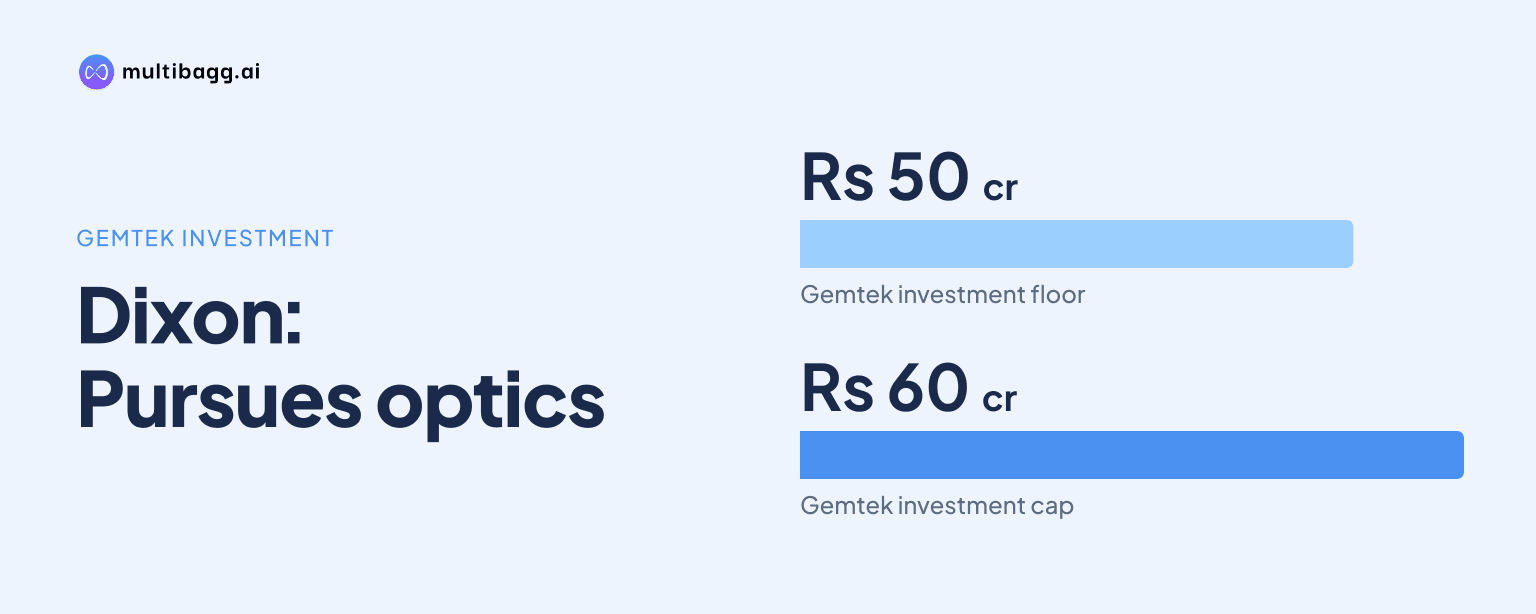
Dixon Technologies will pursue optical transceivers through its Gemtek joint venture, with trials planned for Q4 FY27 and an initial investment of Rs 50 crore to Rs 60 crore, while its silicon-photonics and advanced-packaging ambitions remain separate, earlier-stage initiatives that management said could be eligible for Indian Semiconductor Mission 2.0.
Know Dixon Technologies (India) inside out
Results, valuation, peers and who's buying, in one view.
What is Dixon planning for AI and data-centre markets?
Dixon is evaluating a move into silicon-photonics optical transceivers and advanced packaging for artificial-intelligence infrastructure, hyperscale data centres, telecom networks and high-speed computing. Management said the products would support transmission of larger data volumes with greater bandwidth, extending Dixon beyond conventional electronics manufacturing services into higher-technology, lower-volume categories.
The company has not announced a capital commitment, launch date, customer or revenue target for the silicon-photonics and advanced-packaging effort. Management said it aims to establish these capabilities through acquisitions or partnerships and described the opportunity as an extension of Dixon's electronics-manufacturing base rather than a confirmed new operating segment.
The proposed technologies are small beside Dixon's existing reported operations at this stage. Mobile and other electronics manufacturing services generated Q2 FY27 revenue of Rs 20,093 crore and operating profit of Rs 509 crore, while telecom and networking products generated Rs 1,837 crore. No current revenue was disclosed for optical transceivers, silicon photonics or advanced packaging.
Management linked the plan to a shift towards optical technology in data-centre and network equipment. It said global electronics manufacturing peers have derived growth from this area, but did not name those companies or provide a market-size estimate. The stated objective is to bring relevant technology into India and ultimately serve global markets from Indian facilities.
How does the Gemtek venture fit Dixon's optical strategy?
The Gemtek joint venture is Dixon's defined initial project in optical products, intended to manufacture small form-factor pluggable optical transceivers, or SFPs, and bidirectional optical sub-assemblies, or BOSA. Gemtek is a Taiwanese original design manufacturer, and Dixon said the venture's application under the Electronics Component Manufacturing Scheme, or ECMS, has been approved.
Management expects the Gemtek venture to commence operations in Q4 FY27. In a later response, it specified that trials are targeted for Q4 FY27 and commercial production for the following financial year. That difference means the Q4 milestone concerns initial operating activity and qualification, rather than confirmation of commercial-scale output.
The initial product focus is domestic mobile telecom networks, where management said the venture would start with lower-speed transceivers. Dixon intends subsequently to pursue higher-frequency products for data centres. The call did not disclose the planned technical specifications, customer approvals, production capacity or timing for a transition from telecom to data-centre products.
Gemtek is part of a wider telecom product expansion that includes customer-premises equipment, fixed-wireless-access devices, broadband equipment and microwave backhaul radios. Dixon said production of complex microwave radios for large global brands had scaled successfully and exports could begin during FY27, while complex optical platforms and industrial radio products are planned from the next financial year.
Is Dixon using ISM 2.0 for the Gemtek project?
No, Dixon said Gemtek is an ECMS-backed component-manufacturing project, while the proposed advanced-packaging initiative is separate and could be eligible under Indian Semiconductor Mission 2.0, or ISM 2.0. The distinction separates a venture with an approved application and Rs 50 crore to Rs 60 crore initial investment from a packaging proposal without a disclosed partner or budget.
Management explicitly said advanced packaging would not be executed through the Gemtek venture. It is pursuing additional alternatives to bring higher-frequency optical transceivers, advanced packaging and silicon-photonics capabilities to India, but did not identify any prospective partner, ownership structure or signed agreement as of the Q2 FY27 call.
Dixon referred to assembly, testing, marking and packaging, or ATMP, when discussing the prospective advanced-packaging capability. Management said margins could be high and the return-on-capital profile could be close to Dixon's current profile, but provided no numerical margin, capacity, return target or revenue projection. These are management expectations rather than reported financial outcomes.
The Gemtek investment should therefore not be treated as the budget for a potential advanced-packaging facility. Management described the transceiver operation as not very capital-intensive, but made no equivalent statement about the separate ISM 2.0-linked project. The capital requirement and execution timetable for advanced packaging remain undisclosed.
Got a follow-up? Ask IRIS
What existing component investments support Dixon's strategy?
Dixon is expanding component manufacturing in camera modules and displays, which management presented as part of broader localisation. Q Tech, Dixon's 51% subsidiary, increased annual camera-module capacity from 80 million to 120 million units and plans to raise it to 180 million to 190 million units by the next financial year. Management said deeper manufacturing at Q Tech is intended to support margins.
Display-module development follows a separate schedule from Gemtek. Dixon expects trials for automotive and notebook displays in Q3 FY27, followed by mobile-display trials in Q4 FY27, with mass production targeted from the next financial year. Management said display investment could total about Rs 1,000 crore across the current year, next year and the following year.
In IT hardware, Dixon has installed a solid-state-drive manufacturing line and expects customer trials in Q3 FY27. It is also assessing mechanical enclosures and power supplies, while its 60:40 joint venture with Taiwan's Inventec Corporation is expected to begin trials in Q3 FY27. Management said it would formulate a server strategy after that venture becomes operational.
These component programmes have disclosed operating scale that the optical and packaging projects do not yet have. IT hardware generated Q2 FY27 revenue of Rs 2,160 crore, and management expects FY27 revenue of about Rs 6,000 crore to Rs 6,500 crore from that business. It excluded potential server revenue from its stated Rs 18,000 crore to Rs 20,000 crore IT-hardware ambition for the next couple of years.
What milestones should readers watch in Dixon's optical expansion?
The immediate milestone is whether Gemtek completes its Q4 FY27 trials and starts commercial production in the following financial year. Investors should also watch for evidence that the venture can progress from domestic telecom transceivers to data-centre applications, because management has disclosed no customer contracts or export timetable for those higher-technology products.
A second issue is whether Dixon announces a partner, investment amount and technical scope for the separate advanced-packaging project. The company said the project could qualify for ISM 2.0 but has not committed capital. By comparison, the Gemtek initial investment is Rs 50 crore to Rs 60 crore and its ECMS application has already been approved.
The pace of the wider component ramp also matters. Management said camera and display modules together could expand group margins by 80 to 100 basis points over the next two years, subject to volume ramp-up and operating leverage. Q Tech's capacity target of 180 million to 190 million units and next-year display mass production are therefore nearer-term tests of the localisation strategy.
Conclusion
Dixon is pursuing a staged technology expansion rather than committing to a single integrated AI and data-centre project. Gemtek provides a disclosed entry into optical transceivers, supported by an approved ECMS application, Q4 FY27 trials and Rs 50 crore to Rs 60 crore of initial investment. Silicon photonics and advanced packaging are separate opportunities with ISM 2.0 relevance but without announced capital, partners or commercial targets.
The next events to watch are Gemtek's Q4 FY27 trials and expected commercial production in the following financial year, alongside display trials in Q3 FY27 and Q4 FY27 before planned mass production next year. Management's planned server strategy after the Inventec joint venture begins operations, and any announcement on a separate advanced-packaging partnership, should clarify the scale and execution path of Dixon's higher-technology push.