










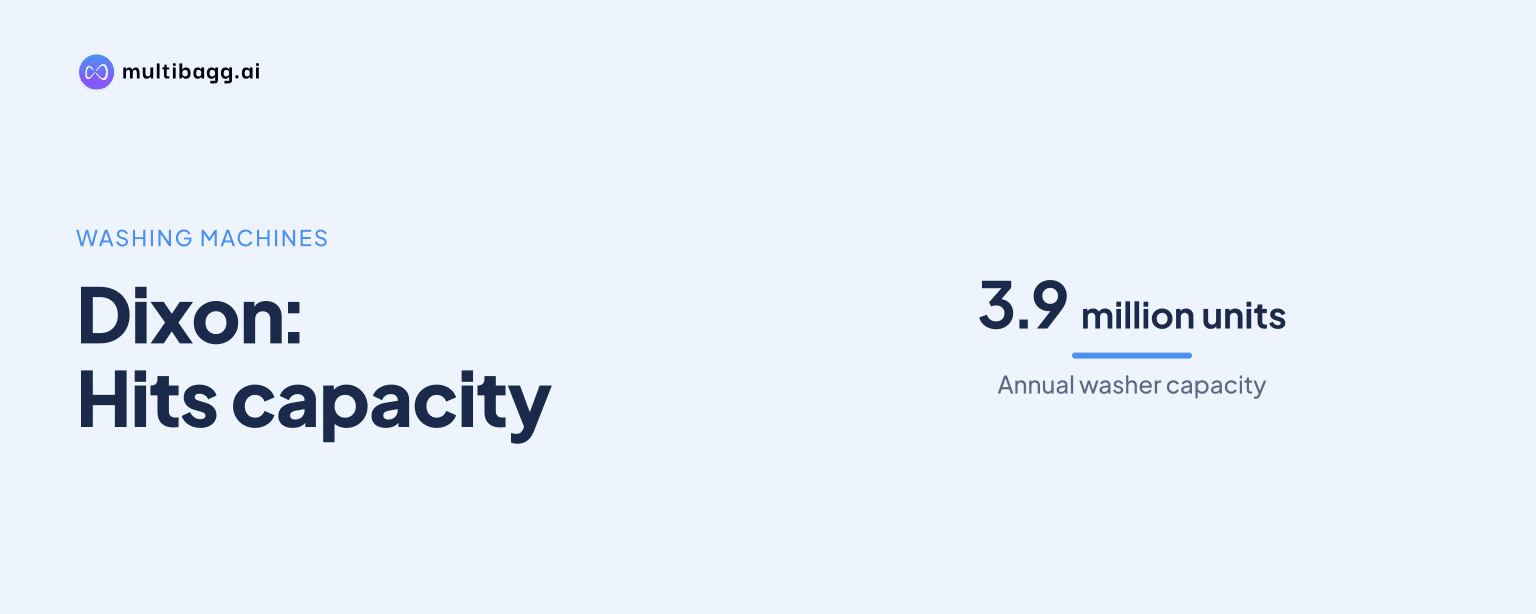
Dixon capacity reaches 3.9 million washing machines annually
Key highlights
- Dixon reported annual washing-machine capacity of 3.9 million units, compared with management’s estimated Indian demand of 12 million units.
- Semi-automatic washing-machine volume rose 27% year on year to 6.3 lakh units in Q2 FY27.
- Fully automatic top-loading washing-machine volume increased 24% year on year to 1.3 lakh units in Q2 FY27.
- Home Appliances reported Q2 FY27 revenue of Rs 586 crore and operating profit of Rs 48 crore.
powered by IRIS
Dixon Technologies (India) Limited reported in Q2 FY27 that annual washing-machine capacity had reached 3.9 million units, equal to about 33% of its estimated 12 million-unit Indian market, as it prepared to launch front-loading machines in Q3 FY27 and dishwashers and microwave ovens in Q4 FY27.
Know Dixon Technologies (India) inside out
Results, valuation, peers and who's buying, in one view.
What is Dixon's washing-machine capacity now?
Dixon has annual washing-machine capacity of 3.9 million units, comprising 3 million semi-automatic units, 0.6 million fully automatic top-loading units and 0.3 million fully automatic front-loading units. Management described this as India’s largest washing-machine manufacturing capacity and compared it with an estimated annual domestic requirement of 12 million units.
The 3.9 million-unit platform represents approximately 33% of the 12 million-unit market estimate cited by management. Semi-automatic machines account for 3 million units, or most of the capacity, while fully automatic top-loaders and front-loaders together account for 0.9 million units. This product split gives Dixon manufacturing capacity in its existing semi-automatic and top-loading categories as well as in front-loaders scheduled for Q3 FY27.
Management said the capacity gives Dixon scope to pursue outsourcing opportunities, onboard customers and increase volumes across product categories. These are management’s stated opportunities rather than disclosed customer contracts, and the transcript did not provide current utilisation for the 3.9 million-unit capacity.
How did Dixon's washing-machine volumes grow in Q2 FY27?
Dixon’s semi-automatic washing-machine volume increased 27% year on year to 6.3 lakh units in Q2 FY27, while fully automatic top-loading volume rose 24% to 1.3 lakh units. The disclosed quarterly total for these two categories was 7.6 lakh units, with semi-automatic machines accounting for the larger volume.
For the half year ended September 2026, semi-automatic volume grew 16% year on year to 10.9 lakh units and fully automatic top-loading volume rose 23% to 2.2 lakh units. The comparison shows faster Q2 growth in semi-automatic products, at 27%, than their 16% growth rate in the first half, while top-loader growth was similar at 24% in Q2 and 23% in the half year.
Management attributed home-appliance segment growth to capacity expansion, a broader portfolio, and in-house moulding and tooling capabilities. Dixon did not disclose front-loading volumes for Q2 FY27 because the Tirupati front-loading launch was planned for Q3 FY27, so the reported 7.6 lakh-unit quarterly total excludes that category.
When will Dixon launch front-loaders, dishwashers and microwave ovens?
Dixon plans to launch fully automatic front-loading washing machines from Tirupati in Q3 FY27. The new product has 0.3 million units of annual capacity within the stated 3.9 million-unit washing-machine platform, following the company’s established semi-automatic and fully automatic top-loading production.
Dixon also plans to enter dishwashers and microwave ovens in Q4 FY27. Management said the two adjacent categories would expand the consumer base it can address, but did not disclose capacity, revenue targets, capital expenditure or customers for either product line.
The timing places the front-loader launch one quarter before the planned dishwasher and microwave-oven launches. Management linked its home-appliance plan to investment in backward integration, saying in-house moulding and tooling, along with further integration, are intended to improve operating leverage and support sustained profitability.
Got a follow-up? Ask IRIS
Why are Dixon's home-appliance profits temporarily affected?
Dixon reported Q2 FY27 Home Appliances revenue of Rs 586 crore and operating profit of Rs 48 crore, while saying washing-machine and refrigerator profitability was temporarily affected by cost and logistics movements. Management identified polymer-price fluctuations, higher freight costs, longer transit times, unfavourable foreign-exchange movements and higher costs of other key inputs.
The company said it took calibrated pricing actions during Q2 FY27 in response to sharply higher input costs, but a lag remained because costs continued to rise before selling-price changes could fully pass them through. This separates the profitability issue from volume performance: semi-automatic volumes rose 27% and top-loading volumes increased 24% during the same quarter.
Management expects pressure to ease as cost pass-through initiatives gain traction and operating efficiencies strengthen, but it gave no date or operating-profit target for that outcome. The stated mechanism is a combination of pricing actions and efficiency gains, while the timing of cost recovery remains an unresolved near-term issue.
How does the washing-machine plan fit Dixon's wider appliance strategy?
Dixon’s washing-machine expansion sits within a Home Appliances segment that generated Rs 586 crore of Q2 FY27 revenue and Rs 48 crore of operating profit. The 3.9 million-unit washing-machine capacity is paired with plans for front-loaders in Q3 FY27 and dishwashers and microwave ovens in Q4 FY27, broadening the segment beyond semi-automatic and top-loading machines.
The company is also expanding its refrigerator platform, where management said Q2 FY27 commodity-price increases and elevated sea freight costs led to higher selling prices that weighed on demand. Dixon said it had begun making side-by-side refrigerators for a large brand and would begin manufacturing multi-door French-door refrigerators from the following month.
For refrigerators, Dixon said it is expanding its facility by almost 3.75 lakh square feet to add capacity for deep freezers, visi coolers and two-door refrigerators. That expansion is separate from the 3.9 million-unit washing-machine capacity, but both initiatives reflect management’s plan to widen appliance products and increase value addition.
Conclusion
Dixon’s 3.9 million-unit washing-machine capacity equals about one-third of the 12 million-unit Indian requirement estimated by management, while Q2 FY27 growth reached 27% in semi-automatic machines and 24% in top-loaders. The figures show expansion in its established washing-machine categories alongside a planned move into front-loaders and adjacent kitchen appliances, even as higher polymers, freight, foreign exchange and other inputs affected appliance profitability.
The next disclosed milestones are the Q3 FY27 front-loading launch at Tirupati and Q4 FY27 launches of dishwashers and microwave ovens. Management’s pricing actions, the pace of cost pass-through, and operating efficiencies from backward integration will determine whether the company’s planned higher utilisation and operating leverage emerge as the expanded portfolio is introduced.