










Dixon sees Rs 18,000-20,000 crore IT hardware in two years
Key highlights
- Dixon targets Rs 18,000-20,000 crore of IT hardware revenue within the next couple of years, excluding servers.
- Dixon expects Rs 6,000-6,500 crore of IT hardware revenue from 1.3-1.4 million units in the current fiscal year.
- Dixon has increased its IT PLI capital commitment to Rs 500 crore from Rs 250 crore.
- Management's longer-term IT hardware volume plan is 3.5-4 million units, versus 1.8-2 million units targeted next year.
powered by IRIS
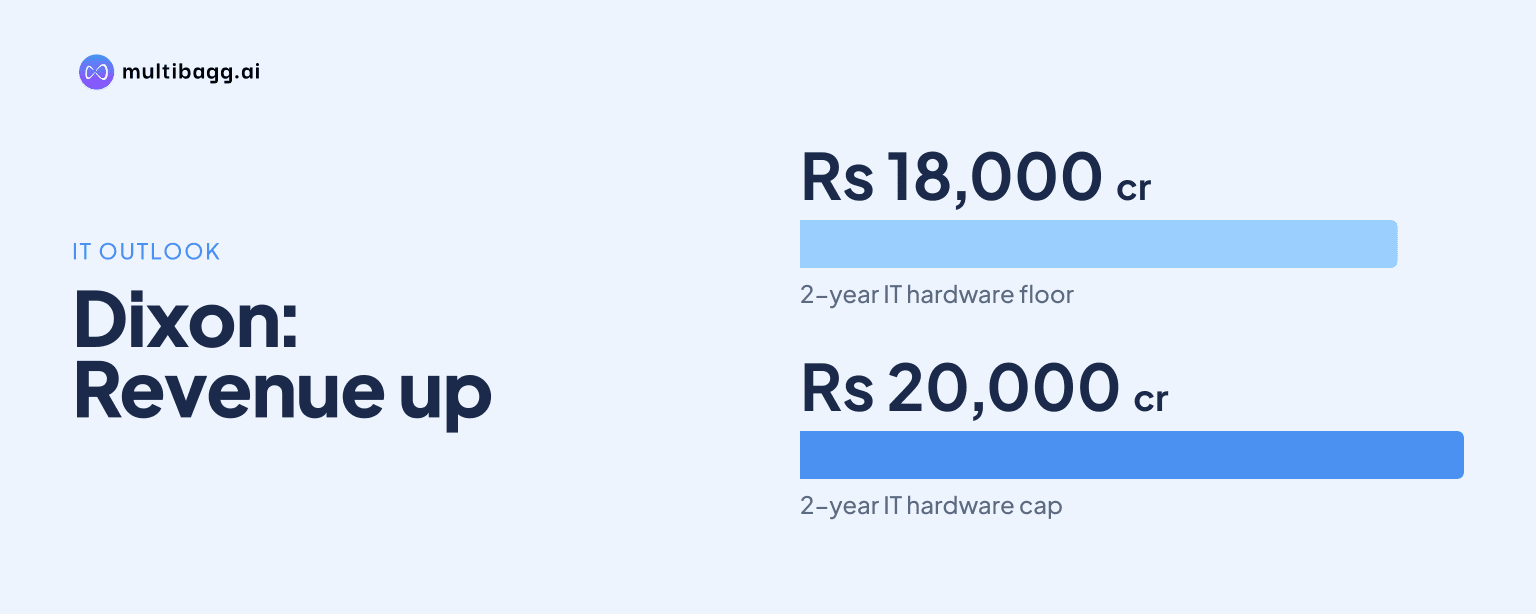
Dixon said its IT hardware business could reach Rs 18,000-20,000 crore within the next couple of years, excluding server revenue, driven by laptops, tablets, desktops and all-in-ones already in its pipeline. Management has increased its IT production-linked incentive, or PLI, capital commitment to Rs 500 crore from Rs 250 crore on the basis of its order book and expected device volumes.
Know Dixon Technologies (India) inside out
Results, valuation, peers and who's buying, in one view.
What is Dixon's IT hardware revenue target?
Dixon's target is Rs 18,000-20,000 crore of IT hardware revenue within the next couple of years, with no server revenue included in that estimate. Management had initially described the opportunity as a Rs 15,000-20,000 crore business, then said it was confident of a Rs 18,000-20,000 crore range from existing device categories.
The current-fiscal outlook is materially smaller, at Rs 6,000-6,500 crore from 1.3-1.4 million units. Management said next year's volume could reach 1.8-2 million units, while the final plan is to reach 4 million units across the IT hardware category. That progression means the revenue target depends primarily on a large increase in device output.
Management also outlined the arithmetic behind the longer-term scale. It said 4 million units at a current run rate of Rs 50,000-55,000 per unit would equate to Rs 20,000-22,000 crore, before adding tablets, all-in-ones and desktops. The calculation supports management's view that the target can be met through devices rather than a server contribution.
Which products will drive Dixon's IT hardware target?
Dixon expects laptops and tablets to provide the main revenue, while desktops and all-in-ones add to the product range. Management said tablet production is already under way, all-in-ones are already being made, and the desktop line has been established, with production scheduled to begin in the third quarter of the current fiscal year.
Dixon said it has four of the top five global brands as customers, although it did not identify them. Management also cited expansion from practically minuscule numbers to almost 2,100 stores in the current quarter, alongside customer traction and the order book, as reasons for increasing the PLI capital commitment to Rs 500 crore.
The company is also extending manufacturing beyond final assembly. Its solid-state drive, or SSD, line has been set up and customer trials have started, while a display line at a new factory is ready for trials by the third quarter. Management is evaluating mechanical enclosures and exploring power supplies, which would increase local content in IT devices.
Does Dixon's Rs 18,000-20,000 crore target include servers?
No, Dixon said the Rs 18,000-20,000 crore target excludes both conventional and artificial intelligence, or AI, server revenue. Management stated that laptops, tablets, desktops and other existing IT device activities alone could support the target, separating the stated outlook from any future server strategy.
Dixon plans to enter general and AI servers, but described the opportunity as an additional initiative. Management said its joint venture with Inventec is expected to be operational by the end of the third quarter or in the fourth quarter of the current fiscal year, after which the partners will determine the server strategy.
This distinction limits what can be inferred from the target. The disclosed Rs 18,000-20,000 crore range is based on products with established or planned manufacturing lines, rather than an unquantified contribution from servers. Any revenue from servers would therefore sit outside management's stated two-year IT hardware estimate.
Got a follow-up? Ask IRIS
How is Dixon funding and localising IT hardware production?
Dixon is doubling its committed IT PLI capital expenditure to Rs 500 crore from Rs 250 crore as it moves from the hybrid category to the global category. Management said the change follows the order book and expected scale in IT hardware, rather than a separately disclosed server investment plan.
Management said the PLI structure provides higher incentives as local value addition rises. Dixon intends to backward integrate displays, SSDs, mechanical parts and potentially power supplies, with a stated objective of localising 25-30% of the bill of materials, or BOM, in IT hardware.
Dixon estimated IT hardware margins at about 2-2.3% at present. Management said higher memory prices can affect the reported percentage because the business earns a per-piece conversion charge, and it expects backward integration and volume operating leverage to improve margins by 80-100 basis points, without giving a date for that improvement.
What supports Dixon's planned IT hardware scale-up?
Dixon's case for expansion rests on current volumes, customer additions, product breadth and localisation plans. The current-fiscal outlook of 1.3-1.4 million units compares with management's 3.5-4 million-unit longer-term range, showing the scale of the planned output increase behind the Rs 18,000-20,000 crore target.
Memory-cost inflation has raised selling prices in both mobile phones and IT hardware, according to management. It said there was no supply-chain constraint on memory availability or production, but higher component prices mean that revenue growth can reflect both unit growth and a higher value per device.
Dixon also differentiated IT hardware from original design manufacturing, or ODM, operations such as lighting, refrigerators and washing machines. Management said electronics manufacturing services, or EMS, activities including laptops and IT products have automatic cost pass-through, while the ODM categories can face a time lag in recovering higher input costs under their contract structures.
The IT plan is being developed alongside separate initiatives in precision engineering, optical transceivers, advanced packaging and silicon photonics. Management described those areas as growth opportunities, including a Gemtek joint venture for optical transceivers, but did not include any revenue from them in the Rs 18,000-20,000 crore IT hardware goal.
Conclusion
Dixon's stated IT hardware ambition is based on an identifiable device pipeline rather than server revenue. The move from a Rs 250 crore to Rs 500 crore IT PLI commitment, the current-fiscal outlook of Rs 6,000-6,500 crore, and the planned rise from 1.3-1.4 million units toward 3.5-4 million units show how management expects the vertical to expand.
The next disclosed milestones are desktop production in the third quarter, display trials by the third quarter and the Inventec joint venture becoming operational by the end of the third quarter or in the fourth quarter of the current fiscal year. Management's progress on localising 25-30% of the IT hardware BOM and converting its order book into higher device volumes will indicate how the target is developing.