










Dixon Technologies Q2 FY27 revenue reaches ₹21,806 crore
Key highlights
- Dixon reported Q2 FY27 adjusted revenue of ₹21,806 crore for the quarter ended September 30, 2026.
- Adjusted Q2 FY27 EBITDA was ₹609 crore and PAT after minority interest was ₹293 crore.
- Mobile and other EMS generated ₹20,093 crore of revenue and ₹509 crore of operating profit in Q2 FY27.
- Dixon produced approximately 9.7 million mobile units in Q2 FY27 and expects 33 million to 34 million units in H2 FY27.
powered by IRIS
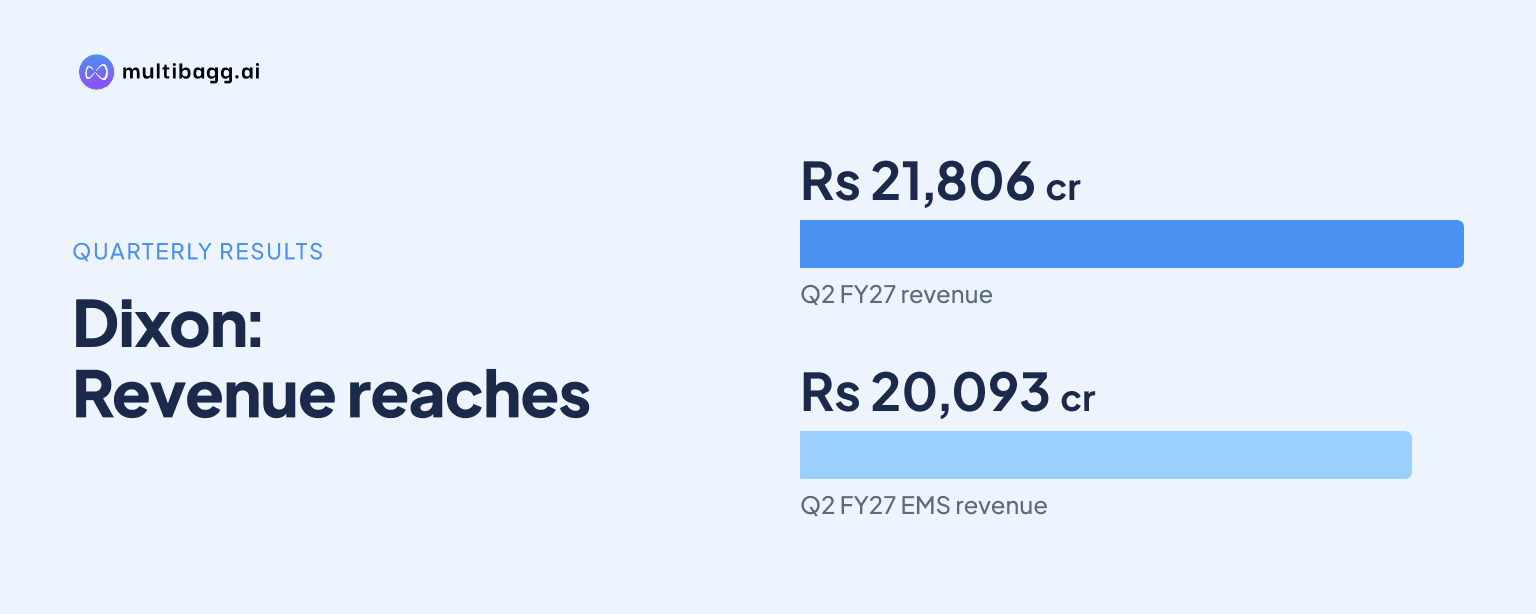
Dixon Technologies (India) Ltd reported Q2 FY27 adjusted revenue of ₹21,806 crore for the quarter ended September 30, 2026. The company also reported adjusted EBITDA of ₹609 crore and adjusted profit after tax of ₹293 crore, excluding the fair-value gain on its stake held with Aditya Infotech Limited.
Know Dixon Technologies (India) inside out
Results, valuation, peers and who's buying, in one view.
What did Dixon report for Q2 FY27?
Dixon reported quarterly revenue of ₹21,806 crore in Q2 FY27, according to opening remarks by Vice Chairman and Managing Director Atul Lall during the October 30 earnings call. The quarterly figures relate to the period ended September 30, 2026.
The company said EBITDA, excluding the specified fair-value gain, was ₹609 crore. Profit after tax after minority interest, also excluding that fair-value gain, was ₹293 crore. The distinction is relevant because these adjusted numbers are intended to show operating performance without the stated valuation-related item.
Published earnings coverage also cited reported consolidated revenue from operations of ₹21,793.64 crore for the quarter. A separate summary put reported revenue at ₹21,863 crore. The management’s stated adjusted revenue of ₹21,806 crore is the figure used as the main operating metric in this report.
Which businesses contributed to Dixon's quarterly revenue?
Mobile and other EMS was Dixon's largest disclosed business segment in Q2 FY27, recording revenue of ₹20,093 crore and operating profit of ₹509 crore. The segment accounted for the bulk of the company’s stated quarterly revenue, highlighting the importance of electronics manufacturing services to the group’s operating profile.
The home appliances business reported revenue of ₹586 crore and operating profit of ₹48 crore during the quarter. The supplied call excerpts do not provide financial details for every business vertical, so the disclosed segments should not be treated as a complete segment-level reconciliation to consolidated revenue.
Management also disclosed mobile handset volumes. Dixon manufactured approximately 9.7 million units in Q2, taking first-half volume, comprising Q1 and Q2, to approximately 17.2 million units through September. These volume figures provide additional context on activity in the company’s mobile manufacturing operations.
What outlook did management give for mobile volumes?
Management said it expected second-half mobile volumes to be around 33 million to 34 million units. This outlook was shared during the earnings call after the company reported approximately 17.2 million units in the first half of FY27.
The guidance points to a substantially higher volume run rate in the second half than the level reported for the first six months. However, the supplied material does not state a full-year mobile-volume forecast, the brands involved in the cited volumes, or the expected revenue and margin contribution from the second-half production.
A published earnings summary also referred to expected next-financial-year volume contributors, including 18 million to 20 million units from Vivo, 6 million to 8 million units from a new Indian brand and higher exports. That information is presented as outlook commentary in the supplied material rather than a reported Q2 FY27 financial result.
Got a follow-up? Ask IRIS
What margin factors were discussed in the earnings material?
The supplied earnings summary said adjusted Q2 FY27 EBITDA margin was 2.8%, down 100 basis points year on year. It attributed pressure to memory-led sales inflation and the expiry of the Mobile PLI, while identifying exports, IT hardware and component localisation as areas supporting future growth plans.
The call excerpts also referred to an initiative intended to move up the technology value chain, expand presence in high manufacturing and pursue next-generation electronics opportunities. Management said this was aligned with the government policy framework of ISM 2.0.
The provided text does not quantify the cost impact of memory pricing, the financial effect of the Mobile PLI expiry, or the investment required for the mentioned technology initiative. Investors therefore have operating direction from management, but limited disclosed detail in the extracts on the timing and scale of those effects.
How did the result compare with market expectations?
Published coverage described Dixon’s quarterly result as stronger than forecasts, citing earnings per share of ₹67.37 against a forecast of ₹45.66. The same coverage cited revenue of ₹21,862 crore against estimates of ₹19,423 crore, using figures that are broadly consistent with the reported revenue range included in the supplied material.
That coverage also said Dixon shares fell after the results, but it did not provide a closing price, percentage movement or trading date. Without those details, the supplied information supports only the observation that market reaction was reported as negative, not an assessment of the size or cause of the move.
For investors, the quarter combines high reported revenue and disclosed mobile production with a stated reduction in adjusted EBITDA margin. The key financial issue is therefore not revenue alone, but how volume growth, component costs, policy changes and the company’s planned expansion in IT hardware, exports and components affect operating profitability.
Conclusion
Dixon’s Q2 FY27 disclosures show adjusted revenue of ₹21,806 crore, EBITDA of ₹609 crore and adjusted PAT of ₹293 crore, with mobile and other EMS contributing ₹20,093 crore of revenue. The quarter also showed the scale of mobile manufacturing activity, with 9.7 million units produced during Q2 and 17.2 million units in the first half.
The next disclosed operational marker is management’s expectation of 33 million to 34 million mobile units in the second half of FY27. Investors will also watch for further detail on margin effects from memory inflation and the Mobile PLI expiry, alongside execution of the company’s plans in exports, IT hardware and component localisation.